17 September, 2026
Happiness Is a Warm Pie
15 September, 2026
(Tits, winkle, and) vibraphone
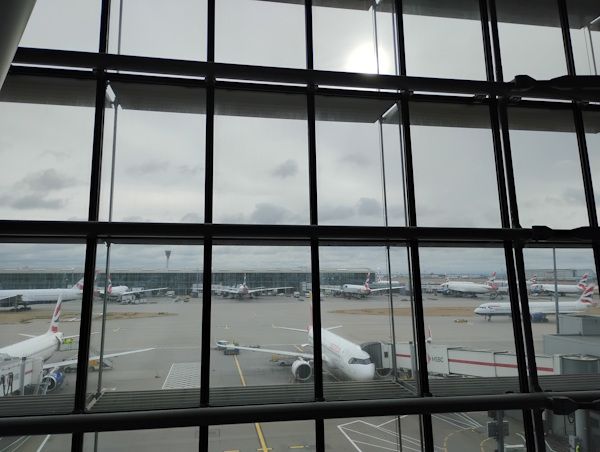
Heathrow and Beyond the Airport
13 September, 2026
The fairest, best builded, quickest, and most populous town of all Lancastershire
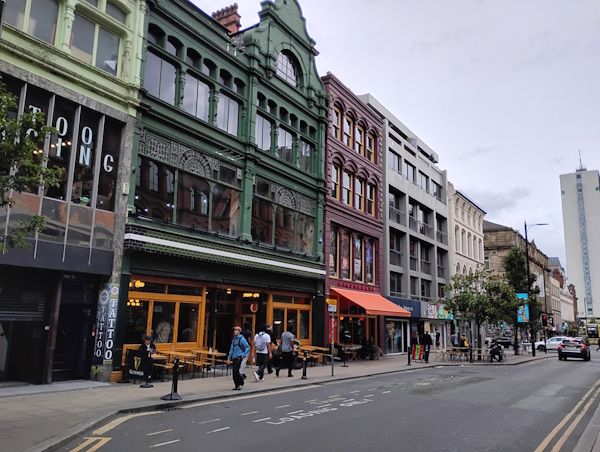
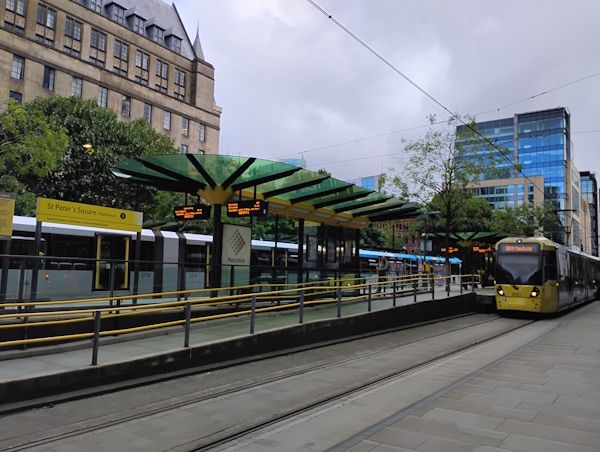
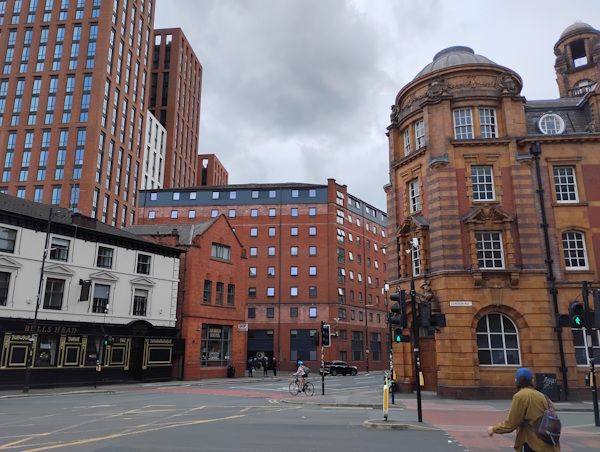
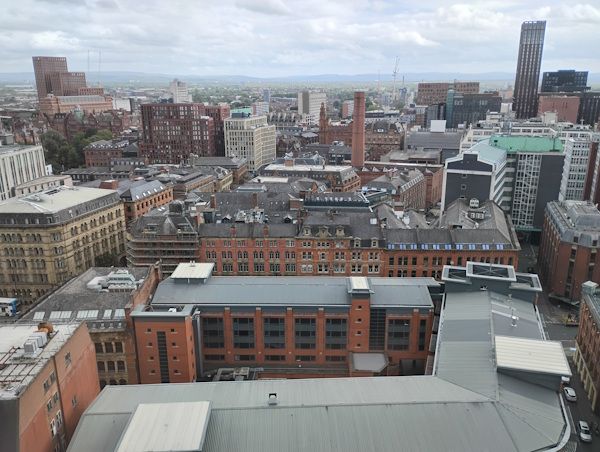
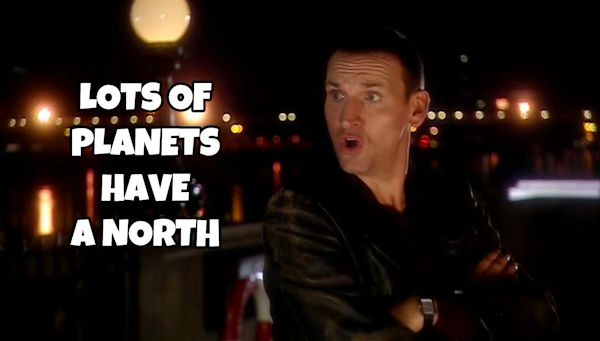
Our trip as originally planned wasn't going to include Manchester but the hotel rate there was just too good to pass up. And so we went from an itinerary that was a lot of London, a dash of Leicester, and a bit of York to one that was largely to be spent in England's third largest city. It would be my first time in the north and this made me think of the Ninth Doctor's quip where he sounds all defensive, "Lots of planets have a north!" It occurred to me that I didn't know where the north begins. Is it north of a motorway like here in Wisconsin?
As I discovered when pondering England's geography, Christopher Eccleston is from Salford, a city in the Greater Manchester area that abuts Manchester itself to the west/northwest. Hence the rebuttal to Rose. Whoo. It's difficult to get a grip on all the English regional accents. Last year a gentleman from Wolverhampton and my tour guide from Birmingham both agreed that there are Black Country accents that they can barely understand. This is akin to someone from Milwaukee being unable to understand the accent of someone from Washington country. I guess when you have a small country, things get squished together and regional variations exist cheek by jowl.
Despite York holding the promise of medieval goodies galore, I didn't mind the change of plans. My ex-Frau and I had planned on going to Manchester back in 2024 but a combination of her mental health issues and the severe deterioration of our marriage put paid to our vacation plans. Going there with my ladyfriend would close the circle on a real low point in my relationship with my ex-Frau and the missed opportunity that resulted from it.
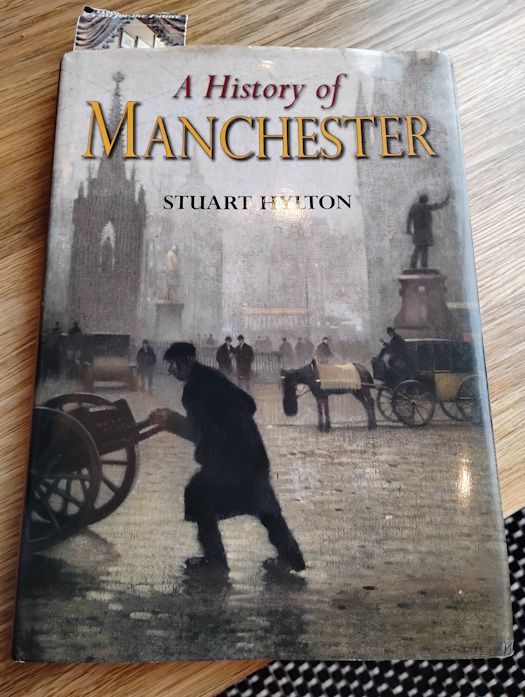
In preparation for the trip, I picked up a book on the city.
I do not recall why I chose Hylton's tome but tend to think because it was on the shorter side and would simply give me a good overview of the city's history as opposed to a more lengthy, perhaps more definitive, text. Start small and move on from there. Because British Airways didn't load my suitcase onto our flight from Manchester to London, I do not have the book before me as I type. But here are some of the highlights for me.
Manchester started out as a Roman outpost. During the Middle Ages it was a market town and processed wool. Despite being Britain's third largest city today, it was a backwater town for most of its life which surprised me. We get some stories about the city taking the side of the Parliamentarians during the English Civil War but, generally speaking, things don't get moving until the industrial revolution.
As Hylton notes, Manchester became a, no the, powerhouse of England's cotton industry. The cool, damp air was good for spinning as it made the threads less prone to breakage. Growth was rapid and the factory work drew people from rural areas. A large section of the book is dedicated to describing the plight of these early factory workers.
They lived in slums and the owners of the means of production were proud to be putting rather young children to work in their dark satanic mills. The living conditions were appalling for many of them with cellars being particularly bleak as there was often no windows to be had and no way for fresh air to circulate. Rain accumulated on the dirt floors as did raw sewage from their neighbors above. I was thoroughly unsurprised to learn that Manchester is the subject of Friedrich Engels's The Condition of the Working Class in England in 1844 and Hylton provides some choice quotes that, alas, I cannot reproduce here.
In addition to factory workers (lots of them being Irish) living in squalor, all the coal being burnt turned the city's air into a nasty miasma. Manchester sits in a hollow so it's pollution was never in a hurry to go anywhere and so it was happy to infest people's lungs and cover the city in a layer of soot. If I had the book at hand, I would provide some colorful quotes that describe just how nasty the air was.
The city didn't get a Minister of Parliament until 1654 when Cromwell and pals were in power. However, as soon as the king was restored, the seat went away and Mancunians didn't get a representative again until the 1830s, a fact that really bolstered the backwater image in my mind. The Peterloo Massacre was described and this brought the Doctor Who story of the same name to life now that I had the backstory.
One thing I didn't know was that the American Civil War affected Manchester greatly as the city's cotton industry got a lot of its raw material from the South. The North's blockade really put a spanner in the works for Manchester.
The city built a completely man-made canal to hasten the process of getting goods to and from the port of Liverpool. An early railway was built to take on the canal industry. In addition to goods, it found success (eventually) in hauling passengers as one of the very first passenger rail services.
The book is a bit light on the 20th and 21st centuries but it read a lot like the sorry tales of so many American Rust Belt cities with deindustrialization hitting it hard. I don't recall the book mentioning population totals during this period but I found a website indicating it went from a high of around 725,000 people around 1930 down to around 400,000 in 2000. It has since rebounded to somewhere in the vicinity of 590,000.
At first, the text along with some commentary from my tour guide in Birmingham last year gave the impression that Manchester is a very blue collar city, rough around the edges, and perhaps not quite as friendly as England's second largest city. (Although I've not yet written about it, I found Birmingham to have a surfeit of Midwest nice.) I got the impression that it would have a Milwaukee-like vibe to it. But, as the book notes, the city went from a manufacturing powerhouse to an economy largely based on commerce and business services which sounded very much like Chicago's transformation.
Hylton includes Mark Twain wry comment, "I would like to live in Manchester, England. The transition between Manchester and death would be unnoticeable." Would the city be dull and lethargic? Was it still the Naptown of Britain? If so, would a bargain hotel rate be worth it?
********
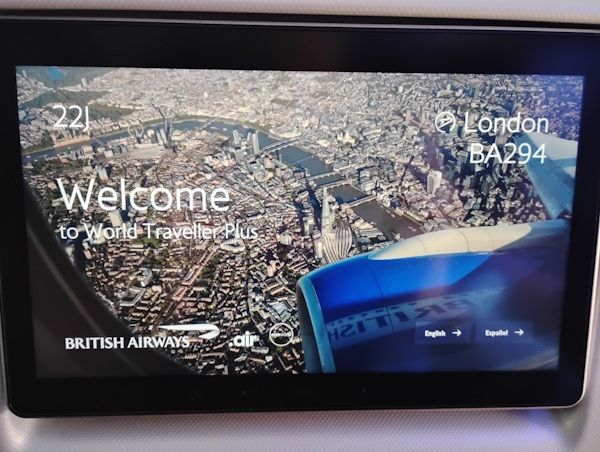
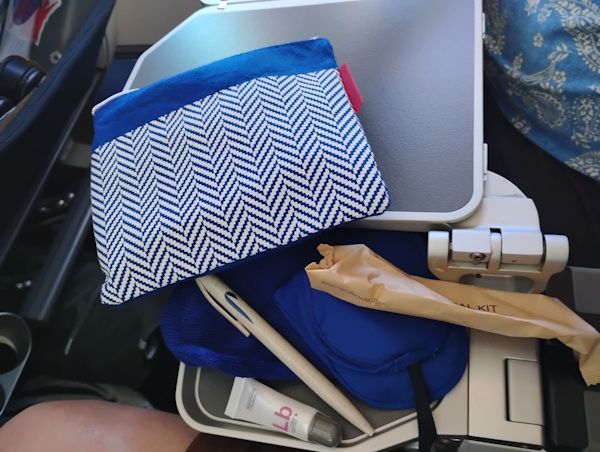
A couple days before my ladyfriend and I were set to leave, I got an email saying that British Airways was looking for people to take a different flight than the one we booked as they had overbooked it something fierce. With approval from my travel companion, I chatted with an agent got us onto a flight that left O'Hare a couple hours earlier and got us upgraded to World Traveller Plus (pronounced ploos) which is luxury economy class.
Never having flown in anything other than a seat for the impecunious proles, I was looking forward to the upgraded amenities, whatever those ended up being.
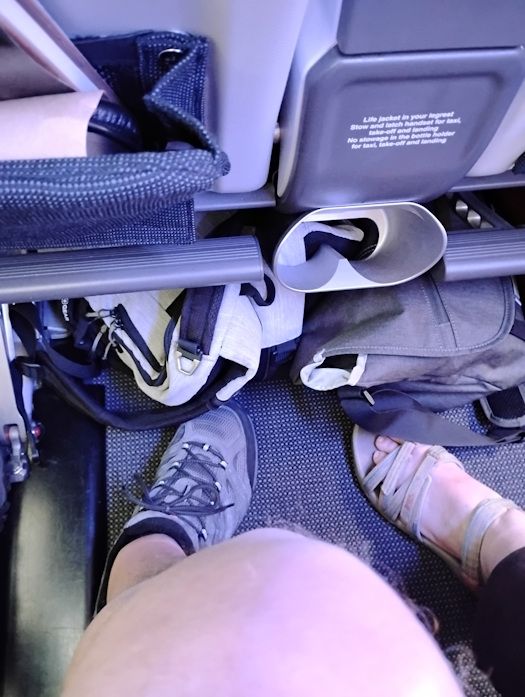
First and foremost among them was lots more legroom. My knees would not have to be pressed against the seat in front of me as they had about 6" of clearance. Ooh la la!
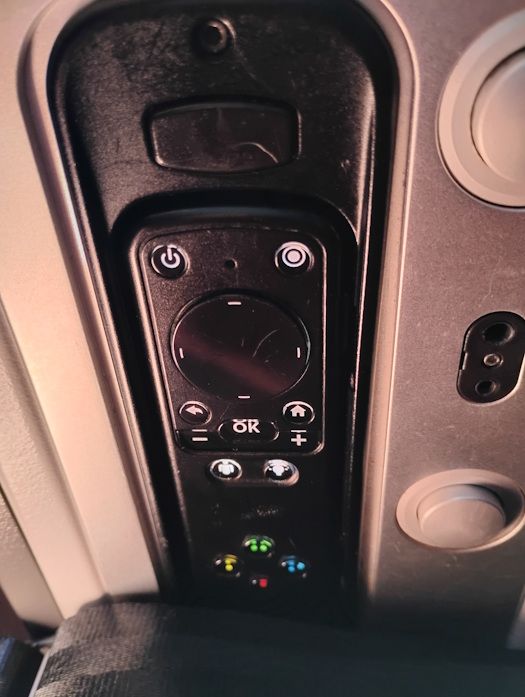
Each seat had a remote control for the screens that were a mere foot or so away from our noses. The ultimate in economy class luxury. We would truly have a flight of ease.
22 March, 2026
26 August, 2025
More prep work for the UK
With my trip to the UK looming, I got some more prep work in recently. This time it was a bottle of HP Sauce.
It smelled almost exactly like Heinz 57, just a tad less potent, less vinegary. It tasted, as my friend noted, like brown - a mellower, less spicy Heinz 57. More tomatoy. Not bad, just a bit on the bland side. We shall see if I find this on tables across the ocean. Maybe I could buy a bottle at Tesco and see if the OG HP tastes different than the stuff we get here.
19 December, 2020
A Trip Is in the Cards
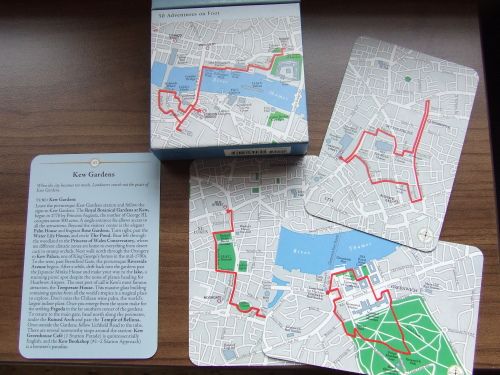
Today I am hoping for Covid to go away soon and wishing I could travel. The Frau and I were supposed to have spent some time last summer in London but Fate worked against us and it was just not to be. So I recently busted out the City Walk cards a friend lent me for the great metropolis.
19 April, 2017
St. Louis: Final Thoughts
Some final thoughts on my weekend in St. Louis...
On the whole I liked St. Louis. But there was one scene which summed up the city for me. As we were driving west over to The Cellar, I spied a new or newly remodeled apartment building. Lovely red brick dotted with black iron balconies. Next to it was a vacant lot overgrown with weeds and ringed by a fence topped with barbed wire. That juxtaposition really encapsulated the city for me. Signs of life and prosperity sitting uneasily next to abandonment and decay. (It was easy to see where all the melancholy in Jay Farrar's songs comes from.) At its peak in the 1950s St. Louis was home to 850,000 people while the most recent census estimate places that figure at just over 312,000. So vacant lots and boarded up buildings are to be expected.
As a public transit advocate I looked for buses but didn't see many. Before I knew where we were going to be staying I gave the Metro Transit site a perusal in case I had time to wander on my own. Bus service was a lot like Madison's in that headway dropped to 30-40 minutes, generally, outside of rush hour. I did see one of the MetroLink trains over in East St. Louis heading across the river. (Parts of East St. Louis seen from the interstate look almost like war zones with abandoned and burned out buildings.) But we didn't spend much time near the train's route.
The lack of public transit and the near absence of bicyclists and pedestrians that I mentioned in a previous post meant that St. Louis lacked that vital pulse that makes cities what they are. Most folks got in their cars, drove, parked, and went inside, it seemed. A week before going to St. Louis I was in Chicago to see "Hamilton" and the contrast between the downtowns is remarkable.
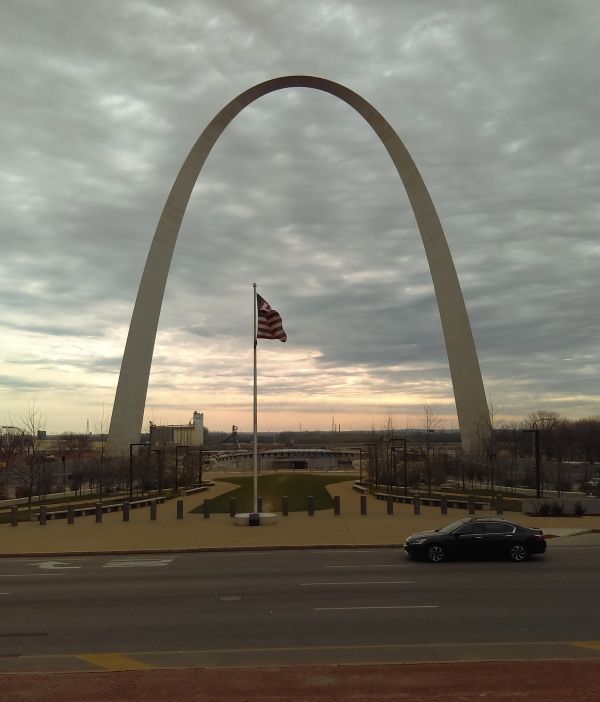
Comparing St. Louis and Chicago comes with a lot of caveats – size, population, and so on. Still, St. Louis' downtown was indeed eerily quiet. It just didn't seem to have a great density of shops and whatnot to keep drawing people. I mean, if you're a St. Louisan, how many times can you go see the Arch? I don't recall seeing any theatres and the City Museum is west of the CBD. I'll note that we only covered a limited area. However, it appears that most of the touristy attractions in St. Louis are outside of downtown and really rather dispersed around the city.
I've already written two posts about the St. Louis beer scene so I won't say too much here besides that I was mightily impressed. A good variety of new and old. Sour beers, English milds, German lagers, eyepahs heavy on fruity American hops – it was all there. And that $2.50 half pints at Civil Life were a real treat.
The food was great. Plenty of pork. Smoked salmon was rather common which surprised me. Next time I'm down there I must try out the unique culinary treats on offer though I reserve the right to be patently offended by Provel.
I consider St. Louis to be part of the South though everyone I ran into spoke with a Midwestern accent. People were also uniformly friendly.
So that's my take on St. Louis. There was a palpable sense of decline though there certainly were bright spots. Not only was there was great contrast to The Loop but even to Madison. Despite all of its problems, its small townness, and envy of larger cities, Madison is a city on the make and growing. Two very different vibes.
I have only scratched the surface of St. Louis, though. The city may only be 312,000 people but the metro area, depending on your definition, is somewhere between 2.2-2.8 million. Not insignificant. There's still much of the area to see and experience.
10 April, 2017
Beer Me in St. Louis: First Impression Part Two
Stepping out of our vehicle we saw this in one direction.
And in the other…
We had to stop in at Strange Donuts. Each of us bought a pastry for breakfast the following morning. (They were tasty.) There were also t-shirts on offer such as this hoopy one.
Donuts safely stowed in the car, it was off to The Cellar.
Side Project brews "Belgian-inspired" beers. Although I am not unfamiliar with Belgian styles, I really don't know a whole lot about them beyond some basics. The menu wasn't exactly Greek to me but it sure highlighted my ignorance. I ordered a grisette and when my friend asked what I was drinking, the conversation went thusly:
Friend: What did you get?
Me: A grisette.
Friend: What's that?
Me (looking at menu): A brett-fermented farmhouse ale aged in oak.
I'd heard of the grisette but had no idea what it was. And nobody else really knows either as descriptions of it prior to its recent revival here in the States have apparently all been lost. There is general agreement that it was a low-alcohol brew made for miners in the Hainaut region of Belgium at some point in the dim and distant past. Having had some, I can imagine those miners quaffing this stuff by the gallon.
It was light, slightly funky-tart, a little oaky, and just all-around tasty. However, the irony of me drinking a less than 12oz pour of a beer originally made for working stiffs costing about as much as the minimum wage in this country was not lost on me.
The Cellar was definitely a place for craft beer aficionados and fairly well-heeled ones at that. Look at the menu. Notice the serving temperatures listed as well as the level of toasting of the foedre used for aging the Foedre Fermier. Not quite the place for hoi polloi like myself.
Still, I really enjoyed my grisette as well as the rye my friend James ordered. There were two ice cubes in the glass and they were nearly flawless. You'd need some kind of laser to detect the imperfections.
The room itself was bright and had some nice rustic charm to it. The Cellar was also the second place in a row whose men's room had but one single solitary toilet.
We made it to the hotel, which was located in a light industrial area, only to find that not enough rooms had been booked and that most of those that were were not yet ready. A real charley foxtrot but also not really that big of a deal. The food, drink, and company more than made up for it.
Once things were sorted, we hit the road back into the city for dinner at Iron Barley Eating Establishment. We had a short wait for a table and so we settled at the bar. I ordered a Zwickel from Urban Chestnut although I was impressed that there was a beer engine back there and it foreshadowed our last stop of the night. Someone else who was waiting struck up a conversation with my friend Randy. He told the gentleman that we were from out of town and looking forward to hitting Pappy's Smokehouse the next day. Randy's interlocutor remarked that there was a new barbecue place in town, a pretender to Pappy's throne, and that their smoked salmon was fantastic.
For dinner I had about an entire pig's worth of ribs perched atop a bed of braised sauerkraut. Quite tasty. I noticed that the menu also offered smoked salmon. A pattern was developing here. Smoked salmon was seemingly quite common. I sampled some toasted barley and it too was delicious. The place reminded me of The Weary Traveler here in Madison though the tavern side of things was smaller. And it was more ragged but not in a forced or kitschy way. I will add that the waitress was wonderful and managed to rattle off a list of what seemed like a dozen specials with ease. Very impressive. The water closet had but one commode. I don't know how much a "Jethro sized" vessel holds, but you could get one of soup.
For a nightcap it was off to Civil Life Brewing. It was tucked away off of an arterial street and had a nice old-time tavern look about it.
My comrade Charles was especially keen on Civil Life as they specialize in beers of the British Isles. He had lived in England for a spell where he acquired a taste for milds and ESBs and has a hard time finding versions of these beers here in the States that match the taste of those he had in their homeland. According to him Civil Life gets as close as you can this side of the Atlantic.
Full English pints were available but also half pints for $2.50. It was a steal especially considering how tasty the beer was. I had a British Bitter.
Cracker and caramel on the malt side with herbal, almost medicinal, hoppiness. Simply tasty. I sampled Charles' ESB and it to was great.
And, yes, the restroom had but a lone toilet. St. Louis regulations must stipulate 1 toilet per 300 people because Civil Life is not small. There's the main bar area with a dart area in back and more room upstairs. Plus there's seating outside to boot. There must be long lines during the summer.
Civil Life closed at 11:00 and we were on the road back to the hotel by then.