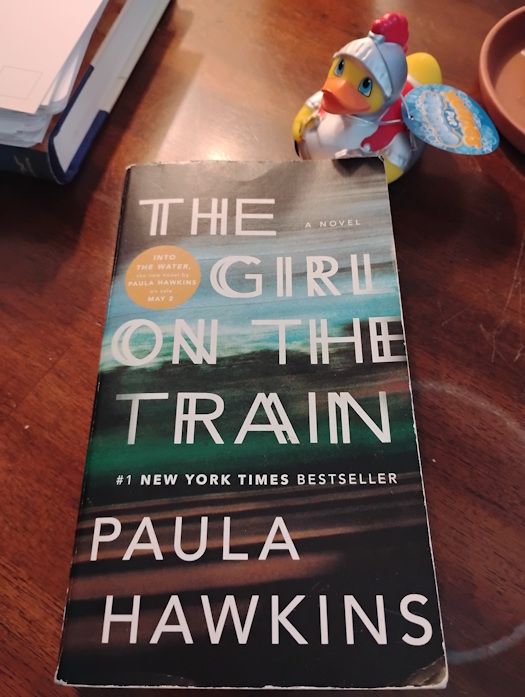
I recall when the film adaptation of The Girl On the Train came out and found my interest piqued. Not enough to go see it but enough to put the story on my to-read list. Here we are 10 years later and I've finally read the source novel by Paula Hawkins.
I began it in our hotel room in Manchester after I'd finished a history of the city we were visiting. Reading a little each night before bed added up and I polished it off on the flight home across the Atlantic. Although nearly 400 pages, it seemed to go by quickly. I think this is due to a combination of narrow pages and Hawkins' plainspoken, straightforward prose style.
The story centers around Rachel Watson, a woman in her early 30s, who takes the train in to London every weekday. The train usually stops at a certain junction or spot near the home of a couple that she names Jess and Jason. From the comfort/remove of the train car, our voyeuristic protagonist fantasizes about their personalities and lives as she sips a can of premixed gin & tonic or a spot of wine.
Rachel's fabulation is an escape from her life which lies in ruins. She and her husband, Tom, tried to have children but Rachel proved to be barren. Turning to the bottle for relief drove them apart and Tom sought comfort in the arms (and legs) of another woman, Anna. After their divorce, Tom kept the house while Rachel moved in with a friend, Cathy. Despite this, Rachel still longs for Tom and calls him at least semi-regularly, much to Anna's annoyance.
A couple months previously, Rachel was fired from her job. Afraid to tell Cathy and her mother, she keeps up appearances by traveling to the city where she wanders, works a bit on her CV, and continues her relationship with the bottle.
It turns out that Jess and Jason are really Megan and Scott and that their house is just down the street from Rachel and Tom's former home. While Tom had meant to sell the house, he ended up keeping it and having his new bride and mother to his child, Anna, move in. Thusly, the train rides provide Rachel ample opportunity to ruminate on her failed marriage and relitigate episodes from it which are, perhaps, best forgotten.
In fairly quick succession, three events transpire. First is that Rachel spies Megan from the train kissing someone who isn't her husband; second Rachel has an episode in which she gets very drunk and blacks out, remembering only tiny fragments of that night; and lastly Megan goes missing only to turn up dead. Did the unknown man Rachel saw kissing Megan do the dastardly deed? Or perhaps a jealous husband avenged the wrong done to him...?
The plot unfolds by alternating chapters narrated by the women here. Rachel's are given pride of place but Anna and Megan's are important as well. Rachel is a drunk with low self-esteem due, in part, to being overweight - a stark contract to the svelte Emily Blunt who plays Rachel in the film adaptation and she is a highly unreliable narrator. Anna's stories demonstrate just how much of a pest Rachel has been and fills in details that Rachel leaves out. We get to know Megan as a very troubled soul and not the carefree stunning blonde that is Jess.
Rachel is like a tipsy Miss Marple. We learn of her failures and foibles but come to understand that she is really a well-intentioned person. She goes to the police to let them know that she'd seen Megan kissing another man but they see her as a troubled soul and don't take her particularly seriously. Feeling terrible for Scott, she contacts him to let him know his wife was having an affair. There are a myriad of these kinds of encounters. Is Rachel helping? Or hindering?
Many times Rachel admits that she shouldn't do X but goes and does it anyway and this reader just rolled his eyes. I had a hard time enjoying Rachel as a character as she is just so pathetic. Witnessing someone so tethered to a past that is unrecoverable, someone who engages in so much self-sabotage is uncomfortable. (I wonder if a thin and beautiful Emily Blunt is more empathetic.) Thankfully the chapters featuring Anna and Megan take the edge off.
The lives (and a death) of all three women are intertwined and I liked how Hawkins wove them together. This is one of those rare books for me where the inner lives of women are put front and center and I enjoyed the mix of vulnerability and strength in each of the characters. The male characters, by contrast, don't come off well here. Scott comes across as tragic, hurt figure for much of the tale but he eventually resorts to violence. Tom is portrayed as something of a victim for most of the book but we come to know that he is truly evil by the end. Mac is deceitful and abandons the woman he impregnated. That he dies of an overdose seemed an excessive addition that merely served to further slander an already unlikeable man.
There were definitely times when I felt I was reading the book just because I wanted to know who killed Megan. But, by the end, I was enjoying getting to know the women characters and how their lives were entangled and what secrets they were hiding. The Girl On the Train reminded me that we all keep secrets and that sadness often lies behind smiling faces, that happy couples are sometimes not all that happy.
Forgiveness is a motif here as is its limits. Who deserves forgiveness and when? Do you have to solve a murder to earn it? The failure of two marriages and the revelation of another doing poorly hit a bit close to home. It's not that these fictional matrimonies were analogous to mine in any detail, it was more the martial conflict that brought back bad memories. This makes me wonder if and when I will ever be able to be confronted by marital conflict and not have flashbacks.
In the end, The Girl On the Train was a good read. Not great, perhaps, but certainly one that captured my attention with its mix of mystery and probing into the lives of all-too flawed characters.


No comments:
Post a Comment