02 February, 2024

Happy Birthday, A Trick of the Tail!

One of my all-time favorite albums - by Genesis or otherwise - A Trick of the Tail, turns 48 today. And one of my favorite songs of all-time - by Genesis or otherwise - "Squonk" is on it. A John Bonham-like drum beat meets a vaguely Rolling Stones-bluesy feel and they team up with some Pennsylvania folktale lyrics. I loved this song the first time I heard it 41 years ago and A Trick of the Tail would become the first Genesis album I ever bought. The song has taken on great sentimental value for me as it reminds me of my dearly departed brother for whom this was also a favorite.

This is "Squonk" live from here in Madison on 9 February 1977.

The Past Is Not Through With Anselm Kiefer

Maybe 10 or 15 minutes in, I thought to myself how much I was enjoying a documentary that was stylistically 180 degrees from Ken Burns. Rather than hearing an omniscient narrator telling me things about German artist Anselm Kiefer, I was seeing his sculpture and paintings in glorious 3D and watching as he goes about his day in his studio.

I'd never heard of Kiefer but I think Wim Wenders does him justice here with a look at his art, which seems to come in one size only - large scale. Themes of German history and the Holocaust are prominent and inspiration comes from the poems of Paul Celan, another artist whom I'd never heard of until seeing this movie.

Anselm is a mix of styles. In some scenes, we see Kiefer at work in his outsized studio which is in a former brick factory. All that space is needed to create his pieces which are usually rather large. Does the size confront the viewer? Or is it meant to make the viewer feel dwarfed or, perhaps, overwhelmed? In others, the camera examines some of his art installations. At first we see them from afar, in toto, the voyeuristic camera hovering just outside their confines. It then gracefully moves into the installation and through them, stopping briefly to let us see the individual statues before moving onto the next one. 

There are also reenactments showing us Kiefer as a boy and as a younger man as well as staged scenes in the present day, such as those with the artist taking a break and lying down with a volume of Celan's poetry.

But we don't get much straightforward info about the man or his work. There's no sense of working through his career chronologically with various periods where a certain media is used and/or a prominent theme emerges.

Just a wonderful mix of scenes that add up to an intriguing, impressionistic portrait of Anselm Kiefer.

The 3D brought the art to life, gave it an immediacy, and made me wish I'd seen Wenders' Pina, a previous documentary also shot for 3D.

Many thanks to UW Cinematheque for hosting the screening.

The Corona Diaries Vol. 105 - Prelude: Bon Iver

24 January, 2024

The Old Man’s Hut

Last week I finally gave the newest Chinese restaurant in Monona a try, La Choza Del Viejo.

The name means “the old man’s hut” in Spanish. While a Chinese restaurant with a Spanish name is more than a little odd, it's exactly this kind of incongruity that adds color to an increasingly bland, cookie cutter area. The owner and chef is one Evelio Castillo, which explains the name.

I neglected to take any photos of the food but nothing tasted like it came from Sysco. The teriyaki beef was tender, if perhaps a bit oversweet; the hot & sour soup was great - not particularly viscous and with a nice black pepper accent; and the egg foo young was rather light & fluffy and not too greasy with a nice fresh oil flavor.

Service was friendly and swift. Highly recommended.

22 January, 2024

The Corona Diaries Vol. 104: Mazomanie Needs a Coffeehouse

(mid-August 2023)

(Dance to the prelude.)

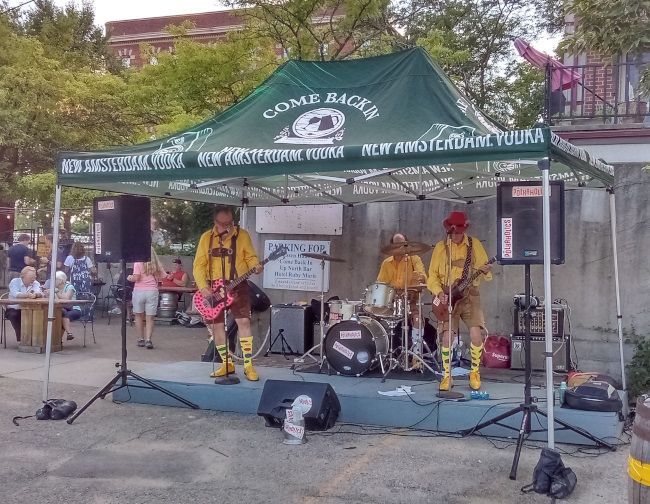
A few days ago thirsty beer geeks from around the country descended upon Madison for the Great Taste of the Midwest, the best beer festival in all the land. Although I didn’t attend, I did go to the Essen Haus, a German restaurant, the evening before as The Polkaholics, Chicago’s renowned polka-rock band, were playing.


As usual, they put the crowd to shame with their haberdashery as they were dressed in the finest Lederhosen complemented by the sexiest socks of any band, polka or otherwise. I had my Polkaholics t-shirt on and Dandy Don, the guitarist/singer, spotted me right away in my stylish outfit. I’d made a music mix for the road trip to Gencon which featured a couple Polkaholics tunes and I was hoping to hear them live. I found that “Paul Konrad Polka”, a tribute to the WGN weatherman in Chicago, was already on the setlist and so I requested the other song, “Sound (of the Beer) Garden Polka”. This one is a musical chimera worthy of Victor Frankenstein himself which fuses the alternative rock of 90's stalwarts Soundgarden with a steady 1-2 polka beat to great melodic (and humorous) effect.

When the sun is a black hole
The beer will be ice cold

Classic stuff. Ooh! And they had a new album out too – Say Yes to Oktoberfest. It is a Dionysian ditty, a concept album, of sorts, about beer, drinking, and Oktoberfest revelry. You bet I bought the CD.

I ran into a fellow whom I knew via Twitter and had met in-person a couple of times. We chatted about craft beer, camping, the sorry state of Twitter, and whatever else came to mind. It was nice to see him again and to meet his wife whose existence I’d learned of online but had never encountered in real life.

********

A few (or is it several?) entries ago, I wrote about walking around Morton Woods. I’d randomly chosen it as a destination for a hike after looking at a map of county parks. Now, if I hadn’t gone there, I would have instead headed to Walking Iron County Park, just north of Mazomanie which is 25 miles west of Madison. A full week of work after spending 5 days down in Indianapolis on vacation at Gencon was sheer hell so, when the weekend finally rolled around, I needed a hike out in nature and headed west to Walking Iron.

For the drive there, I traveled much the same route as I did going out to Morton Woods. Taking the back roads meant I would not feel compelled to drive 55+ and instead cruise along at 35-40 so I could enjoy the scenery from the tops of the many rolling hills out in the Driftless Area.

One advantage of a nice, leisurely pace is that, if I spot a deer in a field, I can actually pull over to take a photograph rather easily as I did on this occasion. 

I drove through a little of Black Earth before turning onto another scenic county road which would take me to Mazomanie. Mazo isn’t very large and, before long, I was outside of town and at the park. It was a lovely, sunny morning.

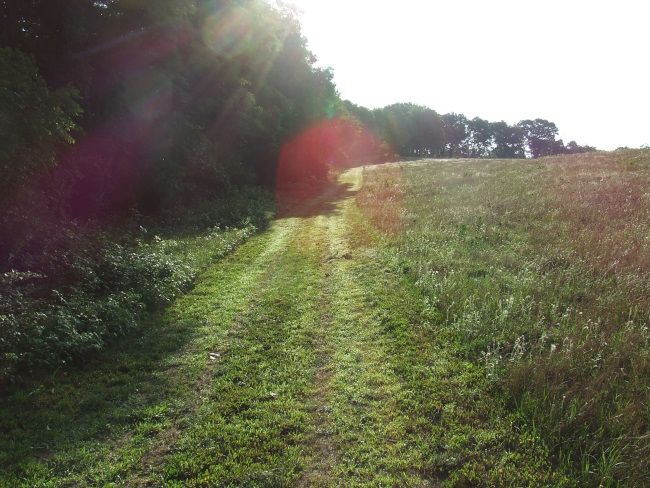
The initial section of the trail ran along the edge of some woods on one side with prairie on the other.

There was birdsong coming from all sides – it was avian surround sound. I would occasionally catch a glimpse of the tiny members of the chorus but that was about it. There were many calls and songs that were completely unfamiliar to me. This shouldn’t be surprising, though, as I only know the basic city slicker repertoire – robins, cardinals, and red-winged black birds. Oh, and red-bellied woodpecker too.

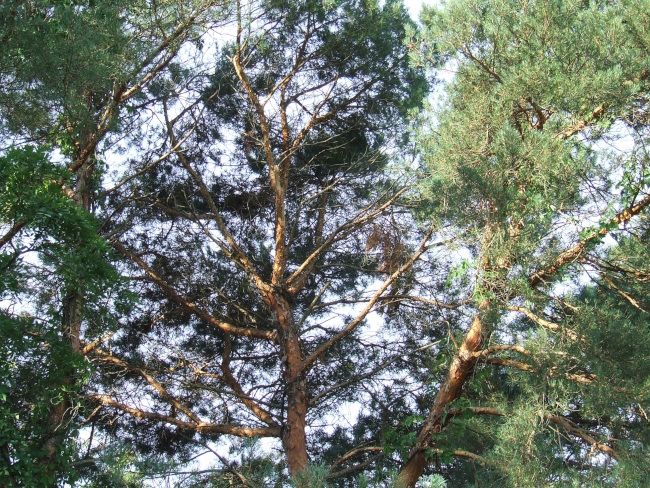
At one point, I came to a spot with some pine trees which scented the air quite nicely.

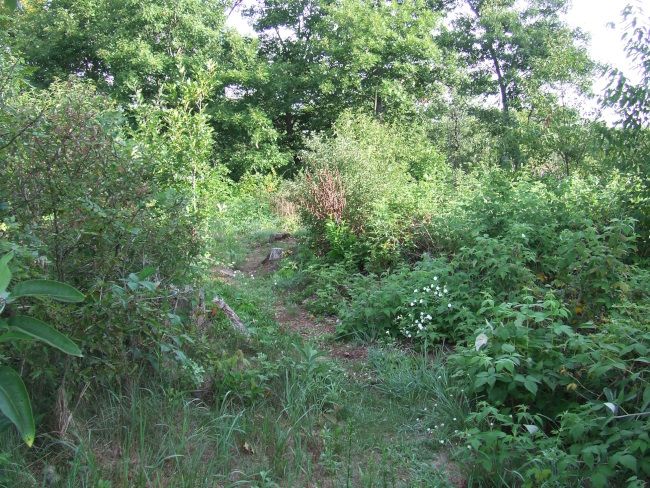
Soon I came upon a trail that led off into the woods.

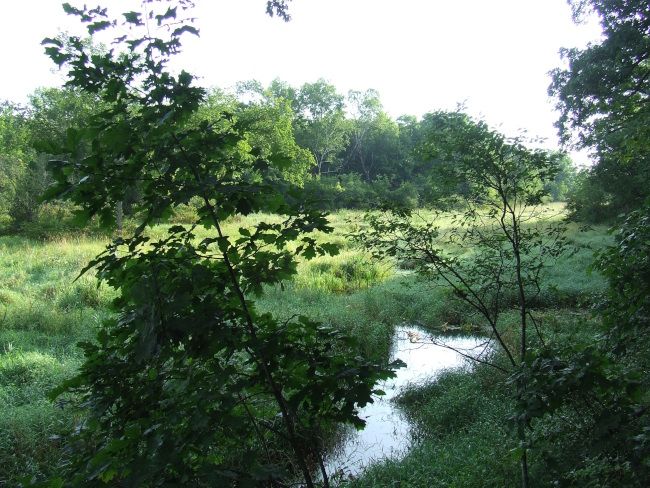
Despite knowing this is exactly the kind of thing that got Hansel & Gretel into trouble, I followed the path into the trees where I discovered that it wended its way down to a creek and ran along side it for a stretch.

The trail through the trees was pleasantly cool but all-too short and soon enough I was back on the path that straddled woods and prairie.

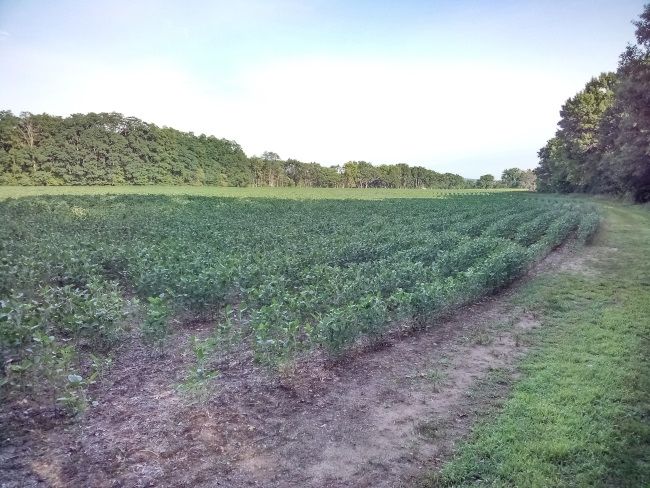
Some parts of the trail straddled farm fields.

The scent on these stretches was all fresh & verdant, to start, and I took in the air thinking to myself how wonderful the countryside is. As I traipsed further along, however, that other scent of the countryside began to creep in: manure. Now, I can handle cow manure just fine. (Chicken shit is a whole different matter, though.) But then the noxious smell of chemical fertilizer kicked in and the combination was really quite bad. I hastened onwards to escape the miasma.

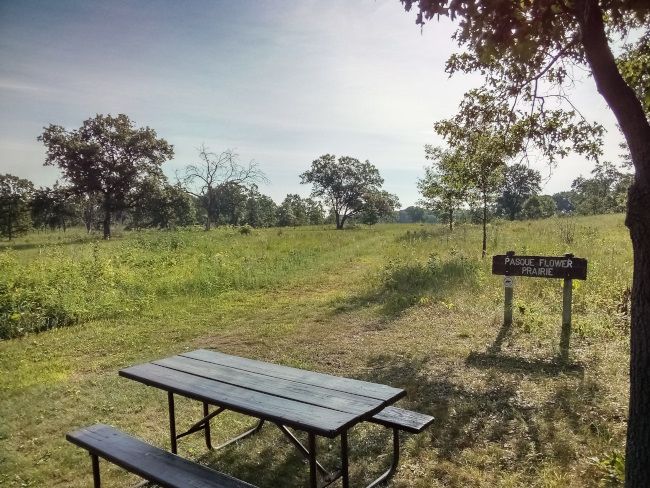
Towards the end of my hike, I found myself at the Pasque Flower Prairie where birds were zipping around from ground to tree, tree to tree - just everywhere.

They wisely kept a good distance between themselves and the human so I wasn’t able to get a decent photograph. However, I was able to see that many of them were blue on top, though they had white or tan bellies.

These weren’t blue jays and the only other bird of that hue that I know of in these parts is the indigo bunting but I thought they were of a deeper blue color and were completely blue, belly and all. After consulting that handy Birds of Wisconsin, my best guess is that they were Eastern Bluebirds.

The walk being done, I headed into Mazomanie for something to eat as I was famished. And maybe a refill on my coffee too.

I hadn’t been there since 2002, when I accompanied the woman whom I was dating at that time to a dance studio in the old part of town. This was where Madison’s Cycropia Aerial Dance had a rehearsal space and my girlfriend was intent on spending some time hanging from ropes, spinning in circles, and learning a little about aerial dancing. Think Julianne Moore in The Big Lebowski but without the paintbrush.

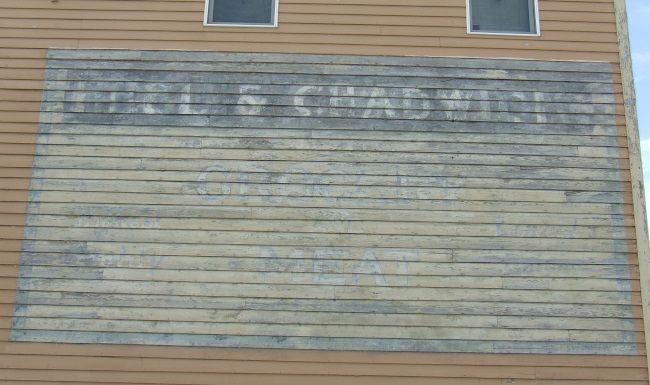
In addition to not immediately finding a coffeehouse as I cruised into Mazo, I also didn't find anyone out and about. It was a bit spooky, as if I was in that episode of The Twilight Zone where the guy wanders around the town only to find it abandoned. I chose a parking spot largely based on its proximity to this neat ghost sign for what appears to have been a grocery store from back in the day.

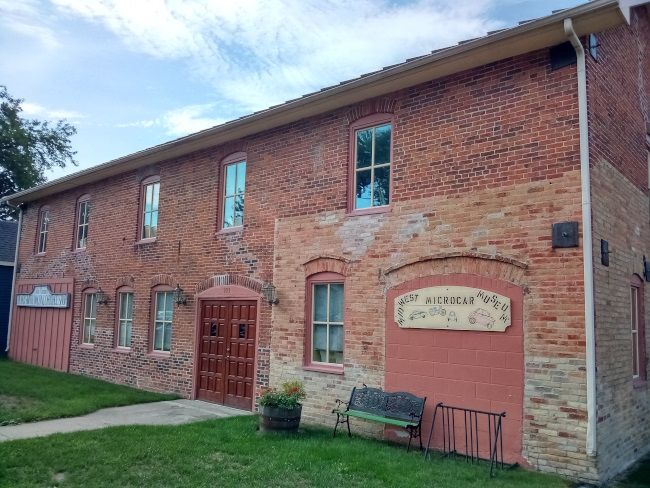
Wandering around town on foot, I ran into an old blacksmith shop that was now home to the Midwest Micro Car Museum.

I don’t know if it is dedicated to those very small cars like the one Mr. Bean drives or just a very large collection of Matchboxes.

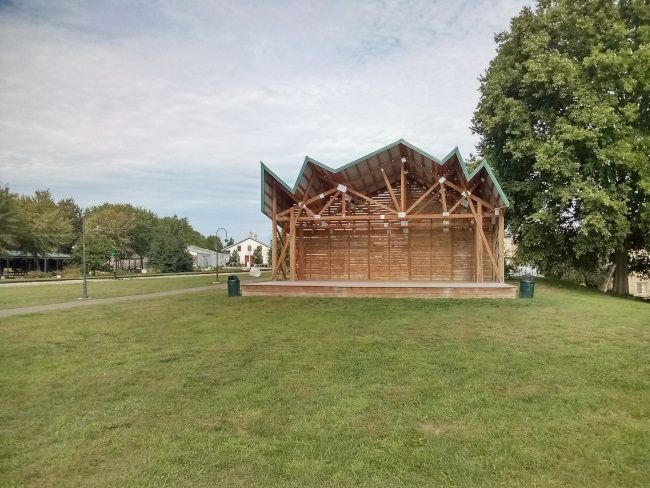
An area where rail tracks ran through town was rather neat. The old freight and coal buildings still stood but, in the field abutting them was a bandshell.

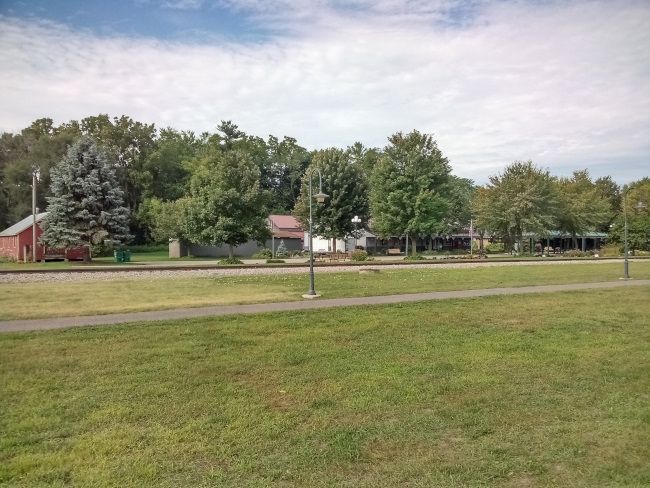
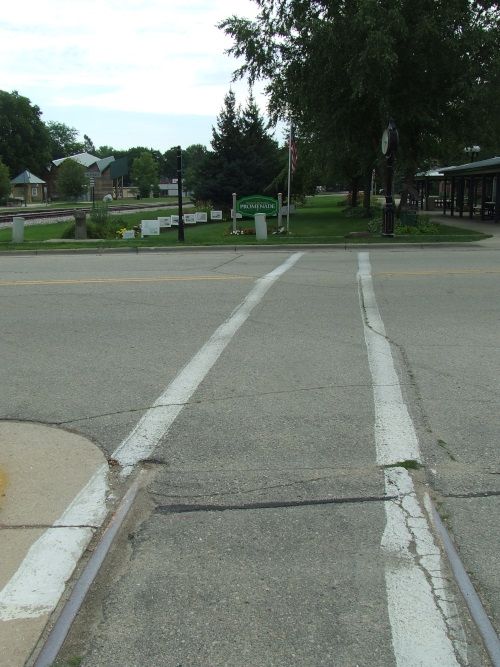
And across the remaining track was a promenade.

The old feed mill was now a fancy restaurant while various other buildings that would have served the trains and/or passengers had been converted into stores along with covered seating areas for music and other festivities.

From the remaining buildings and the layout of the area by the tracks, it seems that Mazo was something of a rail hub back in the day.

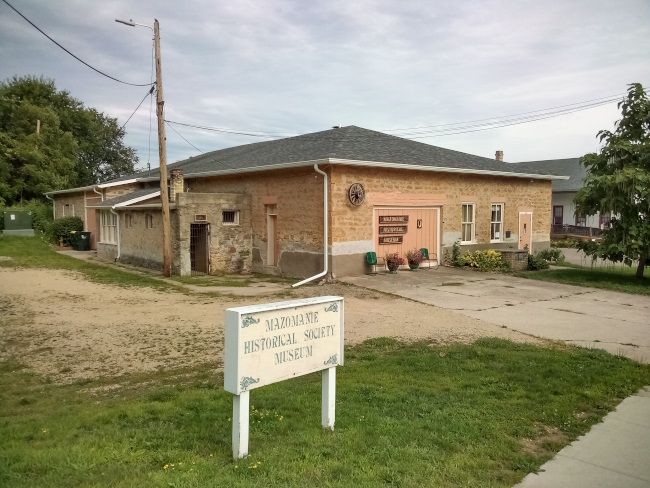
Continuing my walk, I discovered that the town’s historical museum was in an old electric power plant.

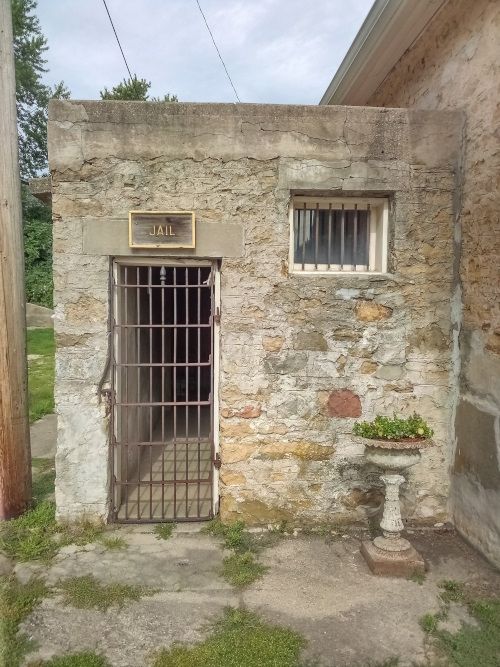
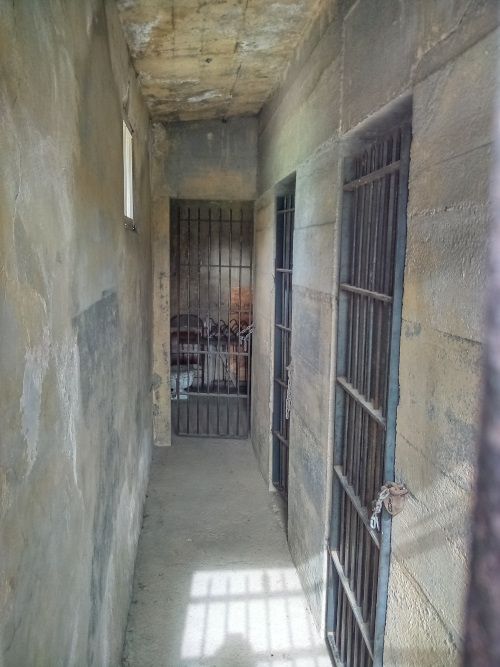
I am not sure when, but the building hosted a jail at some point. Perhaps it was the home of the local constabulary before becoming a power plant.

I guess things got a little rowdy back in the day.

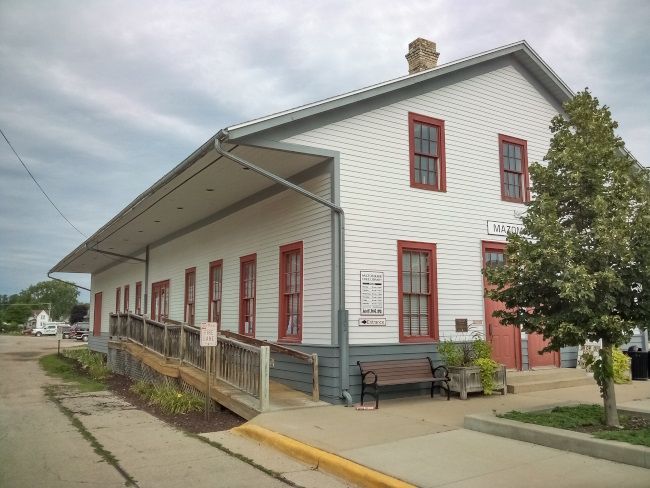
The town library is housed in a former train depot which doesn't look to have changed much since the late 19th century.

Some of the old rails were still visible in the street and you could see how they ran through what is now that slick promenade.

Unfortunately, there was no source of coffee that was open downtown. I eventually saw 3 or 4 people but, otherwise, it was dead. And so I headed out towards the highway for a gas station where I got a breakfast sandwich and more coffee before heading for home.

********

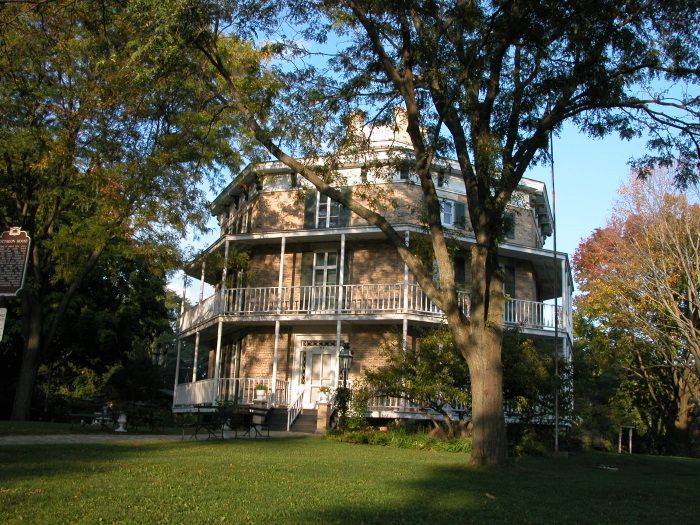
Bonus photo. It’s the octagon house in Watertown. I cannot recall the name of it but it’s a historic site.

21 January, 2024

The pickle beer shortages continue

I ran into another empty pickle beer shelf yesterday. This time it was at Willy Street Coop North and it was the Destihl's Dill Pickle Sour Beer that was apparently sold right out.

At the movies with Piper

Piper and I watched Gunda today and she really got into it for a spell.

She was napping by the time that last scene started. My eyes were not dry watching Gunda grunt and wander the yard in search of her piglets after they were taken from her.

A wondrous movie.

20 January, 2024

Classic Country Corner on WVMO

My pal Eric the Driftless Cowboy now has a radio show on WVMO called "Classic Country Corner". It airs at 8 A.M. on Saturdays. This morning is the in inaugural outing.

19 January, 2024

A Collective Memory Problem?

Back around 1997 or thereabouts, I ran into an essay by a gentleman named Judson Caswell called "Minstrel in the Gallery: History in the Music of Jethro Tull" that I believe he wrote for a college class back in circa 1993. At least that's when he posted it to a Jethro Tull mailing list. In it he wrote:

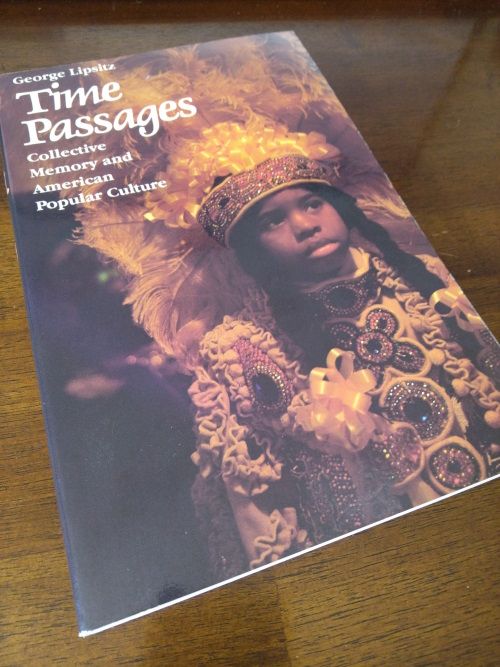
Still, Ian owed much to the black blues and jazz traditions. His flute playing was a stylistic derivative of Roland Kirk, a famous jazz saxophonist. Perhaps he also derived aspects of his later stage persona from Kirk as well. Kirk is described by Lipsitz in his book Time Passages. Lipsitz speaks of Kirk's unusual stage attire and behavior as subversive and unconventional. He also makes note of Kirk's aggressive sense of humor, citing his satirical rendition of hymns and his "mischievous wordplay". Lipsitz calls attention to these characteristics to identify Kirk as a performer who is deriving his power from a sense of history. He explains that Roland Kirk presents an art that can be interpreted at many levels--an art that makes reference to the past through oblique and coded messages. These messages arise as eccentricities in Roland Kirk's music and stage presence.

I knew of Roland Kirk as Tull had done a version of his "Serenade to a Cuckoo" on their first album. Although I've since learned differently, I accepted that he was the model for Ian Anderson's style of flute playing. But I didn't really know much about Kirk himself and found myself intrigued.

And so I sought out Time Passages. Not hard to find. Lipsitz got his PhD. in history at my alma mater and was, at the time the book was published, a professor just to the west at the University of Minnesota.

Lipsitz opens the book with a discussion of Kirk.

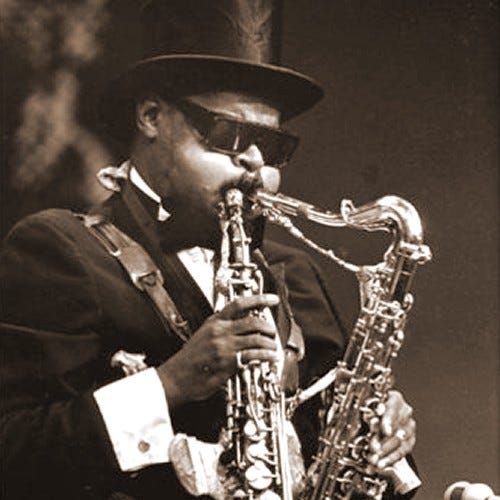
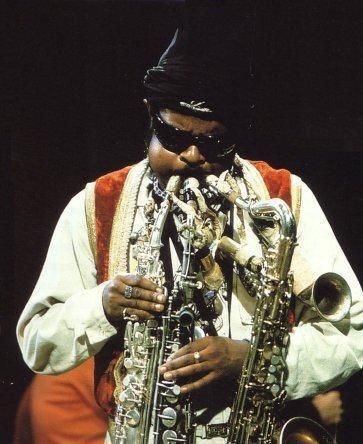
The late jazz musician Rahsaan Roland Kirk used to preface his performances with an unusual word of advice for the audience. A burly black man who often wore a stovepipe hat with a feather in it, and who frequently carried two saxophones (which he sometimes played simultaneously), Kirk would peer out at the crowd through dark sunglasses and growl, "This ain't no sideshow."

He proceeds to portray Kirk as Caswell described. His music, stage persona, and stage banter all "called attention to his role as a black musician in a society controlled by whites." Lipsitz claimed that Kirk "called attention to his identity as a historical subject, a descendant of slaves and a victim of white racism, a human being forced to disguise his pain and anger within the outward appearances of a sideshow."

Personally, I think Lipsitz is overly hyperbolic here and leaves little to no room for Kirk to dress or speak out of pure merriment or to play a song for the sheer joy of it. But I guess that's neither here nor there.

After reading the section on Kirk, I wanted to hear the man himself say those words: "This ain't no sideshow." I wanted to hear this little bit of musical history instead of it simply existing as words on a page.

Life got in the way back in the late 90s but my desire was rekindled during the Covid lockdown. Lipsitz doesn't list any notes for his comments on Kirk. John Kruth's biography, Bright Moments: The Life and Legacy of Rahsaan Roland Kirk, wasn't published until a decade after Time Passages so that wasn't a source. Wikipedia showed that some live material came out during Kirk's lifetime but 3 posthumous lives albums post-date Time Passages' publication thusly they were out. And so, as someone who collects bootlegs, I then sought out every Kirk show I could find.

Boots can be a good way to experience musical history. After all, Dylan aficionados actually heard that guy call him "Judas" long before the show was officially released in 1998.

I came away with Kirk shows from 1963, 1964, 1967, 1970, and 1972-76.

Where to start? Lipzig's phrasing gives one the impression that Kirk began all of his shows with the desired word of advice.

Some help came at the same time I was downloading the concert recordings when I stumbled upon a dissertation by a gentleman named Benjamin Tress called "The Jazz & People’s Movement: Rahsaan Roland Kirk’s Struggle to Open the American Media to Black Classical Music". The paper's first section is a brief biography of Kirk and notes, "...Kirk also gradually changed his image, moving away from the conservative style of dress he had sported in the Fifties and early Sixties...In 1967, he was back on the cover of Down Beat, though this time with thicker sunglasses, a large knit hat, and facial hair that was reminiscent of a Black Bohemian style."

Furthermore, Tress says "Kirk’s recorded statements from the late Sixties and early Seventies also indicate a trend towards greater racial awareness."

My guess was that I'd find my prized word of advice in recordings from this time period.

Thinking that it would be fun to listen to a bunch of Roland Kirk and Rahsaan Roland Kirk music, I just started with the earliest show and made my way forward. Since it was quite possible that Kirk had said "This ain't no sideshow" at some point other than the outset of a show, I listened to each of the recordings in their entirety.

Here they are:

10/24/1963    Club Montmartre, Copenhagen, Denmark
9/26/1964    Philharmonie, Jazztage 1964, Berlin, East Germany
9/27/1964    Prälaten, Jazztage 1964, Berlin, East Germany
10/2/1964    Paris, France
10/6/1964    Messuhalli, Helsinki, Finland
10/10/1964    Teatro dell'Arte al Parco, Milano, Italy
10/14/1967    Sala Kongresowa, Warsaw, Poland
10/19/1967    Prague, Czechoslovakia
2/26/1970    Stuttgart, Germany
3/3/1972    Studio NDR, Hamburg, West Germany  34min(set 2)
4/2/1972    Village Vanguard, New York City, NY
9/22/1972    “SOUL!” TV show
10/29/1972    Jazz Workshop, Boston, MA
12/31/1973    Village Vanguard, New York, NY-
4/4/1974    Village Vanguard, New York City, NY (early show)
4/4/1974    Village Vanguard, New York City, NY  (late show)
4/14/1974    Village Vanguard, New York City, NY 
6/30/1974    Glen Island Casino, New Rochelle, NY
1/3/1975    Village Vanguard, New York City, NY
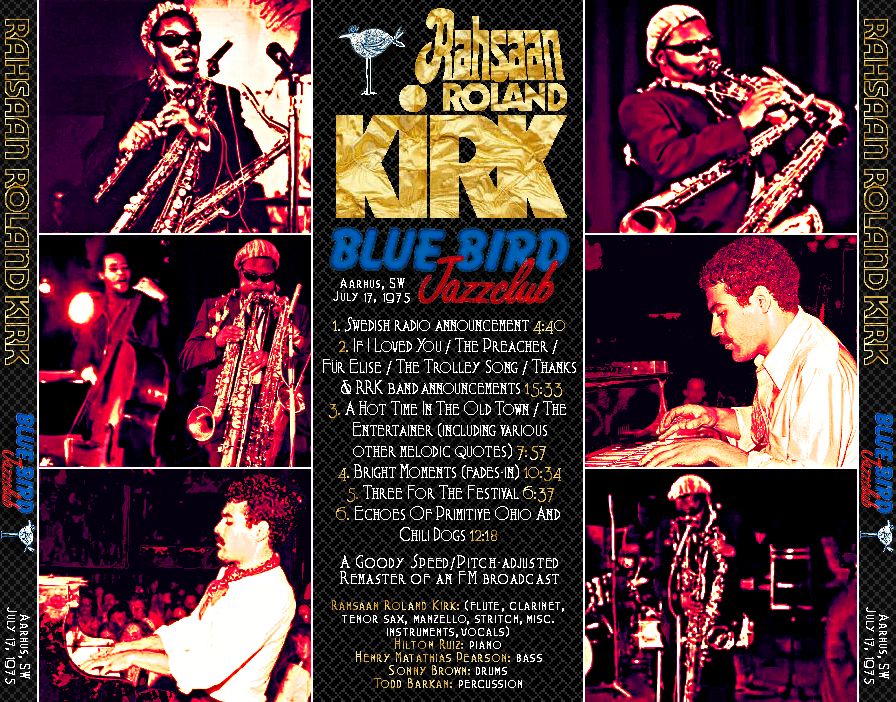
7/17/1975    Blue Bird Jazzclub, Aarhus, Sweden  58min
11/14/1976    Studio 104, Maison de la Radio, Paris, France

There is a country ton of absolutely mind-blowingly fantastic music here.

Kirk was a master of circular breathing and there are times when he holds a note for a full minute, maybe more. As noted above, he played multiple saxes at once. Sometime they play in harmony, giving a rich, full melody; at others he's busting out different parts on each sax.

On one of the earlier shows, he threw in a bit of "Let It Snow", which took me by surprise. Kirk and his bands perform originals and a wide variety of covers that range from New Orleans jazz, Duke Ellington, John Coltrane, Stevie Wonder, and more. He definitely celebrates all manner of black American music and implores the audience to do the same. In later shows, they even do a bit of "Hey Jude".


Some random notes from my listening:

The February 1970 show has a song with some parts that brought "Low Spark of High Heeled Boys" by Traffic to mind. Similarly, there were a few piano solos that brought some Keith Emerson parts to mind. These moments drove home the fact that progressive rock leaned on jazz heavily at times and not always by people in the Canterbury scene.

"Fingers in the Wind" from 3 March 1972 is simply gorgeous.

At the Boston '72 show he gripes about Jethro Tull's version of "Serenade to a Cuckoo" getting a lot of radio airplay while his original does not.

Racial awareness came to fore at the September '72 show. He bemoans the paucity of black classical (i.e. - jazz) musicians on TV - Kirk helped found the Jazz & People’s Movement to address just this issue. He also says "plantation Earth" instead of "planet Earth".

"Fly Town Nose Blues" is a great song. On the 4 May 1974 shows he's got a guy named Kenny Rogers on baritone sax and he plays this wonderful struttin' melody as Kirk wails on flute. Just fantastic.

The late show from that date features the proto-rap "Clickety Clack". Influenced by The Last Poets? Gil Scott-Heron? Kirk says The Beatles came to American and took all the money while a black man went to a Rolling Stones concert and got killed. He proceeds to diss Lawrence Welk and say that Redd Foxx got screwed over.

That last show from 1976 was performed after Kirk's first stroke which left one side of his body paralyzed. That he continued playing was miraculous. Here, though, the band sounds smoother, the rough edges have been polished and the simultaneous saxes are missing. Everything seems more conventional, less eccentric, less Kirk.

So, which shows featured Kirk saying "This ain't no sideshow."?

None.

Not a single one.

I grant you, not all of these recordings are complete so it's entirely possible that he made that comments at some or all of these shows and the recorder in the audience, the radio station, or the TV station either didn't record it or left it out of the recording that has made it out into the world of bootlegs.

Having listened to all of my boots, I went to Youtube and listened to:

11/9/1973    Bologna, Palazzo dello sport (Festival del Jazz)
Jun-73    Kongsberg Jazz Festival, Kongsberg, Norway
7/18/1975    Montreux Jazz Festival
6/24/1972    Montreux Jazz Festival
1972  France

Again, no sideshow comment.

As stated above, Lipsitz provides no notes or the slightest clue where he got the notion that Kirk said "This ain't no sideshow" even once, much less at every show, as he implies. I don't think that my little round of listening to Kirk shows is iron clad, rock solid, definitive proof that Lipsitz is wrong, but I find it very suspicious.

I didn't expect to hear Kirk utter those words until shows from the late 60s so I wasn't surprised that I came up empty on the earlier ones. But I was surprised that I never heard them at all. I was also more than a little bewildered to find no mention of Kirk's sideshow comment beyond Lipsitz when I did general internet searches. Maybe I need to search the Down Beat archives or some such thing. Perhaps it was mentioned in an article and Lipsitz simply forgot to give credit.

While "This ain't no sideshow" certainly sounds like something Kirk would say and I don't doubt that Kirk said that at some point, I just don't believe Lipsitz that it was a very common, much less ubiquitous, occurrence. Either he got something wrong or pursued Herzog's ecstatic truth for his text.

Whatever the case, it was pure joy listening to all of that music by Kirk and I recommend you check him out if you haven't already done so.

Uff-da, it's cold out!

My survey of winter beers continues. 

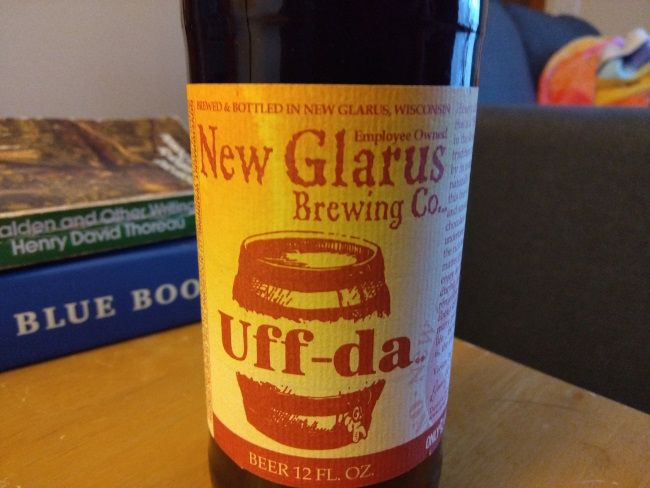
I was happy to hear that Uff-da has returned. It's been a favorite of mine ever since New Glarus brewed it for the first time back in - what? - the mid-90s? That malty goodness kept back the chill on a recent evening.

18 January, 2024

My first Winter Skål of the season

Winter beers are my favorite. They are during winter, anyway. In addition to anticipating Tippy Toboggan, I also greatly look forward to Capital's Winter Skål. I'm not sure how a Vienna lager became the brewery's winter seasonal as this is not an especially hearty brew - their many doppelbocks are more generous with their malt - but it is a bit heavier than the beers in their regular line-up.

Not a liquid bread like their Dark Doppelbock, which is also out now, it has a wonderful roasty caramel taste to it without being syrupy. I personally wouldn't mind a bit more of those spicy hops. Regardless, I've been enjoying Winter Skål on snowy nights for years and will do so until I die or they stop making it, whichever comes first.

At the Meadery of Madness: Necro by B. Nektar

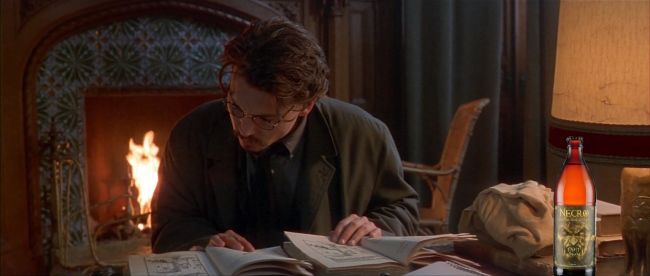
It's been a while since I've had mead. At about this time last year I went on a little honey wine jag but I lost the momentum. Not long ago I noticed a bottle of Necro mead at the back of our refrigerator just waiting to be opened. I felt like the Doctor in "The Awakening" stumbling upon the Malus as I poked around only to be confronted by the face of a demon when all I wanted was some cream for my coffee. I've had it before, back in the days when it was still called Necromangocon.

Necro is made by B. Nektar over in suburban Kadath, er, Detroit. It appears they are no longer a mere meadery and have branched out into beer and cider as well. I don't know that B. Nektar was ever content with making a plain mead as they've added fruit and spices to their meads for as long as I can recall. The words "modern" and "sub-pop culture" appear on their website more than once giving me the impression they hired a sociologist to do their ad copy. And seeing all of those pop culture references on their labels makes me wonder if that sociologist had read some Foucault. What is "sub-pop cultury" about zombies and AT-AT's from The Empire Strikes Back and H.P. Lovecraft?

There's just this precocious 12-year old kid vibe about B. Nektar, always saying, "Look how clever I am!" in a bid for attention. Maybe that's what a meadery needs to do to stay afloat, in addition to making cider and beer.

But what's important is the taste and quality of, in this case, the mead.

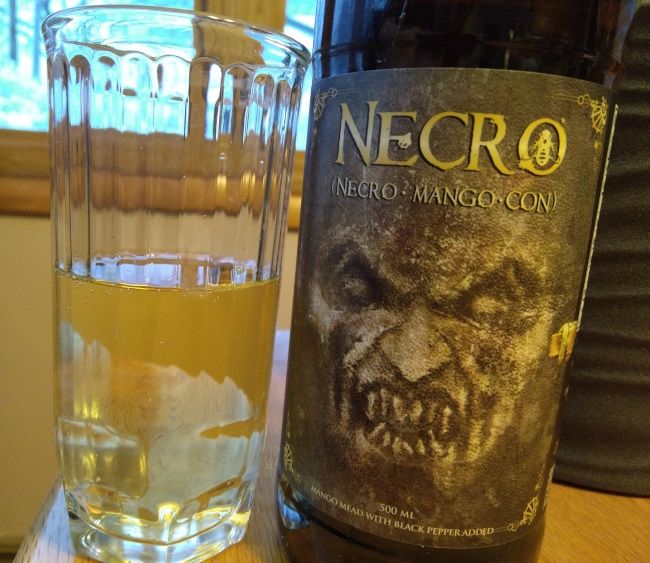
Necro is a mango mead, i.e. - a mead with mango juice added, though I don't know where it gets added in the process of making the stuff, plus black pepper. It is 6.2% A.B.V. which is much less potent than your typical mead/wine. A session mead? A small mead?

I am not sure how I managed such a canted angle in this picture. My excuse is that I'd been listening to a podcast about film noir and the genre's use of them. ¯\_(ツ)_/¯

Despite the daemonic label and the sepulchral name with its Lovecraftian overtones, Necro was no stygian spirit but, rather, straw colored. And clear. My pour produced a lively, though short-lived, head of soda-like fizz. It smelled rather sweet and of - quelle surprise! - honey and mango.

When fruit is added to adult beverages these days, I assume that it'll be a prominent flavor with plenty of sweetness behind it so as to give it that Hawaiian Punch sheen. I was pleasantly surprised here to find that the mango was fairly restrained, setting it on a more or less equal footing with the honey instead of being its superior. The honey provided not only its lovely earthy-vanilla flavor but also a nice floral accent. There was a hint of that fizz - just enough to give a medium body instead of something heavier.

On the finish, the sweet flavors faded to a surprisingly dry finish. Not very dry, mind you, but drier than you'd expect for a mead with mango juice. Cleared the sweetness away quite nicely. I think I finally tasted the black pepper here. Nothing strong and instead a nice, mellow woody undertone.

I may find B. Nektar's ad copy and brand image a bit cloying but Necro is anything but. This is wonderful mead. Not particularly sweet - I'd hazard a guess and say it qualifies as semi-dry - with the honey and mango flavors perfectly balanced and the pepper making for a really nice accent. With a lighter body than your typical/ normal strength stuff, it goes down quite easily.

A drink fit for Abdul Alhazred himself.

Junk food pairing: Pair your Necro (sounds a bit disgusting - sorry) with a bag of Lay's Kettle Cooked Maui Onion potato chips.

R.I.P. Valkyrie Brewing

Valkyrie Brewing is no more. Last call was on the 6th and Ryan Urban was there.

Saturday’s farewell event featured many of the elements of a Saturday at the brewery. Games of cribbage were going on at nearly every table, game after game was played at the vintage pinball machine, friends and strangers alike conversed with enthusiasm and laughter, and there was music—for this occasion, by Kaptain Karl and the Dirty White Boy Band. Many people brought flowers and gifts for the Lees, and there was a cake, which they cut together with a sword, of course.

I am going to miss stopping in there on my treks up north for some muscle relaxant (Whispering Embers...mmm...) after a hike and those Jethro Tull-inspired beer names.

17 January, 2024

Glühbier v2

Earlier this month, I tried my hand at mulling beer. It proved unsuccessful with the beer taking on a prominent and distasteful bitterness. At the time, I wasn't sure if it was the hops becoming pronounced as the beer warmed or if I had added too much mulling spices, i.e. - an overdose of clove and mace. Not ready to admit defeat, I recently tried again.

This time, I tempered my zeal for spice and used only 2 cloves and a lone cinnamon stick. For my mulligan, I went with Hofbräu Winter Spezial, a doppelbock.

Not shown is my jar of buckwheat honey.

I gently simmered, sampling all the while.

 
While those spoonfuls from the kettle, er, saucepan were warming, the end result was the same as last time: bitterness reigned.

I think I could make something palatable if I were to add more cherry juice and a lot more honey. But I fear I'd be masking the taste of the beer to too large a degree.

A failed experiment but I shall do a bit more research to see what can be done.

First Tippy Toboggan of the season

I shoveled 6-8 times during and after the last snowstorm. Roughly every 3 hours during the day I bundled up, grabbed my shovel, and proceeded to scrape the sidewalk. Then, when the storm was done, it took a couple rounds to clean up and dig out the driveway after the plows had come through.

All of the shoveling used muscles this desk jockey doesn't normally use. When I need some muscle relaxant after a hard day of shoveling snow, I turn to Tippy Tobbogan from Vintage.

Spring is right around the corner

spring is right around the corner

spring is right around the corner

spring is right around the corner

spring is right around the corner

If I say it enough, it will come true, right?


Warm lap

Piper has been keeping my lap warm during this cold snap. The weather outside may be frightful, but inside is so delightful.


However you say it, this beer is OK by me: O-Katz by Urban Chestnut Brewing

I may be a bit late with this review but, if breweries are going to release their Oktoberfest beers during those days when Sirius follows the sun, then I can review one in the bowels of winter.

And I do mean bowels. Jebus, it's cold out! Considering all the bitching about Madison Metro's new bus network and all of the problems riders are encountering, I am thankful that everything went smoothly yesterday. It was about -10°F in the morning when I trekked out to the bus stop. My C bus was on-time and the driver greeted me with his usual warm demeanor and welcoming bonhomie. I look forward to the temperature being above 0° the next time I am waiting for the bus.

For once I did not go to Chicago (or St. Louis, for that matter) to enjoy some Urban Chestnut beer. Instead a friend of mine got a hold of a cache via a friend of his who had apparently ventured south and I ended up being the beneficiary of this kindly stranger's travels and refined taste in beer. My friend gifted me a 4-pack of UC's O-Katz Oktoberfest just before Jesus' birthday (observed).

O-Katz is short for Oachkatzlschwoaf which means "tail of a squirrel". I do not understand this cultural reference but UC's Bavarian-born brewmaster, Florian Kuplent, does and that's what counts. It wasn't that long ago that I was enjoying some of his Dunkel in more temperate weather. The stuff was quite tasty and I expected no less here with his Oktoberfest.

I will note here that, since I took this slightly out of focus photograph, I have gotten a new phone whose auto focus seems to be a bit better on these close-up snaps. Methinks the auto white balance it still lacking but that's a gripe for another time.

My O-Katz poured a hazy gold. I assumed it was a protein haze or whatever you call it because I have a hard time thinking that a Bavarian brewmaster wouldn't centrifuge or filter an Oktoberfest to perfect burnished aureal clarity. A palpable sense of relief washed over me after seeing the beer's color. I felt bad because I know I shouldn't have; I knew the brewmaster is Deutsch. But I've been exposed to American Oktoberfests for so long that I am just accustomed to them looking and tasting like someone melted a bunch of Werther's candy and added booze.

Of course a Bavarian would take the more "authentic" route and go pale.

My pour had a lovely off-white head that lasted an average amount of time and I spied a fair number of bubbles inside.

I knew I was in for a real treat when I took a whiff and smelled bread and grass. The kids can keep their aromatic melanges of tropical fruits most of them have never eaten or even seen in their lives and I'll take the Brot und Gras. Smelling that heavenly combo sets my Teutonic blood flowing with extra vigor.

My tongue was greeted by the golden elixir like it was a conquering hero as wave after wave of Maillard triumph washed over it. That bready taste was simply marvelous! There was some honeyed sweetness, but just a bit. Spicy hops lurked underneath all of the malty goodness and kept things balanced.

On the swallow, the bready taste gently fades as peppery/grassy hops come in to cleanse the palate with a medium dose of bitterness which led to a satisfyingly dry finish.

As Milhouse Van Houten is wont to say, that's good squishy!

O-Katz is on a very short list of American Oktoberfests that obviate the need to buy Paulaner Wiesn in September. Alas, it is not available here in Wisconsin. Too bad because this beer is just great. Plenty of bready goodness wrapped in a perfect mix of spicy and grassy hops inside a luscious light-medium bodied brew with just the right amount of fizz.

Junk food pairing: For the full Gateway to the West experience, pair your Oachkatzlschwoaf with a bag of Old Vienna (of St. Louis) Southern Style Sweet & Spicy BBQ potato chips.

14 January, 2024

Somebody at the Wisconsin State Journal Needs a Geography Lesson

East of Milwaukee?

Lake Michigan is east of Milwaukee, last I checked, not West Bend which is north of the city.