21 August, 2023


18 August, 2023
Hawk!
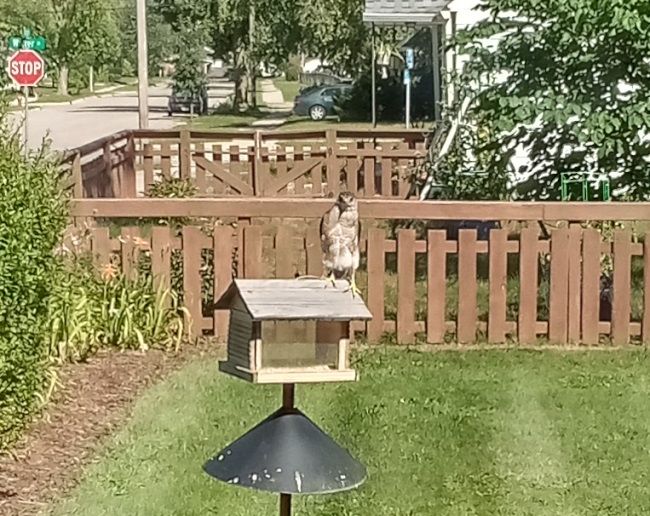
A hawk decided to hang out on one of our bird feeders for a little while the other day. A Cooper's hawk?
A flower?
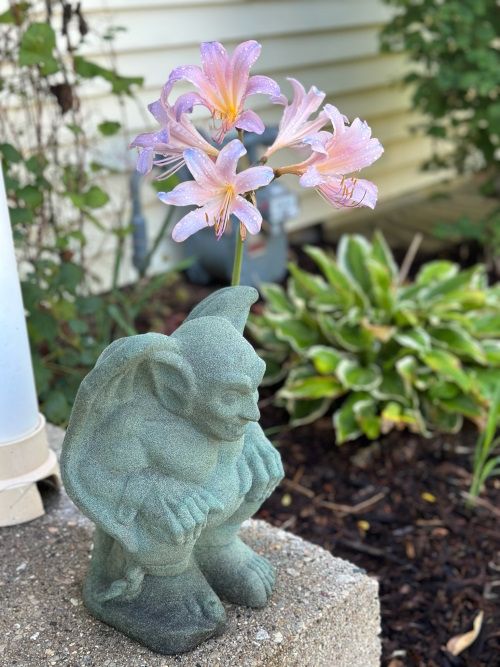
A flower magically sprouted out front and my Frau managed to get a couple really nice photos.

Kraut Day returns to Lapacek's

Tomorrow is kraut day at Lapacek's Orchard out in Poynette.
"We'll be cutting cabbage, helping with salt, showing you our pounding methods, and you'll get to go home with your own bucket of salted, crushed, cabbage all ready to ferment!"
Do you fear this man's invention that they call atomic power?
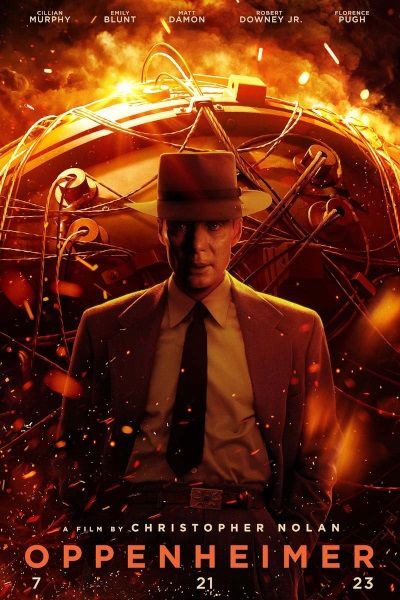
While I was in Indianapolis for Gencon, I availed myself of the chance to see Oppenheimer on an IMAX screen and on film at the Indiana State Museum. To the best of my knowledge, director Christopher Nolan shot as much of the film using IMAX cameras as was practical. Plus, I know of him as a big fan of film as opposed to digital so it seemed that this was an opportunity to see the movie as the director intended, so to speak, and I couldn’t pass it up.
In the weeks leading up to the screening, I’d listened to Rush’s “Manhattan Project” countless times and one day coincidentally found myself a couple blocks from Stagg Field in Chicago, the site where Enrico Fermi and company became the first people to create a nuclear chain reaction – as part of the Manhattan Project.
The theater was near or at capacity and I remain amazed that a three-hour movie about J. Robert Oppenheimer is attracting large audiences. Are people really that interested in a story about this man? Or is Christopher Nolan’s name that big of a draw?
Let me get this out of the way: Oppenheimer is a three-hour movie and should have had an intermission. I wanted to pee and I bet a lot of other people in the audience wanted to as well without missing a frame like me. I guess the industry has to squeeze as many screenings in as they can, audience bladders be damned.
OK.
The movie has two storylines: “Fission” and “Fusion”. The former is where we follow Oppenheimer from student to “father of the atomic bomb”, more or less. The latter storyline is itself bifurcated into one in black & white with scenes depicting the Senate hearings for Eisenhower’s nominee for Secretary of Commerce, Lewis Strauss. This storyline shares time in the “Fusion” world with scenes from a hearing that was to determine if Oppenheimer would be able to keep his security clearance.
That Rush song is on an album called Power Windows and most of the songs on that album are about power and how it is wielded. The more I think about it, the more it seems that this is one of Oppenheimer’s themes. The power of atoms, the power that the bomb has to destroy, political power, the power we have in interpersonal relationships – all kinds of power are on display in this movie.
The power inherent in atoms and the ability to harness them in the form of a bomb are readily apparent. The “Fusion” line portrays political power as we get a glimpse of the inner workings of Washington and find out that Strauss, who says at one point, "Power stays in the shadows”, was responsible for initiating the investigations into Oppenheimer and his loyalties which resulted in the hearing we see which eventually resulted in the celebrated scientist losing his security clearance.
As far as power in interpersonal relationships go, the scenes with Edward Teller in the security clearance hearing come to mind first. Teller testifies against the father of the atomic bomb yet Oppenheimer shakes his colleague's hand after he finishes his damning testimony. This infuriates Kitty Oppenheimer, J. Robert's wife, who is deeply angered by her husband’s refusal to stand up for himself. Kitty goes on to defiantly stick up for her husband at the hearing and steadfastly refuses to shake Teller’s hand.
I really need to go see this movie again to get my thoughts truly in order but here are some other things that stood out for me.
Early on when Oppenheimer is lecturing, he asks his students how light can be a wave and a particle at the same time. This idea of duality/ambivalence continues throughout the movie and really embodies Oppenheimer. On the one hand, he sees the atomic bomb as something that will end the war and bring about peace. Yet on the other, he views it as an abomination, an existential threat to humanity that should be hidden away and never used.
I really liked how Nolan used the IMAX format for scenes depicting massive flames, ripples on the surface of water, and just any phenomenon that captures the scientist's vast imagination. The sheer size of the screen engulfs us and, just perhaps, instills a tidbit of awe in our minds as the man on the screen ponders the universe and its workings.
The Trinity scene was just great. The movie cuts to various people looking on as we hear only breathing despite an atomic bomb just having detonated. And then the sonic boom hits them. But it also hits us with that IMAX sounds system cranked up. I felt the boom. Just fantastic cinema. And great credit to Nolan for not making this the climax, the end of the movie. It’s another element of Oppenheimer’s story, albeit a very important one, but it’s not the end of his tale.
One thing that I am rather ambivalent about is how much shallow focus there is, how often the only thing on the screen for us to glean information from is a face. I wouldn’t doubt that part of this stylistic choice was made because of technical limitations of the IMAX format. I really don’t know what kinds of lenses those cameras can or cannot use. The characters seemed like isolated atoms all too often, where we see their faces but their surroundings seem almost irrelevant.
Having said this, Cillian Murphy’s eyes and his facial expressions are amazing here. They go from wide-eyed wonderment at the workings of Nature to the sadness of carrying the burden of having fathered the most destructive weapon ever devised by mankind.
The last thing I want to mention here is Nolan’s use of cutaways. I mentioned one kind above – those of natural phenomena, whether on the macro scale like an ocean of flames or on a micro scale where we see what I think are meant to be elementary particles in motion. (As I said, I need to see the movie again.) These get us inside Oppenheimer’s head and demonstrate his fascination with the universe and the rules that govern it.
But there are also cutaways that demonstrate Oppenheimer’s growing unease with the idea that there are now what we’d call weapons of mass destruction around and that he played a pivotal role in creating them. One of these cutaways is that big IMAX frame full of fire which sits in both realms. It’s a fascinating natural phenomenon yet it also symbolizes death and destruction.
Another takes place after Hiroshima and Nagasaki have been bombed. Oppenheimer is either walking to a stage to address the denizens of Los Alamos or away from it having already spoken to them and he zones out and imagines stepping on the charred corpse of an atom bomb victim. His foot goes right through it and his shoe emerges covered in ash.
In a scene that takes place in the cramped conference room where a panel of modern day Torquemadas question him, Oppenheimer appears nude before them. A cut shows him from another angle and his lover, Jean Tatlock, is on his lap, her hips thrusting in ecstasy.
As a stylistic device, I like these impressionistic cutaways. Done well, they get you into a character’s mind on a basic, emotional level. And I enjoy that feeling of being taken out of the story’s “real world” and placed somewhere different, perhaps somewhere “unrealistic”. These kinds of scenes just work on my brain in a different way that is fun and interesting.
I liked Nolan’s use of these cutaways here in Oppenheimer but I wish that there had been more of them, that they were used in something of a rhythmic pattern. There didn’t need to be a whole lot more of these cutaways but I think a few extra would have done the trick. But the ones we did get were great and paired well with a dynamic soundtrack. Again, just a few more to give that really visceral impression to punctuate the plot and illustrate our protagonist's state of mind.
At three hours, Nolan gives us a lot of food for thought. I really need to watch it again if I am to piece things together, to get a better view of the whole megillah. As it stands, I very much enjoyed this film, with an emphasis on film. It looked fantastic. I am, however, ambivalent on the whole Strauss storyline. It’s not that it’s bad and I think I understand its importance in helping give shape to Oppenheimer’s post-war life. It gives you an idea of what he did and of the powers aligned against him.
But I can’t help but think that more of Jean Tatlock would have been interesting. I don’t know anything of their real-life relationship but she is a clever and formidable woman. The scenes with her show us an Oppenheimer distanced from his work, the bomb, and all of the horrible implications.
Regardless, this was a very good film, flaws and all, and I am keen on seeing it again though, sadly, it likely won’t be in IMAX.
P.S. - at the screening I attended, a notice was shown before the film that there were no additional scenes to be found in the middle of or after the credits. Was this an Oppenheimer thing? A peculiarity of the venue? I'd never seen that before.
P.P.S. - Martin Scorsese's latest film, Killers of the Flower Moon, looks to clock in at just under three and a half hours. This is Ben Hur territory. Surely there will be an intermission.
R.I.P. Gary Young
I hear that Gary Young, Pavement's original drummer, passed away yesterday. This is the band playing "Two States" with Young here in Madison at the late, great Club de Wash on 10 June 1992.
Into the void
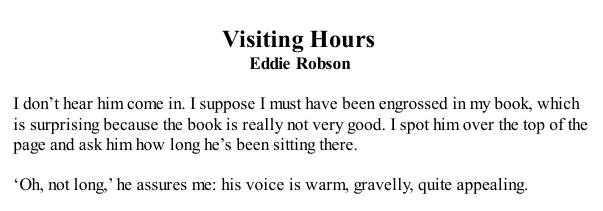
As the story opens, the Doctor is visiting a Miss Woods at some anonymous hospital. She tells him that, despite there being multiple patients there, no visitors ever pay a call. The Doctor learns that she reads only schlocky detective novels so he offers her some titles from his own library that is his capacious jacket pocket. I smiled when the first book he pulled out was Cancer Ward which I assumed was the Solzhenitsyn book. The Doctor, a bit embarrassed says, "You probably don’t want to be reading that."
Our Time Lord hero is there because Jamie is. The patients slip into comas and dream of a void, a "velvety blackness". The Doctor follows Miss Woods into this void using a trick he learned in Tibet, presumably when he wasn't fleeing from Yetis. With all of the strange hospital's patients in the void, the Doctor pulls out a bottle with a bubble wand thingy in it. He blows a bubble which touches the blackness and creates a hole that leads back to the real world.
Everyone is able to escape except for two patients whose squabbling is resistant to mediation and so they are left behind to be "consumed in a flash of light and a shattering roar" which I guess means they blew up real good.
The Doctor explains that everyone was part of some nefarious experiment but he doesn't really have all the details. With Jamie safe, they head out to find Zoe and just who is behind this ghastly research project.
This is a wonderful little tale. I really enjoyed how it began in media res with Miss Woods just suddenly noticing that the Doctor is in her room. Similarly, I appreciated the open ending with Zoe still lost and the minds and motives behind the experiment still unknown. Plus, it's a bit of a weird story with people or perhaps their consciousnesses being transported to a mysterious void. Eddie Robson does well to keep the details under wraps. The Doctor never really explains much and I was kept wondering just what the heck was going on. Well played!
A really fine example of what a Doctor Who short story can be.
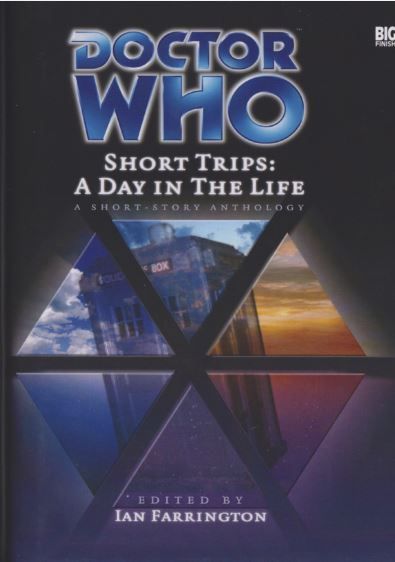
What do you call it when the rich steal from the rich?
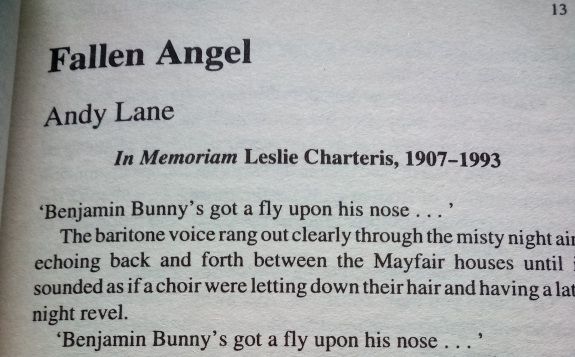
It is 1933 and we are introduced here to a thief named Lucas Seyton. He has absconded with "Madonna and Child" by Reubens and he manages to outwit the aptly named Constable Sharpless while making his escape. Traipsing back to his domicile, he hears a kerfuffle coming from an alley which he dutifully investigates.
He discovers the Doctor being accosted by a trio of men who turn out to actually be robots. Seyton is able to dispatch with one of them causing the others to beat a hasty retreat. The hero of the hour leaves his calling card on the busted robot - "The Fallen Angel". Back at his rescuer's place, the Doctor explains that he and his companions "appeared" in a house that is guarded by those robots. It is their duty to keep the prisoners in and kill anyone who dares enter from without. The Doctor had managed to escape but he must return to find Jamie and Zoe.
Seyton, it turns out, is no petty thief. Instead he is a real life Dennis Moore, er, Robin Hood. Well, kind of. To atone for the past sins of his family who got rich off the backs of others, he steals things from his fellow aristocrats, sells them, and gives the proceeds to the poor.
After hearing the Doctor's tale of woe, Seyton volunteers to help this peculiar man find his companions and enlists the help of a friend, Ketters, who flies them to the prison/house in a Sopwith Camel or some such type of plane. Robots are sent on an intercept course and a dogfight, of sorts, ensues with one of the robots being destroyed and the plane meeting a fiery end but not before the Doctor and Seyton are able to abandon ship, so to speak. Ketters, however, met a different and less salubrious fate.
The Doctor and Seyton make it to the house and breach the entrance by using an electronic pass that they recover from the robot that was downed in the dogfight. They find that the prisoners are dead, having killed one another, but that Jamie and Zoe are still alive. However, escape will not be easy as a rather nasty metal guard spider confronts them. Just as things are looking grim, the spider is destroyed by shots from none other than Ketters who managed to survive after all.
Since the house was a high tech prison on Earth, it was outfitted with a mechanism that wipes the memories of people who stumble upon the place and they forget that they ever did within a few hours. And so Seyton is deprived of his memories of this adventure.
Andy Lane is a fine writer of Doctor Who novels and this excursion into short story territory is quite good. Seyton is a fun character. He's flippant, quotes Winnie-the-Pooh, and takes the bizarre in stride. I don't think we ever get a detailed explanation of the prison but the Doctor does say he had a hand in its creation. For instance, he programmed the guards.
Just a fun little adventure that made me wish I'd run into Lucas Seyton again.
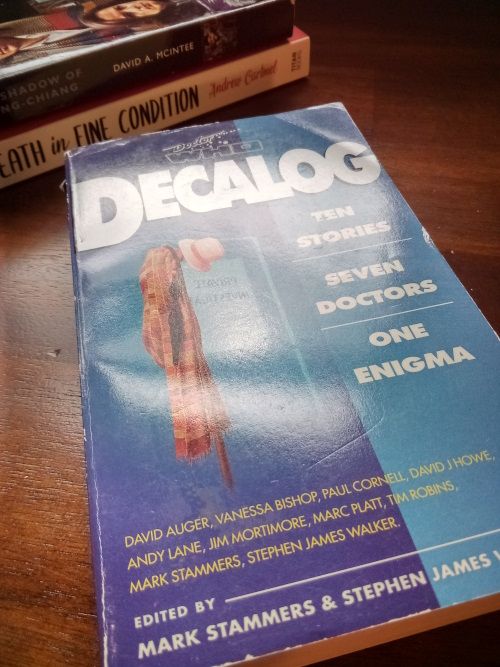
17 August, 2023
Doctor Who In An Eldritch Adventure With Hideous Creatures
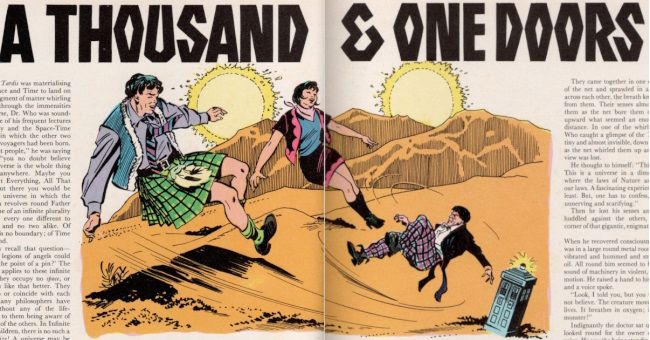
This, the final Second Doctor short story in an Annual, begins on something of an odd note with the Time Lord discoursing on the subject of infinite universes. This brief esoteric diversion provides the illusion that we're in for something different and then the author steers us back to the silly world of the Doctor Who Annual by having the Time Lord refer to Jamie and Zoe as "my children". The TARDIS then lands on a planet with dual suns. Wanting to investigate, the Doctor opens the "great door" of his ship. Can "eldritch glow" be far behind here?
While the air outside is breathable, gravity is a bit wonky, apparently, as they all float in the air. Until they're caught in a net, that is, and pass out. When the Doctor awakens, he hears a voice calling him a monster because he breathes oxygen. This trope again? And the Doctor's captors threaten to dissect him. I guess it's the same author as the Marie Celeste and chimp man stories and he or she was a good recycler.
The Doctor learns that he and his friends have been captured by dimension explorers from the 8091st Universe. They use "doors", that is, points where the various universes touch and allow travel from one to another. The Doctor basically gets tired of their anti-oxygen breather BS and clocks one right on the glass dome head which shatters. Running on adrenaline, the berserker Time Lord also rips away part of the creature's suit. What the Doctor sees almost makes him sick.
"That face and that body! There were no words to describe it."
I've got one: "eldritch". I cannot believe the author didn't use "eldritch"!
Although he or she neglected "eldritch", the author did find words to describe it: "a writhing vortex of something slimy and sticky". And it burned up in the oxygenated air.
The creature's pals were so shocked by the bellicose oxygen breather that they just stood there, mouths no doubt agog in astonishment behind their glass helmets which gave our favorite time travelers time to escape and flee to the TARDIS.
Not only are there creatures that discriminate against those who breathe oxygen as in another tale, but this story is yet another in this annual that features the Doctor killing someone to save Jamie and Zoe and escape.
As far as this tale goes, I like its mood. It begins with some esoteric banter about multiverses before we meet some stern, sadistic figures. I don't know why, but I simply liked the combination. Also, I give it points for the Lovecraftian descriptions of the creatures behind the mirrored helmets.
Glad to be done with Second Doctor Annual stories. It's funny to me how they're directed at pre-teens yet the author uses "eldritch". Surely it fell out of anything resembling common usage during the Edwardian period, if it indeed ever was remotely common. I didn't care for all the quarreling amongst our heroes. Perhaps I could have tolerated it more if those scenes were more often balanced by those in which they show some affection for one another or, at least, had a rapport beyond "Let's go this way."
Let us hope the Pertwee era Annuals show improvement.
The Pied Piper in reverse
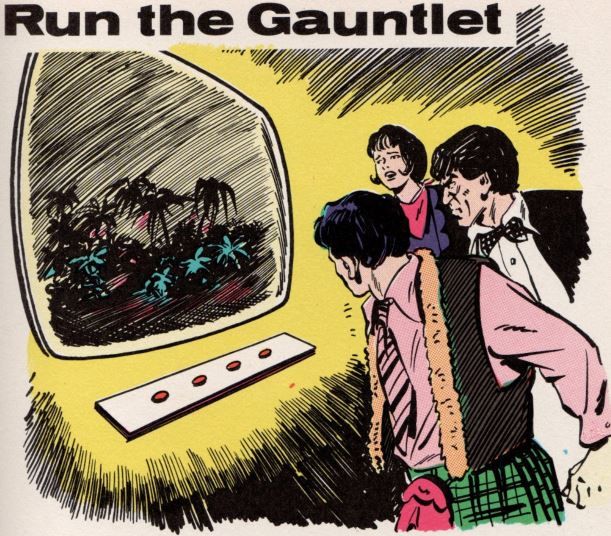
The Tardis lands on a jungle world that Jamie has no desire to investigate. However, the Doctor's other young passenger is game and she tells "the Professor" that she's ready to go out exploring long before Ace was even a blip of a thought. Just then a chimpanzee-like creature wearing a tool belt appears on the scanner. Much to the Scotman's surprise, it also has on its chimpanzee something that looks like a blunderbuss. Jamie is so astonished that he gives another "Sizzling satellites!" which we last had in "Man Friday". Uff da.
Zoe and the Doctor slap on some insect repellent cream, don contra-gravity suits, and head outside. At one point they're flying above the chimp fellow who promptly zaps them with his blunderbuss and deactivates their suits. With no TARDIS translation, the Doctor guesses the native tongue of the creature and says, essentially, that they come in peace. Well, this guy, Valgar, doesn't believe a word of it and accuses our time travelers of being robot spies sent by the Jaibohs. Valgar is going to bring them back to HQ to have them dissected.
In the lab, Valgar puts on a lab coat and thrusts the Doctor and Zoe in front of a machine that bathes them "in an eldritch blue glow." Hmm. Now where have I read that before? Valgar discovers that the Professor and his passenger were telling the truth. They are not robots.
Fortunately, the Doctor was not relieved of his recorder as it is chimp creature repellent and it allows the Doctor and Zoe to escape. Out in the jungle they run into Jamie who has used a string to mark his trail, a trick he learned by reading an old Greek legend in school. What?! Did he go to Highland High? Inverness Public School? Also, he has moved the ship closer to the action with a short hop. What?! The Doctor can't even do that yet Jamie can?!
As they are nearly home free, Valgar appears riding some small, zeppelin-like craft. Some mid-period Schoenberg on the recorder, however, dispatches with the chimp on the blimp and our heroes are able to get back to the safety of the TARDIS.
While I can appreciate the Piped Piper in reverse thing here as well as a lack of bad guys with slanted eyes, this, the penultimate Annual tale for Troughton, is just blah.
I am the Robot King and I can kill anything
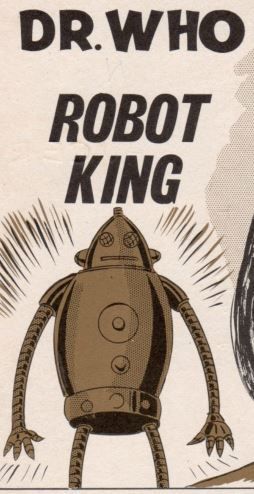
I was absolutely shocked to find that the illustrator of this comic drew Zoe and Jamie as the Zoe and Jamie we know and love from TV. I was so surprised that I did a double take.
The TARDIS lands in Hope City in the far future and our heroes find that it's more like Woebegone City. The metropolis is in ruins. Zoe and Jamie go wandering and are captured by a robot - the Robot King - who has a distinct dislike of humans. The Doctor ostensibly comes to their aid only to be hoisted into the air by the humanophobic robot. Presumably the Time Lord would be thrown to the ground and be the recipient of an Atomic Leg Drop. However, the Doctor fortuitously sees the robot's power switch on its back and turns the maniac off before it wreaked its vengeance upon him and his friends.
Sadly, although the look is right, Zoe is just a damsel in distress here instead of a capable computer whiz. Well, this comic was short and only took a couple minutes to read.
Let Ekk's people go
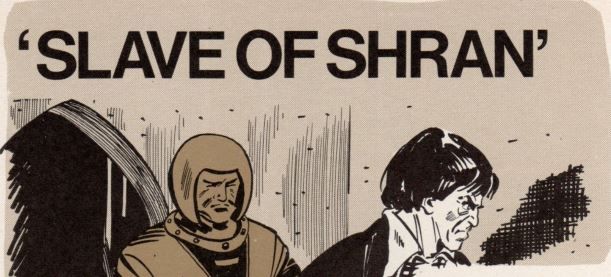
I went into this tale, "Slave of Shran", hoping that these short stories get better in the Pertwee era Annuals. With my luck, the illustrators won't bother with looking at Liz Shaw and write the Third Doctor like Troughton.
But this one began well with the story beginning in media res with the Doctor a slave who mindlessly concedes he is ready to obey - obey a rogue supercomputer named Shran. It had the Doctor's memory wiped and used his not insignificant cranial power to fix its spaceship. The Time Lord's next task is to build a (very late-60s) atomic bomb to destroy the planet after Shran and Co. make their escape.
Our Gallifreyan Oppenheimer is led to a dungeon where he is to do his work. Also there are a race of beings known as the Shelgars who look like cockroaches and they too have been enslaved by Shran. One of them, Ekk, shoots a guard and frees the Doctor who recovers his memory. The TARDIS had landed in a giant bird nest and he went out to investigate while Jamie and Zoe caught some zzzz's. Mama bird returned forcing the aspiring ornithologist to flee and get captured.
The "eldritch glow" of the laser gun is what restored the Doctor's memory so he hastily modifies the gun so that it can safely be used on the other Shelgars.
Curiously enough, Ekk has an airship and for reasons unknown, it's parked nearby. He and the Doctor escape and fight off some pterodactyl-like creatures before landing near the TARDIS. But a warrior of Shran was waiting for them. Luckily Jamie had awoken by this time and was outside to see that the Doctor and his new friend were in a jam. One big rock on the warrior's head later, the danger is gone. The Doctor rejoins his companions while Ekk returns to Shran's city where he plans to lead an uprising against the dastardly computer which is a thoroughly apposite moral for our times, if you ask me.
I give this story a lot of credit for starting the action in the middle of things and for portraying cockroaches as good, brave creatures instead of a joke about being the only things to survive an atomic blast. Other than these things, I've gotta say this is just more of the same Annual kind of stuff. I suppose I should add that it was a welcome relief that there was no bickering amongst the TARDIS crew here.
His Robot Friday
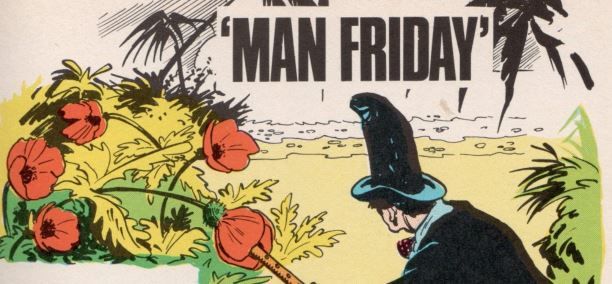
The Tardis lands in a tropical paradise with a blue lagoon so I immediately started having warm memories of Brooke Shields in her finest role ever. So far, so good.
This paradise is on an island on the Planet Delffo in Galaxy G which is one of the single dullest yet corniest location names in all of Doctor Who. It's almost like the author used those names as placeholders meaning to come up with something more interesting later but never bothered.
For reasons hopefully lost in the mists of time, Jamie's catchphrase here is the appalling alliteration "Sizzling satellites!"
The Doctor has been there before and wants to hook up with his old pals, the Creels. Our heroes retreat to the TARDIS library which holds an extensive microfilm collection that helpfully catalogues all of the Doctor's adventures in time and space. Really? Was microfilm actually considered high tech in 1969? Does the TARDIS library have a card catalogue? Well, after perusing the microfilm, they discover that they've landed on ominously named Island of the Devils. Jamie bemoans the fact that it doesn't sound like quite the place for him to get some R&R which really pisses off the Doctor.
"Sometimes I wonder why I ever chose you as a companion for my journeys."
Harsh! Wasn't it just a couple stories ago that Zoe was all pissy and told him to shut up? What's with all of this intra-TARDIS conflict?
Jamie storms out of the ship in a huff.
Eventually Zoe and the Doctor go out in search of him despite the Time Lord thinking, "...why should I bother, I really don't know." This is real First Doctor testiness!
They stumble upon a single giant footprint in the sand and a message scrawled next to it by Jamie, presumably: "GONE WITH MAN FRIDAY TO MEET DEVILS IN MOUNTAIN". The Doctor and Zoe promptly go in search of their missing friend.
After a while, they happen upon a Creel. Though not normally found on the Island of the Devils, this one, Goruf, is doing some scientific research and tells the Doctor that one of the Devil's giant one-legged robots, a Blikk, has taken Jamie. Goruf gives them directions to find their wayward Scotsman which turns out to be a nano Odyssey involving soporific flowers and a tunnel with an unknown guard.
They eventually find the subterranean lair of the Devils where Jamie is hanging out. As it turns out the Devils, a.k.a. - the Lava People, are really nice folks who just want to live in peace with the Creel.
I liked that the Devils turned out to be good, peaceful folk. And I agree that Zoe has a pulchritudinous brow. But the Doctor getting really irritated with Jamie for no good reason and then going off on him like that was just ridiculous. And just like the previous tale, the ostensible villains here have "slanting eyes". Same author? This must be a racist trope.
Grip of ice, you're willing to sacrifice our thought cubes
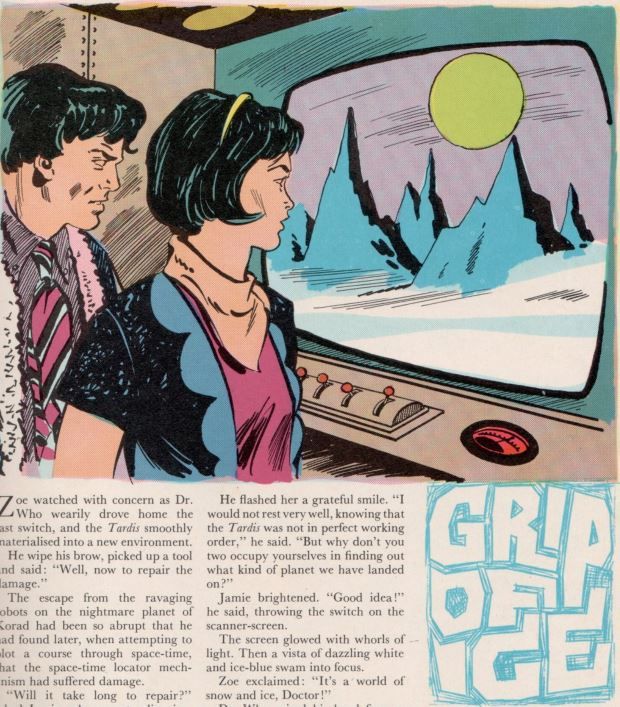
Having survived the nightmare planet of Korad, the TARDIS lands on a Hoth-like planet of snow and ice. Zoe and Jamie don some funkadelic silvery planetary uniforms(?) and head outside to investigate while the Doctor attempts to fix the ship. As the beloved companions approach a crevasse in the ice, a breeze springs up which Zoe deems as being very odd: "Doesn't it strike you as unnatural..a breeze in these conditions?"
Living in Wisconsin, I must admit a breeze when it's all ice and snow outside is not only not unnatural, but par for the course. Not having the wind chill you to your bone is what I'd find unnerving.
This breeze menacingly blows our companions perilously towards the crevasse.
When the Doctor is finished repairing the ship, he goes out in search of Zoe and Jamie. He finds one of Zoe's buttons in the snow near the crevasse which now has a handy-dandy snow bridge spanning it. The Doctor walks across only to have the bridge go poof! and return to a dusting of snow. He continues on and finds a city.
He enters a building and discovers a bunch of cubes - thought cubes, that is. These square thingies are all the remains of a race called the Morrains. You see, when their sun exploded, things got chilly so their head boffin, Cosmos, transformed them into thought cubes but he remained in humanoid form to watch over his fellow Morrains. Well, as it turns out, Cosmos wasn't such an altruistic chap after all. He was building a spaceship to leave the icy planet and was attempting to use the cubes' collective thought power to propel it to the nearest beach planet.
So, how many pounds of thrust per cube?
The Doctor is told that Zoe and Jamie's thought power were exactly what's needed to get Cosmos' ship up and away. Our hero, a.k.a - "the scientist", hops into a nearby scout car and heads to local version of Barad-dûr where Cosmos readies his ship. The Doctor offers his mega brain power in exchange for Zoe and Jamie and the rogue scientists agrees.
Zoe and Jamie take the scout ship to safety and await the arrival of the Doctor so they can head for the TARDIS. They hear an explosion from the tower but their friend is safe. He reversed the polarity of the neutron flow his thought-power which caused Cosmos' equipment to overload or some such thing and blow up real good. The villain was killed and the Doctor emerged unscathed.
And they all lived happily ever after.
While I thought that the thought cubes were a neat idea and I found it cool that Cosmos had 3 arms rendering him bilaterally asymmetrical, this was just another hokey Annual tale for 10 year-olds.
The TARDIS doors are described as "great doors" but I never thought of them as being these huge things. Also, Cosmos has "slant eyes". Is this an appeal to the notion that East Asians are crafty and evil? Or just a more generic description that has taken on racist overtones when none were meant?
It's like The Chase Never Happened
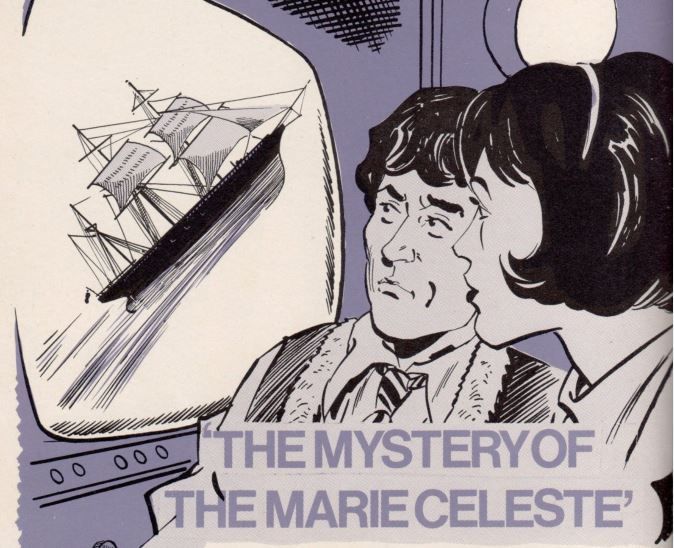
As expected, the Second Doctor is written like the First, e.g. - "That ship, my children..." The Tardis lands on a big metal ball which is in the middle of snagging the Marie Celeste from the ocean with a tractor beam. Stepping out to give things a look-see, Jamie senses danger and suggests a retreat back to the ship which prompts Zoe to reprimand him, "Oh, shut up. This is only a spaceship. They're quite common where I come from."
Odds are the writer had no idea where Zoe came from. What horrible dialogue. I don't think Zoe was ever this cantankerous on TV. Then again, I do have one more TV story to go.
Both the TARDIS and Marie Celeste crews are brought inside the globe which is operated by a couple of Arcturans named Eretz and Lantis who, we are told, look "like magnificent specimens of early Greek manhood." Not sure quite what that means...Anyway, they do not breath oxygen but rather ammonia and methane. The globe is like their version of the H.M.S Beagle as they're out roaming the galaxy to investigate other species, though luckily they are eschewing the whole anal probing thing.
The two ersatz Darwins are in an enclosed observation area but Jamie and the Doctor shatter the windows with some marlin spikes which I learned are used to make knots, something sailors do a lot of. This breach means that our heroes' captors have a little trouble breathing. Their respiratory problems lead to the ship going out of control and falling into the sea. But it also presents an opportunity for escape.
The skipper of the Marie Celeste asks the Doctor how to escape the metal
ball and he selfishly replies, "I'm not concerned about getting out of
the iron ball. All I'm concerned about is getting inside this ship of mine here."
Unfortunately, the Doctor can't find the TARDIS key and he goes from being pissy to sounding like a pitiful teenager as he moans, "How stupid I am, my friends. How you must despise me."
I rolled my eyes here, I can tell you.
The dreaded Kraken attacks the ship and the Doctor recalls that he had left the key in the TARDIS door lock. He, Jamie, and Zoe scramble to their ship but the crew of the Marie Celeste now regard them as warlocks or madmen and refuse to board the TARDIS. And so our heroes merely look on as the sailors die in agony as ammonia and/or methane overtakes them.
After watching the sailors suffocate to death, the Doctor becomes rather cheerful and says he is happy to have solved the mystery of the Marie Celeste.
Uff da! This one was just bad. Making Troughton into Hartnell was especially annoying here for me but I don't know why. Maybe it's because the Hartnell imitation was so lame.
16 August, 2023
The (Lake) Superior Stout: North Tower Stout by Earth Rider Brewery
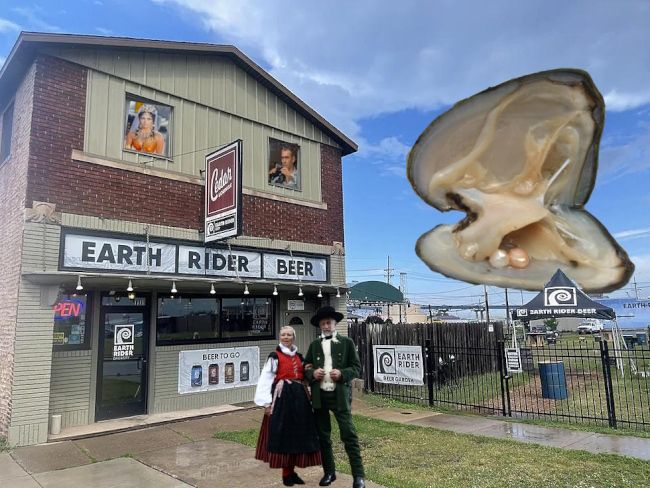
Funnily enough, this summer I've been seeing bus wraps - those ads that take up the whole of or both sides of a bus - trying to lure Madisonians on a trek up north to Superior way on the opposite side of Wisconsin in the far northwestern corner. These ads refer to the city on the Great Lake of the same name as the Paris of Wisconsin. I smile every time I see a bus with this ad drive by me.
Superior is a town of some 26,000 people and a not insignificant number of them are drunken blue-faced Finnish Americans. And I'd bet that a fair number of these folks are relaxing in a sauna plotting some kind of socialist workers revolution as I type. No wonder that Douglas County is a blue island that stands out in a sea of red up north.
I've been trying to sample the breweries of northwestern Wisconsin as they're not generally available down here and have been successful at several of them. While I was in Spooner, home of Round Man Brewing, back in June, I was there on a day when, alas, the brewpub was not open. I find it odd that brewpubs up in that part of the state aren't open every day of the week during the summer. It's tourist season with thirsty Chicagoans and Minneapolitans everywhere up north. Plus, the bars in your town are open Monday through Sunday. Maybe they're just short-handed.
Whatever the case, I've been able to sample Lazy Monk (arguably west central), K Point (ibid), Bloomer Brewing, Valkyrie, MoonRidge, Agonic, South Shore, and the Angry Minnow. One brewery from up that way that does distribute down here is Earth Rider.
While perhaps never exactly common here in Madison, I used to be able to find their brews at Woodman's with ease. Not so lately. Both east and west. Who knows. Maybe the Earth Rider supplies are always replenished the day after I do my shopping. Regardless, I managed to find their beer at Brennan's which seems to be a good source for less common brands and brews.
I know a couple folks from the northwest part of the state who have good things to say about Earth Rider so I was looking forward to putting another notch on the beer bedpost.
The brewery's website doesn't have much to say about Earth Rider history but I discovered elsewhere that it started up in 2017. Their claim of being "the first brewery in Superior, Wis. to produce beer for the region since 1967" belies the fact that Thirsty Pagan Brewing, just down the street from Earth Rider, predates them by 11 years or so. Maybe the marketing department at Earth Rider considers Thirsty Pagan to be a brewpub and pizzeria and not a brewery proper.
While it was a bit frustrating that their website didn't give me much fodder for this blog post, it was nice to not have an overly sentimental and probably half true story about how the founder's quadriplegic father gave his life so that his only begotten son could attend brewing school or some such thing. But I did learn that the brewery and its taproom are in historic buildings and that they use Lake Superior water for brewing.
While Brennan's had a mix pack thingy that would have given me a variety to choose from, I decided not to jump in and instead dip a toe into the water. Perhaps it had an IPA and/or a pale ale which didn't appeal to me. So I settled on their North Tower Stout.
It's an oatmeal stout, I discovered, even though the label doesn't mention oats on it. The brewery is near North Tower Avenue and the label seems to picture the big grain silos behind the brewery and a cargo ship out in the choppy waters of Lake Superior.

North Tower looked oddly out of place on my deck on a sunny summer day. A lovely tan head of loose foam sat atop the positively Stygian stout. It lasted an average amount of time, in my estimation. Despite its opaque appearance, when I looked at that little dimple where the stem meets the bowl or whatever you call the part of a glass where the beer resides, I could see it was, in fact, a very deep brown color. Taking a whiff, I caught coffee, milk chocolate, plum, and just a touch of grass. Nothing unexpected but it looked beautiful, if a bit menacing, and smelled wonderful.
My first sip revealed a firm fizziness and a medium-heavy body. Milk chocolate was out front and it teamed up with a fair dose of malty sweetness. There was a bit of coffee in the back and I found that the plum that I had smelled translated to something more like cherry on my tongue. As promised with the addition of oats, this stuff was creamy and smooth. I found that, as it warmed up, the beer developed a slight smokiness which I quite liked.
The stone fruit and milk chocolatey sweetness lingered a bit on the finish. A mild herbal hoppiness offered just a modicum of bitterness and a little dryness. These provided some counterpoint to the sweetness but not enough to truly balance things out.
I am ambivalent about North Tower. Credit must be given for avoiding the typical American stout recipe of bitter coffee, dark chocolate, and heavy roastiness. Those flavors are all here but are toned down in favor of a sweeter malty flavor that ended up tasting like milk chocolate. While I liked how this paired with the cherry flavor, I found myself thinking that this was like a dessert beer. It was rather sweet, fairly heavy - just not a good choice for an 85 degree day for me personally.
North Tower is a very good beer but its sweetness means that one is enough for me. I now need to find something else from Earth Rider to follow up one of these.
Junk food pairing: Pair your North Tower with a bag of Lay's Roasted Garlic Oyster potato chips.
This is the Vinegar of Company Bragg
I saw some drinking vinegar or a drink with vinegar in it or whatever you call it from a company called Bragg (which made me think of Commander McBragg) recently at Woodman's and I picked up the lime citrus version, although they have a bevy of other flavors.

It's just water dosed with apple cider vinegar, lime juice, and lemon juice with a dash of monk fruit to take a bit of the edge off. This stuff is "prebiotic" and a "daily dose of wellness", or so says the brag of company Bragg. I don't know what "prebiotic" means nor what the health benefits, if any, are of drinking vinegar. The citrus juice will keep scurvy at bay, though.
It was quite refreshing with a firm citrus tartness up front and a hint of the vinegar sour in the background. While I did find this stuff to be very tasty, I have a lot of Central and Eastern European blood in me and I found myself wishing there was more vinegar in it.
The cthonic coffee
I drank some robusta coffee for what I think is the first time the other day.

It's one of the two most common types of coffee trees, though less popular than its cousin, arabica. It grows at lower elevations but its taste is less desirable. Or that's what I recall from reading Mark Pendergrast's history of coffee, Uncommon Grounds, anyway.
Arabica beans have a sharper, more sprightly flavor while these robusta beans were much more woody and earthy tasting. I guess robusta has more caffeine too. Is that where the name came from? The java I drank may have actually come from Java. A co-worker was given it from someone who had traveled Southeast Asia and I honestly don't know that I have ever seen robusta here in Madison.
Subscribe to:
Posts (Atom)