Showing posts with label Third Space Brewing. Show all posts

11 January, 2021

Darker Than Your Average Beer: Ice Bear by Third Space Brewing


Erratum. In my last review of a Third Space product, I wrote that it – their Cranberry Gose – was my first taste of their beer. This was incorrect. I have since discovered that I had tasted one of their brews back in the olden times before Covid, about 11 months ago.

Mea culpa.

Milwaukee's Third Space Brewing is a relative newcomer having opened in 2016. But my impression is that they are generally well-liked. Or their beers seem to be, anyway. And I have at least a modicum of respect for any brewery that makes a Baltic porter, a style that doesn't seem to be in favor these days since A) it's (generally) a lager and B) it is fairly resistant to hops that taste like mangos.

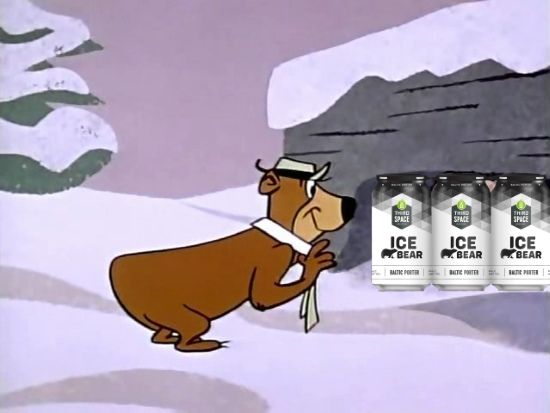
Long ago when I first heard about Baltic porters with their high alcohol content and black color, I figured this beer had been consumed in the Baltic region since time immemorial. In my mind's eye I saw medieval Latvians ripping off their furs to wrestle reindeer and bears naked for sport and, afterwards, chugging down a flagon full of the heady brew. Later I would discover that the truth was a little more mundane.

Without meaning to get overly epistemological, I suppose I should put an asterisk next to "truth" because I wouldn't be at all surprised to learn that the origin story of the style is partly (or mostly) apocryphal. The tale imparted to me is that the genesis of the Baltic porter lies in the pleasant pastures of Albion.

Well, more likely the dark satanic breweries of London. Porter brewers began exporting extra strength versions of their beer to the Baltics in the late 18th century. The Russian imperial court developed quite an affinity for it and the brew became known as Russian Imperial Stout in some quarters. Locals started to brew it and, when the lagering craze hit the area in the late 19th century, they started to lager it. Fast forward another hundred years and you have English beer lover/writer Michael Jackson swing through the region and quaff a bunch before proceeding to label them "Baltic porters".

There's nothing outrageous in this account, no Dan Brown-esque conspiracy between an obscure Lutheran sect and the Hanseatic League forcing English brewers to have their product shipped north over to Murmansk and thusly requiring an extra strength brew with extra hops to survive the overland trips south to Riga. So, until I hear differently from someone like Ron Pattinson or Martyn Cornell, I am sticking with the above account.


Ice Bear looks like what I expect Baltic porters to look like – full on stygian gloom. Sure, if you hold your glass up to the light and twist your neck to just the right angle you can tell it's a very dark reddish brown but, if you look at the glass like a normal person, then it's black. As in no light gets through. The head was a lovely tan color and rather rigid. I moved my glass but it more or less remained in place.

The beer smelled really nice with coffee and dark/bitter chocolate being most prominent. I caught a hint of herbal hoppiness too.

For a beer that looks like a glass of Valvoline, it was medium bodied. That coffee and dark chocolate from the nose was present on the tongue but so was a nice plum-like sweetness. A little roasted grain bitterness was joined by a smidgeon of smokiness. Ice Bear is 9.5% A.B.V. and there was just a hint of booze. A bracing dose of spicy/grassy hops linger after the beer has gone down the hatch and makes for a pretty dry finish.

Ice Bear really hit the spot on a recent winter night. I adore the coffee and chocolate flavors from highly roasted grains and they're here in spades. The sweetness wasn't cloying but rather provided a fine foil for the bitter elements. It was nicely carbonated with just enough for a little tongue tingling fizz and a hint of the dryness to come on the finish.

It brought back nice memories of eating at Arbat Russian Restaurant (R.I.P.) in neighboring Fitchburg where I used to wash down plates of pelmeni and chebureki with a Baltika 6. I'm glad to see someone offer this style in these parts as it seems to be a rare sight in liquor stores. Perhaps it's where I shop, but I don't recall seeing any of the usual suspects like Okocim, Żywiec, or Baltika lately. And Vintage doesn't seem to have brewed their Baltic porter this year.

Third Space is probably having a rough time being a third space right now. (A third space being somewhere to socialize other than home or work.) But, if I were to go visit their beer garden, Ice Bear would be the perfect choice for standing outside in the Wisconsin winter trying to get my Gemütlichkeit on.

Junk food pairing: For a hearty brew like this, be sure to have a bag of beet chips on hand along with horseradish & bacon dip for, well, dipping.

19 December, 2020

Getting to Third Space: Cranberry Gose


On a recent trip to the liquor store, I made what I think is my first purchase of a brew by Third Space Brewing in Milwaukee. It looks like they've been around for about four and a half years and, according to the BeerBaron, Third Space is one of Wisconsin's best breweries. They sure have a lot of IPA's which just about disqualifies them from being a "best" brewery, for me, but I did find their winter sour, Cranberry Gose, intriguing. Perhaps it would prove be a pleasant alternative to the heavier beers normally consumed during this time of year.

Gose is a German ale that uses a lot of wheat and is "traditionally" flavored with coriander in addition to a mild dose of hops. If your water source isn't salty, then salt is usually added. The style dates back to the 16th century and the city of Goslar in north central Germany although it really took off in Leipzig, some 200 miles to the southeast. Tradition being more mercurial than we give it credit for, you can either use salt and coriander or not as you please and still claim your brew is "traditional". From what I've read, neither was added far back in the beer's history and are instead more recent additions, though I'm not sure when exactly. As the beer's name hints at, Third Space replaced the coriander with cranberry, though the salt remains.

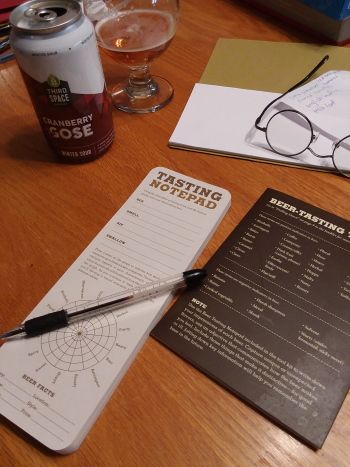
For my tasting, I used Jeff Alworth's Beer Tasting Tool Kit which was a gift from last Christmas that I have finally gotten around to opening.


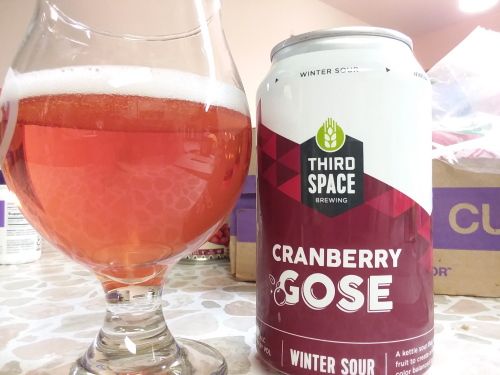
Cranberry Gose – quelle surprise! – is red. It's a lighter shade and a bit dull. I thought it had a slight orange tint to it and a hint of haziness. The pour made a small white head that disappeared quickly. It smelled astringent with a prominent citrus scent from all the lactic acid used to make it sour.

As expected, it had thin body which was made up for in tartness and sourness. Again, my sources on the Internet tell me that the Gose, say 50-100 years ago, was really, really sour. Like xenomorph blood sour. Third Space didn't quite go that far but it is rather acerbic with a nice lemony taste. The cranberries add a piquant tartness and berry-like flavor.

When I cook, I don't measure salt - I do it by eye. And I have this vision of a brewer at Third Space clutching a big 40# sack of salt and casually pouring the crystals into a kettle and saying at some point, "That should do it." They then reconsider the situation with their eyes darting back and forth between the kettle and the sack. After due consideration, they add just one more pinch. Regardless of how it was done, they got the salt level just perfect, for my taste. You can tell it's there enhancing the flavors but it falls just short of tasting particularly saline.

This is a well-carbonated beer. All those bubbles look pretty running up through a sea of red in your glass. Plus, they make your tongue tingle as you quaff which makes for a rather dry finish.

No Schaumhaftvermoegen was to be found on my glass.

While I liked this beer, I felt that there was a bit too much carbonation. You've got your lactic sourness, the tartness of the cranberries, and then you top it off with a generous portion of CO2 – an acidic overload. I enjoyed Cranberry Gose but one serving was enough. I do give Third Space credit for using cranberries, though. Wisconsin grows more cranberries than any other state in the Union so their use in this beer makes for a nice regional touch.

For anyone looking for a non-fruited Gose, the only place around Madison that I know of is Delta Beer Lab. I've not had it but intend to do so. Next Door Brewing has brewed a Gose in the past but I am unsure if they've done so lately.

Junk food pairing: Pair Cranberry Gose with a bag of white cheddar pork rinds. Let the smooth, creamy cheese dust mellow your tongue after those blasts of sour.