26 September, 2016

A Surfeit of Festbiers


From Green Bay we now head southwest to Lake Louie Brewing.

Hypothesis: Tom Porter and the gang out in Arena brew a tasty Dortmunder Export and fine, if boozy, helles bock. And so, while they mostly brew ales, they have a proven track record with lagers. Odds were good that the brewery's first Festbier would be a winner.

Experiment: Lake Louie's Oktoberfest went the pale Märzen route with its gold color. The bier was clear revealing a goodly number of bubbles making their way up to a nice bed of white foam. All of that effervescence gave my tongue a firm, yet gentle, carbonic bite. Bread, a mild honeyed sweetness, and a touch of spicy hops came in the initial salvo while a bit of roasted grain and even a tad of toasty, Maillard reacted malt were noticeable upon repeated quaffs.

The lovely malt flavors quietly faded as the spicy hops grew louder as they took on some grassy tones leaving my tongue high'n'dry.

Conclusion: Really good. Easily the best Oktoberfest I've had this year from a Wisconsin brewery. Cheesehead brewers have basically shit the bed this Oktoberfest season sending countless German settlers a-spinning in their graves. Lake Louie's Festbier has a nice bready flavor, which, if it had been fuller, I wouldn't have complained. Plus the hops gave a nice bite on the finish. As a bonus, the Schaumhaftvermoegen was generous and pretty.

Lake Louie's Oktoberfest went well with Late July Bacon & Habenero tortilla chips which have what is likely the best bacon flavor on any chip anywhere, anytime.
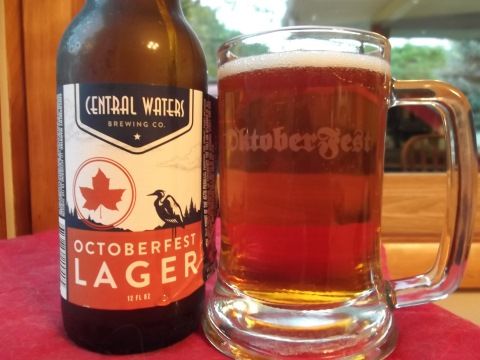


Back up north to the Wisconsin interior and Central Waters.

The cicerone cries
Amidst the gadarene rush
To slumgullion


About 90 miles west of Amherst lies Black River Falls and the Sand Creek Brewing Company. They've got a nice little place up there.

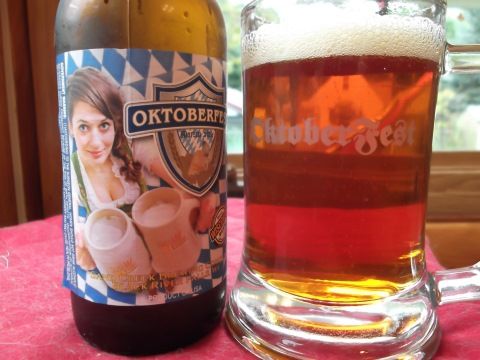
Another Wisconsin brewery that specializes in ales. Methinks their Oktoberfest is their only lager. I give them credit for putting a brunette in a dirndl on the label, though, instead of a blonde. Thinking outside the box.

I have to wonder if Sand Creek exists but for the grace of contract brewing. This is not meant as a sleight – simply an observation. Or perhaps Wild Ride Eyepah sells like gangbusters and I am blissfully unaware. It's just that I don't see hordes of Chicagoans crossing the border in search of their beer. Hell, I don't see them around Madison much outside of liquor stores. Oscar's Chocolate Oatmeal Stout, a darn fine beer, used to be seen (by my eyes, anyway) more frequently in taverns and restaurants but is a relative rarity today. I guess not making grapefruit beer has taken its toll.

Onto the Oktoberfest…

Sand Creek apparently took a more traditional route with its Festbier as it was amber. Nice and clear, it was a lovely bier to be sure. The head was a light tan and I got about an inch of the stuff. Inside there were bubbles. Lots and lots of bubbles. It looked like it has having an embolism.

The aroma was, overall, on the mild side. What there was was led by caramel which didn't surprise me given the bier's hue. Just a little roasted grain peeked out from behind some grassy hops.

The taste too was, to put it kindly, mild. Again, a bit of caramel sweetness was most evident but that's not to say the bier was sweet. This was joined by some apricot-like fruitiness as well as grassy-peppery hops. If this bier was a palimpsest, then that would be the bit that got erased yet faintly bled through. On top of all this was a harsh, dry acidic bite from all of that carbonation. It was like Oktoberfest champagne. Zoinks!

As what little malt there was faded, my tongue was hit with a one-two combination of carbonic bite and very peppery hops which made things quite dry and equally as bitter. On the plus side, there was some nice Schaumhaftvermoegen in my glass with a few streaks of foam for decoration.

I get that Festbiers are not supposed to be as malty as doppelbocks. And while I'm not a big fan of Bohemian pilsener levels of hops in them but, if that's your thing, go for it. But for Pete's sake, have a good, firm bready, malty base. Sand Creek joins several other Wisconsin brewers who are putting out Oktoberfests that lack a solid grainy foundation. I had a Paulaner Oktoberfest a few weeks ago at a chain restaurant in the middle of mall Hades and it was great. It was shipped from Bavaria in who knows what kind of container an indeterminate amount of time ago yet it was superior to the Oktoberfests from just down the road a piece.

I am getting paranoid that my tongue is simply giving out. Is my brain malfunctioning? That Paulaner was a symphony of malt tastes in harmony. Bread, Maillard toastiness, a little doughy sweetness, and some roasted grains all played in time and accompanied by a chorus of hops. But it's like the brewers of my state are mired down in fourth grade strings class trying to play some twelve-tone Schoenberg while being led by a conductor doing the St. Vitus dance.

Junk food pairing: spray some Easy Cheese on Smoked Gouda Triscuits to accompany your Oktoberfest.

21 September, 2016

I Watched Steinkrugs Glitter in the Dark Near the Siegestor Gate: Bent Tuba by Titletown Brewing Company


OK, Green Bay. You may not draw the attention that various breweries here in the southern part of the state do as I hypothesized previously, but that certainly doesn't mean you don't warrant more love. So strut your stuff this Oktoberfest season. I am rooting for you. Hinterland was unable to pull through due to diacetyl so now it's time for Titletown to step up. John Brockington is counting on you. Don't let him down.

Titletown turned 20 this year. While that makes the brewery something of an elder statesman, they didn't begin distributing down here in Madison until relatively recently. Good thing they finally did because Titletown brews an absolutely fantastic pils and a stellar schwarzbier as well.

With a proven ability to brew up wonderful lagers, I just knew Titletown would make a great Oktoberfest.

Bent Tuba poured a simply beautiful deep gold with a tint of amber. It was perfectly clear. Titletown went the newer route with a paler brew. The small white head didn't hang around long while just a few bubbles could be seen inside.

Unlike the Oktoberfest brewed across the street which smelled like a movie theater concession stand from 20 paces, Bent Tuba had very little aroma. For a second I pondered the possibility of a conspiracy, that I was in fact drinking a test brew from Wisconsin Brewing Company. But no, I wasn't. There was a faint bit of caramel and an even fainter scent of bread. The grassy hops were muted. While the aroma was disappointing, or rather the lack thereof, I'd had beers with precious little smell that tasted fine.

As is now my wont, I concentrated on the carbonation on my first sip and did not find it wanting. It added a pleasant little bite. Some tame notes of roasted grain mingled with a light caramel taste that had just a touch of sweetness. Overall, it had a nice, clean lager taste. The hops were not exactly ostentatious here merely whispering their soft grassy pleas to be tasted.

For the finale, the malt flavors faded – this did not take much – allowing the hops' spicy side to be revealed. In concert with the carbonation, they gave dryness but not much lingering bitterness. Schaumhaftvermoegen was nowhere to be found.

OK, so I had a bit of an epistemological crisis here. All of the requisite flavors were present but the grainy ones were lost like tears in rain. What should have been full and rich was instead thin and watery. On the plus side, the sweetness was restrained. And I really liked the hops at the end where they became a little spicy. But the dryness was without its malty counterpoint.

Junk food pairing: If you don't happen to have any soft pretzels und Obatzda on hand, then grab a bag of Snyder's Cheddar Cheese Pretzel Sandwiches.

16 September, 2016

Boreal Brew: Oktoberfest by Hinterland Brewery


I've not quaffed a whole lot of brews by Green Bay's Hinterland Brewery and have only reviewed a trio of them. They've been a mixed bag, in my humble opinion, but I am quite partial to Winterland with its vital juniper berry heat. But when I saw their Oktoberfest, I jumped at the chance to try it on for size.

If I were to describe Green Bay as being "up north" I would surely draw indignant comments from some fellow Cheeseheads. The whole concept of "up north" is arguably a state of mind or way of living rather than a physical place but I tend to think of it as being demarcated by a line that goes from Hudson to Oconto (roughly). Once you get north of Eau Claire and Wausau – then you're up north. Perhaps my definition was influenced by living near Eau Claire, but really, north of this line your conurbations get smaller and smaller and fewer and farther between. There's lots of forest, Indian reservations, and bears. People get around on snowmobiles and sleighs in the winter more than we do here in the southern part of the state.

And so, Green Bay is more mid-state. While the city is our third largest, its microbrew scene lags behind that to west in the center of Wisconsin where you have Red Eye, O'so, Central Waters, and Point too. I say "lag behind" meaning simply that Green Bay breweries don't seem to get as much publicity or have quite the reputation of their mid-state peers down here in the southern part of the state. Then again, at least they don't have it as bad as Eau Claire area breweries, many of which don't even distribute down here.

Hinterland, Titletown, and Stillmank all distribute to Madison (I don't believe that Badger State Brewing does, though) yet they are a bit like the Rodney Dangerfields of brewing down here – they don't get no respect. That's not true but they don't seem to have found a breakout beer, a beer that really makes a name for the brewery, a beer that can take them from yeoman to royalty, so to speak. Perhaps it's where I roam on the Internet, but praise for Green Bay breweries tends to be parceled out in words like "solid" as opposed to "stellar".

Perhaps Green Bay's microbrewers can make a name for themselves with Festbiers…

Hinterland's Oktoberfest poured a gorgeous deep gold color with a slight haze. My bad luck streak in pouring school continued with my glass getting a teensy bit of white foam up top that quickly transmogrified into a thin film. A smattering of bubbles inside the glass were making their way up.

As I was waving my glass around to see if the bier was more gold or amber, the smell of butter wafted into my nose. I was hoping it was just an illusion or a trick of the nose but, upon giving Oktoberfest a sniff, I caught a big wave of butter which was followed by caramel and black pepper. What a bummer. The disappointment was compounded by the fact that I had run into the same problem with their Weizen Bier. I tasted half a six pack of that before consigning the rest to a date with the Madison Water Utility. (This is in addition to a butterscotchy tasting bottle of Lakefront's Brandy Barrel Aged Cherry Lager. I have yet to open a second bottle.)

But stiff upper lip and all that so I plowed on and poured some into my mouth. I was quite surprised not to taste any butter. Instead I found that it had a nice little carbonic bite and that the black pepper made a return appearance. Indeed, the spicy hop flavor was quite prominent. There was little malt sweetness, just a bit of stone fruit and dough along with a mild bread taste. As the bier warmed, the butter flavor crept in until it overpowered the vein of Märzen goodness that I had found.

I tasted some lingering malt sweetness at the end which butted up against more of that spicy, peppery hop taste which I really liked. The hops added a modicum of bitterness and dryness. Just the perfect amounts, truth be told.

The peppery hops reminded me of Great Lakes' Eliot Ness just as did Tyranena's Oktoberfest, Gemutlichkeit. The line between a Vienna lager and an Oktoberfest, at least far as American brewers go, is pretty blurred. So blurred that Coke bottles glasses will do you no good. I tend to think of Vienna lagers as being a bit drier than their Bavarian cousins but that distinction seems to be going the way of the dodo.

But let me not stray too far from the big "D'oh!" here that is the big buttery aroma and taste. This is two styles in a row from Hinterland in which I tasted diacetyl. Either Hinterland has a quality control problem somewhere along the line or my gustatory organs are failing. Am I alone in this experience?

Moving beyond butter, Oktoberfest wasn't bad. Or it had potential. Or something. One thing it did have was the virtue of not being particularly sweet which I appreciated, but this was mostly due to the fact that grain taste was thin on the ground. The bier was also lacking in more savory malt flavors. There was little bread taste and a shortage of the Maillard reacted toasty taste (that is the gold standard for me) in the same way Venus has a shortage of water. I really liked the peppery hop flavor, though, and I think I am growing accustomed to Oktoberfests that aren't afraid to give hops something more than a bit part. Still, more maltiness is needed to make the contrast complete.

Junk food pairing: I've been thoroughly enjoying Cape Cod's Smoked Gouda potato chips lately so they get the nod with their smooth cheesiness and hint of smoke.

Lay's had a limited run of smoked gouda chips and I saw similarly flavored Triscuits last weekend. Smoked gouda snacks appear to be a pico trend. I approve.

13 September, 2016

Märzen Ohne K: O-toberfest by O'so Brewing Company


The 2016 Oktoberfest season rolls on today with O'so up in Plover.

I remember when O'so first hit store shelves in Madison and tasting Duzy Piwo. Not only was it a tasty blonde ale but, I, having some Polish blood in me, appreciated how the name paid tribute to the Polish heritage of Portage County. Those days are long gone and O'so is now renowned for its sour beers. This is probably a good thing because had they tried to specialize in, say, barrel aged beers, there would have been mass carnage. I recall drinking one of their early attempts at aging beer in bourbon barrels during the inaugural Madison Craft Beer Week at Jan's Unfriendly or whatever moniker the tavern at Baldwin and E. Washington had at the time. It was barrel aged Night Train (now Night Rain thanks to a trademark dispute) and the emphasis was clearly on the bourbon. That stuff was rocket fuel and the walk to The Malt House did us good, I can tell you.

I'm trying to recall if I've ever had O'so's Oktoberfest, O-toberfest. Odds are that I have at some point but it apparently didn't stick out enough for it have left an impression. O'so is primarily an ale brewery and so I am a bit nervous going in here. Until recently they brewed a pilsner, Memory Lane, which was serviceable, and I believe they continue to make a doppelbock as well as an American pale lager, Doe in Heat, neither of which I've ever had, to my recollection.

It's not that ale breweries cannot make a fine lager, but rather that this is done relatively infrequently, from my experience. So let's find out how O'so fares.

O-toberfest is a deep amber and so falls into the more traditional Oktoberfest realm, at least as far as appearance goes. Oddly, it was just a touch hazy. While this may get you docked points at a competition, I personally don't mind. Unlike the last Oktoberfest I poured, this time I got a good crown of foam – almost an inch of loose, off-white stuff. It lasted a slightly shorter period of time than I think of as average but it had nice effervescence with a fair number of bubbles inside.

Caramel sweetness was at the top of the aroma followed by some toasted grain, a dash of grassy hop, a pinch of vanilla, and even some stone fruit which was closest to plum. That caramel made me even more anxious because I prefer more toasted grain. But I wasn't surprised considering the beer's color and, besides, the sweetness may be toned down in the taste.

Well, no. While not very sweet, toffee and dough were the first footers that crossed my tongue's threshold. The taste was really just like the aroma, at least as far as its constituent parts. Add in some stone fruit, a touch of vanilla, and a light roasted grain flavor. Carbonation and some spicy tasting hops that hovered in the background and tried to corral everything into some kind of order.

Malt sweetness lingered at the finish and was joined by more of the hop spiciness which added only a modicum of bitterness and a hint of dryness. Schaumhaftvermoegen was noticeable by its absence.

I did not care for O-toberfest all that much. It has a nice medium light body but the malt flavor was primarily sweet and lacked fullness. While it didn't taste exactly like wort, it leaned in that direction. The malt tastes were just not very rich and they remained disparate instead of coming together in a gestalt of grainy goodness. I am going to stick with Infectious Groove and Picnic Ants when I need my O'so fix.

Junk food pairing: I paired my O-toberfest with some Ruffles All Dressed potato chips. "All dressed" is a Canadian thing which apparently means everything including the kitchen sink. And so the chips have a little sweetness, some vinegar tang, smokiness, spice – the whole 9 yards.

12 September, 2016

Ein Prosit, Ein Prosit: Gemutlichkeit by Tyranena Brewing Company


Poking around the Tyranena website I see that they no longer offer Stone Teepee Pale Ale. That's too bad because that label used to make me laugh. You see, at a previous job there was an historic preservationist who would get exasperated with people who brought up the subject of the supposed stone pyramids underneath the waters of Rock Lake over in Lake Mills, home of Tyranena. He'd get calls from "researchers" wielding "proof" that the mounds of stones were man-made and aligned with the sidereal movement of the heavens. These calls were in addition to ones such as the time someone phoned him up to breathlessly relate how she saw "spirit orbs" rising up from some Native American effigy mounds.

So, just to get his goat, I'd ask him about the pyramids. If he was in a good mood, I'd get a pair of rolling eyes and a moderately curt, "Shut up." And if he were in a bad mood, I'd get, "There are no pyramids. They are just piles of rocks!"

Tyranena is something of an underrated brewery, in my opinion. I think it enjoys a good reputation generally but doesn't seem to have an "it" beer. Honestly, I am surprised that Bitter Woman never became the official state IPA. It came out in – what? - 2002? Scurvy, an IPA with orange zest, predates the current citrus IPA trend by a few years, if not more. And Rocky's Revenge? They were barrel aging back in 2004, long before it became de rigeur. It's like brewmaster Rob Larson is so ahead of the curve that he's behind it now.

Gemutlichkeit, Tyranena's Oktoberfest, is a "limited seasonal" and is only available in Wisconsin. It complements the brewery's other autumn seasonal, Painted Ladies, a pumpkin spice ale which is apparently not limited. Perhaps the brewery has only a limited amount of space to dedicate to lagering.

Gemutlichkeit is a burnished gold color and as clear as day. This puts it in the camp of the newer, paler Wiesn style. Sadly, I managed to pour the bier and basically produce no head. My inability to simply create foam was astounding. All I could manage was a white film atop the bier that doesn't even count. There was a smattering of bubbles in the brew itself.

Dinner was on the stove when I drank my bottle of Gemutlichkeit so it's possible that my nose was skewed here. My caveat aside, I smelled grain which was not sweet but more bready as well as some hops that were grassy-floral. The recipe calls for both Liberty and Tettnanger hops but I'm not sure which one contributes more to the aroma. I think of the latter as being like spicy, almost like black pepper so I am going to guess it's the Liberty here.

Those Tettanager hops made themselves known in the taste, however, which had a distinct bit of pepper to it. The malt tastes here were of bread as well as biscuit and some sweetness too which had both toffee and honey flavors. Carbonation was firm, though not big while the medium light body leaned more towards medium and was clean'n'lagery.

For the finish the malt flavors found themselves gently swept aside as the spicy/peppery hop flavor came through. Overall it was not very dry or bitter but there was just enough hop to chase away the lingering malt sweetness. Curiously, there was no Schaumhaftvermoegen to be had.

It had been several years since I'd drank a Gemutlichkeit and I enjoyed it as much now as I did then. Honestly, I was strongly reminded of Elliot Ness by Great Lakes with the peppery taste. There is a nice bready flavor to be had here, though not a strong Maillard toastiness, but it is subtle with the malt sweetness over shadowing it. This is not to say that Gemutlichkeit is very sweet, but I would have liked a bit more of that bread flavor so as to give the sweet taste a run for its money. I really liked the peppery hop flavor, though, and how it remained steadfast throughout.

Junk food pairing: My Gemutlichkeit went well with some Cape Cod Smoked Gouda potato chips as well as a handful of pretzel sticks.

08 September, 2016

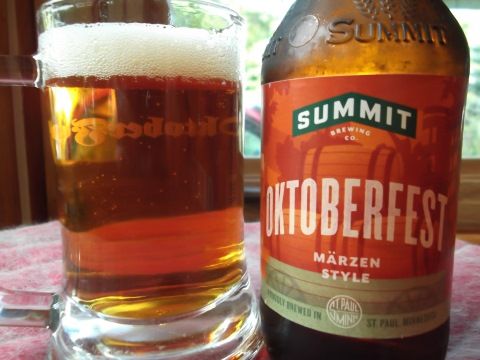
Thus Brewed Stutrud: Oktoberfest by Summit Brewing Company


It is now September so I feel more comfortable drinking Oktoberfests than I do when they appear on stores shelves in July. While singles shelves can be where beers go to die, this time of year they are cornucopias bursting with fresh Oktoberfests from far and wide. Well, there's no guarantee that the bottles from Munich haven't accumulated seniority but surely more local brews are still in the flush of youth.

After admitting my guilt a couple months ago when it comes to not giving our neighbors to the west, Summit Brewing, enough love, I jumped at the chance to try their Oktoberfest again. Besides, it had been a long time since I'd last had one.

While I have not done a large scale survey of American Oktoberfests, the anecdotal evidence I've accumulated thus far shows that they tend to be some shade of amber and have a range of sweetness that goes from "Oh, there's a bit of sweetness in there" to "I think I just got a cavity and developed diabetes to boot." My understanding is that, if you were to actually go to Munich and hit the bier tents during Oktoberfest, you'd be served a paler version of the brew known as Wiesn.

Regardless of your Oktoberfest's color, the key is the malt flavor. My preference is for a rich, decocted, Maillard reacted, toasty malt taste with sweetness kept to a minimum. I had some Spaten Oktoberfest recently and, while I am not qualified to determine whether it is the Platonic ideal of the style, it certainly fit the bill for me. American renditions of the style – the ones I've had, anyway – rarely achieve this Überflavor. This is not to say that American brewers who don't decoct cannot concoct a fine Festbier because they do, but rather that they tend to achieve a bready taste that lacks the toasty element to it that German brewers conjure so well.

Summit Oktoberfest pours a lovely amber that is crystal clear. My mini-stein, an Oktoberfest glass from some Kohler festival a few years back, got about ¾" of off-white foam which lasted about 30 seconds. Now, when I see photographs from Oktoberfest, I see a buxom blonde carrying litre steins that have about three times the head. Methinks I need pouring lessons. Anyway, a smattering of bubbles inside helped make this a mighty pretty bier.

The aroma represented perfectly the duality of the Oktoberfest – that Jungian thing, if you will. A lovely bread scent was predominant but there was also a honeyed sweetness there in the background. This boded well to my taste.

Oktoberfest was a bit sweeter than the aroma betrayed with some honey and dough-tasting sweetness but it was far from cloying. Atop this was a really tasty bread flavor. Summit decocts their Pilsener but I do not know if this bier was brewed using that method. The taste here is slightly chewy and like fresh bread as opposed to the more toasted taste of Maillard reacted nectar. The carbonation's firm hand kept the malt from running amok as did a spicy hoppiness that loomed over the proceedings in a very tasty manner.

Malt sweetness came to the fore on the finish but not for long. The Summit webpage indicates that Saaz hops are used here and you could really tell on the finish. Their characteristic sharp, mint-like spiciness rose to the occasion and cleared the sweetness out leaving a trail of bitterness and dryness in their wake. My glass began pretty and ended the same way with some really nice streaks of Schaumhaftvermoegen.

I really liked the bready malt flavor here. Unfortunately the taste found itself equaled and occasionally bested by sweetness. It's not that this is a cloyingly sweet bier, I just wish that the balance leaned a bit in the other direction. On the other hand, I really enjoyed the Saaz hops as they made for a nice departure from the normal hoppiness of a Festbier. The bier retains the Noble taste but kicks it up a notch for a little sumpin' sumpin' to keep the sweetness honest.

Junk food pairing: I enjoyed pretzel sticks smothered in garlic dip – the stuff you get at Corn Fest in Sun Prairie - with Oktoberfest.

07 September, 2016

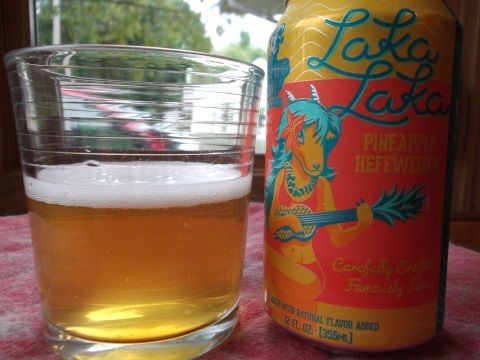
You Got Hala Kahiki in My Bier: Laka Laka by Horny Goat Brewing


I am embarrassed to admit that I didn't realize this was a Horny Goat beer until I took it out of the refrigerator to drink it. It was purchased in late July down in suburban Chicago as part of a mix'n'match set, although it was The Dulcinea that chose it. A pineapple hefeweizen sounded tasty and I just didn't take notice of the brewer as she put the can into the six pack holder.

Once I was aware that this was a Horny Goat brew, it occurred to me that I have not seen their beers around Madison in a while. Or at least I cannot recall doing so. Surely my eyes just wander past them and the brewery hasn't left the market.

Horny Goat was founded in 2008 in Milwaukee and is a brewery that hires other breweries to make their beers. My can indicates that they are City Brewing in La Crosse and the Stevens Point Brewery in – where else? - Stevens Point. However, the company opened a brewpub called the Horny Goat Hideaway in the Cream City but it closed last year. Presumably a period of retrenchment is over and now it's time to rebuild.

Laka Laka is, as I noted above, a pineapple hefeweizen and appears to be a summer seasonal. "Laka" is, according to Wikipedia, the name given to two different heroes in Hawaiian mythology while "laka laka", according to Urban Dictionary, means to have sex or to f*ck off. Presumably the former is being invoked here.

Laka Laka pours a medium yellow/light gold. Its slight haze did not prevent me from seeing a copious amount of bubbles inside. A small, loose, white head dissipated quickly. To be honest, I was not expecting this bier to be great but it sure got off to a nice start because it looked really nice.

Unsurprisingly, the aroma was heavy on the pineapple. It smelled like pineapple juice, actually. There was also a little bit of honey. Combined, they gave the bier a very sweet, though not overly cloying, scent.

The taste was similar with pineapple juice taking the lead. It was quite sweet but the generous carbonation helped take the edge off as did a hint of some spicy hops that were like a wallflower in the background. I struggled but was unable to taste any flavors that make a hefeweizen a hefeweizen. No banana, clove, or bubble gum.

For the finale, some of the sweetness stuck around and was joined by vanilla – the first sign that this was a weissbier – while the hops gained traction and came out to the dance floor. Bitterness was still retrained but the contrast was stark considering how sweet this bier is. Schaumhaftvermoegen consisted of a sizable group of spots towards the bottom of my glass.

I will admit that I liked Laka Laka but this is because it tasted like pineapple juice and pineapple juice is good stuff. On the other hand, I couldn't taste any wheat nor any of the fine flavors that the yeast produced such as banana or clove, excepting a dash of vanilla on the finish. All of that juice de-hefed the bier.

I don't want to deny hard pineapple juice a place in the pantheon of summer thirst quenchers but I ws expecting and hoping for more hefeweizen. If you add so much fruit or fruit juice to your beer so as to obscure the hallmarks of the style, is it still that style? I thought about this when I was drinking that mango Kölsch last month. With that bier, the light, delicate fruit flavors from the yeast were supplanted by a light, delicate dose of mango. Yet I liked it greatly.

Here I think the difference isn't simply that pineapple supplanted an estery taste here or a phenolic one there. It's that, excepting the hops, the tell-tale characteristics of beer were in absentia.

Junk food pairing: Go for the authentic Hawaiian experience and pair your Laka Laka with some Spam flavored macadamia nuts.

04 September, 2016

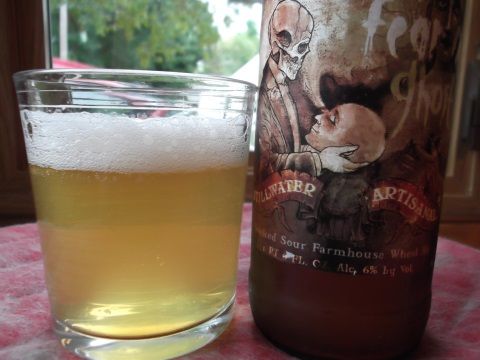
Don't Fear (The Smoke): Fear of Ghosts by Stillwater Artisanal Ales


While I knew that I'd encountered Stillwater Artisanal Ales previously, I had completely forgotten that my previous two run-ins were both collaborations and that Stillwater was a "gypsy" brewery.

And so this is my first solo Stillwater brew. Fear of Ghosts is a smoked sour farmhouse wheat ale and also quite a mouthful. Although folks of an agrarian bent around the world have been brewing ales for some time, "farmhouse ale" tends to refer to – here in America, anyway – a Franco-Belgian variety. Admittedly, this is not a style with which I am very familiar but O'so's Picnic Ants has slaked my summer thirst many times, although I have no idea how "authentic" it may be.

I tend to think of these beers as being wine-like in that they're on the dry side with fruity and spicy tastes courtesy of the yeast but lacking sweetness. Plus they have a little tartness as well. In this case I was drawn by the promise of smoke. It is, after all, the Summer of Rauch and the idea of a smoky saison was novel and intriguing. Fear of Ghosts debuted back in the spring.

The beer pours a light yellow and has an almost spectral haze in keeping with being a wheat ale. My glass had a big, firm, white head but it disappeared rather quickly. Inside there was a thriving colony of bubbles.

Juicy pineapple stuck out on the aroma which led me to believe that the beer had been dosed with nouveau American hops. The sour part of the style was lemony here while some earthy, resiny notes were a bit further back. I was struck by the absence of smokiness, sadly enough. This combined with West Coast pale ale flavors made for an inauspicious start.

On the first sip my tongue was greeted with a spookily large dose of lemon-tasting sour that let up some as I continued sipping but was always keen on reminding me that it was there. Those tropical fruit and pine/resin scents made a return appearance here. The tartness helped keep the beer dry tasting as did its attendant acidity and the solid carbonation. As it warmed, a little sweetness crept in, but just a touch, as did barnyard funk. I let the beer sit a bit longer and the funk got stronger as some grapefruit came through as well as a hint of the wheat. But no matter what I did, I could not discern any smoke.

Unsurprisingly the tartness lingered into the finish as did the nouveau hop flavors. However, there was not much bitterness to be had. There were a couple of small patches of foam left on the glass along with a smattering of spots.

Fear of Ghosts gets low marks from me for the phantom smoke flavor. My palate is not particularly discerning so it is possible that there was some smoke flavor in there. If there was any, it's likely that it was on display in the same sense the plans for the bypass that went through Arthur Dent's home were. And then there's the matter of those trendy pale ale hops that I tend to avoid. Truth be known, I liked the tropical fruit and resin tastes in this beer. They didn't try to steal the show like Kanye West at the MTV Awards and were content with joining the chorus of flavors instead.

I liked the beer's firm and consistent tartness as well as its brett funkiness which slowly gained strength but never overwhelmed. It has a pretty light body which went well with the dryness. This brew was really nice on a hot day, though it weighs in at 6% A.B.V.

Junk food pairing: Pair your Fear of Ghosts with some kind of lime-chili chip such as Takis Fuego chips. The lime tartness will complement the beer's sour and its citrus flavors.

03 September, 2016

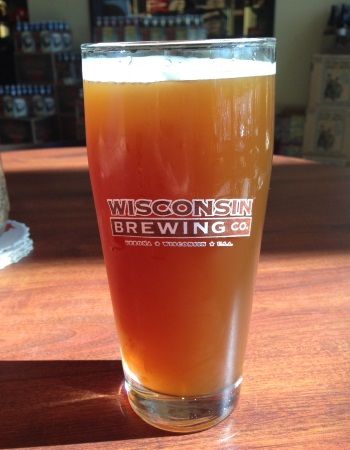
A Wondrous Hypotyposis: Smoked Dubbel by Wisconsin Brewing Company


Last week Wisconsin Brewing Company unveiled another brew in their Forward! Series. This time out it was a Belgian dubbel, a smoked dubbel, no less. With the Summer of Rauch 2016 having precious few weeks left, The Dulcinea and I headed out to Verona to give the beer a taste.

The last time I reviewed an entry from the Forward! Series I found myself wondering who brewed these beers. Was it brewmaster Kirby or was it his minions? The veil was lifted last week as it was revealed that Smoked Dubbel was brewed by a production intern named Adam.

The beers of Belgium are certainly ones that require more of my attention and that of my mouth. It's not that I don't enjoy them, it's that, well, I've been neglectful. While I've read a tad about Belgian beers, I am probably on par with a proctologist's knowledge of the human heart. I know they're out there and I am happy for it. I just don't know a whole helluva lot about them.

As a style, the dubbel is apparently a Trappist ale or abbey ale, if you don't happen to be a Trappist monastery. "Trappist ale" is a legally protected appellation like "Kölsch" or the letter M printed in yellow and is produced by just 11 breweries around the world. As someone who enjoys medieval European history, I revel in the thought that contemporary monks are following in the footsteps of their forebears of many centuries ago. For my part, when drinking one of these beer I like to envision myself as a monk – think Remigio from Name of the Rose - having a quick pick-me-up before starting my shift at the scriptorium. It's like drinking history.

A small, white head that was very loose disappeared quickly leaving me with a glass full of a light copper color that had perhaps a very modest red tint. It was very cloudy and I didn't see much in the way of effervescence. I'm not sure if the beer should be clear or not. I tend to think of these brews as at least having yeast remaining in them so I wouldn't be surprised if clarity isn't an issue.

I had to do a double-take with the aroma. It was very sweet with caramel but also had a big banana scent which was joined by bubble gum. Now, I know dubbels should taste fruity but I didn't think that they resembled a Weißbier so closely. I was just expecting some raisin to be in there too.

The first thing that struck me upon tasting the beer was the lack of carbonation which no doubt contributed to the very smooth feel on my tongue. While the banana made a return engagement, it was accompanied by stone fruit – think plum & apricot – and topped off with some caramel sweetness. The precious smoke was moderate at first and then quickly faded into the background to become a pleasant accent to the fruity flavors.

That banana taste lingered at the end along with some of the sweetness as some grassy hops made their presence known. While they didn't give a lot of bitterness or dryness, it was just enough to overcome the fruity sweetness for a nice contrast. There was no lacing left on my glass.

While I certainly wouldn't have complained about this beer having more smokiness to it, I enjoyed its subtle support of all the fruity esters and phenols and whatever other chemicals the yeast produced. This was cherry wood smoked malt which sounds like the perfect fit for this style. If you've ever had Karben4's NightCall, think that level of smoke. Although Smoked Dubbel had a lot of nice flavors, it was thin-tasting. I expected a much richer malt flavor as well as a fuller body than I got.

I give Adam credit for conceiving this beer but it just didn't come off correctly, to my taste. Hopefully he'll try again because a smoked dubbel sounds like a perfect autumnal alternative to "pumpkin beers".

Junk food pairing: Since Smoked Dubbel is only available at the brewery, pack your picnic basket with some Fig Newtons and Andy Capp's Cheddar Fries.

31 August, 2016

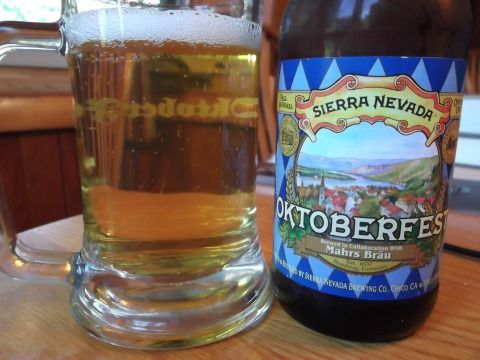
Just Say Ja to Oktoberfest: Oktoberfest by Sierra Nevada and Mahrs Bräu


You know it's July when American Oktoberfests hit store shelves. I managed to refrain from buying any until late August this year because, well, that's just how it should be.

Pretty much everyone and their mother brews an Oktoberfest here in Wisconsin these days. Lake Louie brewed their first one this year. Ale Asylum decided to finally bottle a lager this year and that lager was an Oktoberfest, Oktillion. It's surely the most resilient vestige of the state's German brewing heritage which has laregely been cast to the wayside in large measure to accommodate hoppier eyepahs and the style's attendant off-shoots. Breweries that specialize in ales even find the time to do a little lagering during the summer.

Surprisingly, to me anyway, is that Wisconsin brewers have largely avoided tinkering with the style. Milwaukee Brewing Company's Hoptoberfest, an aggressively hoppy take on the style, springs to mind as an exception. But I have yet to see Oktoberfests blitzkrieged by brettanomyces or assaulted by Citra. I am sure that there are more modifications of the styles out there than just Milwaukee Brewing's, but I don't see them. Perhaps they're at taprooms and brewpubs. Or I am oblivious to them.

My guess is that my intro to the Oktoberfest was Capital's. In fact, I think Capital tutored me in seasonal beers. And I recall when New Glarus introduced their Oktoberfest, Staghorn. It was love at first sip.

While those two beers will always be part of my late summer/autumnal drinking ritual and have special places in my heart and liver, I have to be honest and say that the Oktoberfest that I was looking forward most anxiously was Sierra Nevada's.

Last year the venerable California outfit decided to "explor[e] the roots of Germany’s famous Oktoberfest beers" by partnering with a different German brewery to produce a version of the style. The first collaboration was with Brauhaus Riegele and the resulting bier was simply fantastic. This year Sierra Nevada teamed with Bamberg's Mahrs Bräu.

Oktoberfest pours a medium yellow/light gold color which puts it in the wiesn or pale Märzen camp. From my experience, Wisconsin Oktoberfests are amber. But, from what I've read, the paler variety is what you will be served in Munich at the Oktoberfest. It was clear which made for a very pretty sight as did the loose, white head that formed atop my bier. The foam went away fairly quickly. However, there was a goodly amount of bubbles inside.

Taking my first sniff of the bier reminded me why it only took one brew last year to make it eagerly anticipated this year: bread. That lovely bread smell. There was a little honeyed sweetness, but not much. This year Sierra Nevada is advertising the use of a rare variety of Belgian hops called Record. As far as I know, this was my first encounter with them. My nose caught some grassy hoppiness but I am not sure if that was Record or not.

Just like last year's Oktoberfest, the new iteration was like a bakery in a bottle, steeped in Maillard toastiness. Simply wonderful. It was complemented by some less toasty and more yeasty bread flavor, a touch of doughy sweetness, and a very healthy dose of hops which were both spicy and herbal tasting. Was this the Record hops?

The plethora of malty mannas faded on the finish allowing a zesty, spicier hop taste to take center stage where it offered up a firm bitterness and dryness. Alas, Schaumhaftvermoegen was absent.

Ausgezeichnet! Sierra Nevada and Mahrs Bräu have created a great Oktoberfest full of the Maillard toastiness that I love. But they've also tweaked tradition by giving the bier a heftier hoppiness. Not content with that, the two breweries made sure that the hops would be of a different character at each step: grassy to my nose, herbal/spicy to the taste, and then an almost citrusy Saaz flavor at the end. Just marvelous.

The bier is 6% A.B.V. and has a light-medium body which will go very well over the next few days as temperature cools down into the low 70s.

Junk food pairing: Pair this year's Sierra Nevada-Mahrs Bräu Oktoberfest with pork rinds or some Cheetos White Cheddar Puffs. To satisfy a sweet tooth, heat up a Pillsbury Apple Toaster Strudel.

30 August, 2016

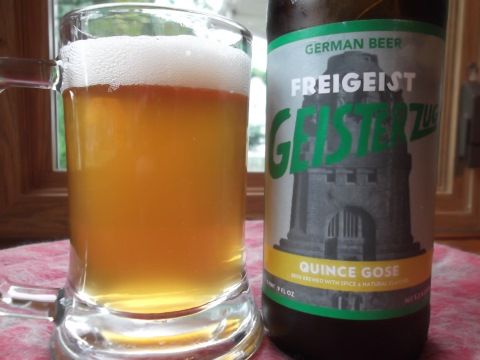
I Dined on Mince and Gose of Quince: Geisterzug Quince Gose by Freigeist Bierkultur


Another bier from Freigeist!

I have previously enjoyed Sebastian Sauer's spruced gose as well as one laced with rhubarb. He takes a – how shall I phrase it? - German approach to brewing gose. Rather than upping the sour to levels that would corrode metal or extreme doses of other flavors, Sauer retains the spirit of, in his words, "the classic, very balanced and nuanced beer" that is the traditional German gose. However, as you can see, he is happy to ignore any "purity" laws that would prevent him from using fruit or other flora.

This time around I have Sauer's Geisterzug Quince Gose. From what I've read, the quince is native to central Asia but gained popularity in the West during the Middle Ages. I gained a taste for it when I came across a Renaissance era recipe for quince marmalade and made it in my kitchen. Apparently it was fairly common here in America back in the day but now it seems to be more of a specialty/"ethnic" item. I don't believe that I have ever seen a quince for sale in Madison. Indeed, the fruit is so rare in these parts that even quince & apple, a local purveyor of preserves, offers none of the former. But quince's profile may very well have changed over the past several years as more ethnic grocery stores have opened.

Geisterzug Quince Gose is a lovely light gold color and hazy. My pour yielded a nice, frothy head. The white crown decided to stick around for a little while which made for a pretty sight as did a fair helping of bubbles inside.

The philosophy of brewing balance was apparent with the aroma. Lemony lactic sour came first. It was, however, not deathly pungent and found itself on equal footing with that wonderful floral apple-pear fragrance of the quince. My nose also discovered a slight sweetness here too.

Gentle carbonation joined a measured citrus flavored tartness making for a firm, but not overpowering, acidic tang. Again, balance is the key with the quince complementing the sour in strength while its floral fruity sweetness made for a nice contrast to the sharper citrus tartness. I also tasted a mellow spiciness which may have been coriander.

My sips finished with the quince fading and the tang filling the void. The salinity became apparent here as well. Lastly, my mouth was left with a mild fizzy acidic feel. Schaumhaftvermoegen came as a clutch of thin foamy streaks as well a smattering of spots.

Another fine brew from Freigeist. I suppose that going in with a taste for quince went a long way in predisposing me to enjoy this bier. Beyond that, however, I appreciate Sebastian Sauer's application of balance which allows sour to co-exist with sweet in harmony allowing each its place in the sun. As the bier warms the quince comes ever forward yet you never forget that you're drinking a sour bier. The balance, the light body, and the relatively moderate 5.2% A.B.V. all add up to an excellent brew.

Junk food pairing: Pair Geisterzug Quince Gose with lighter fare such as plain potato chips or, because we're talking German bier making pork almost mandatory, plain pork rinds.

29 August, 2016

A Berliner in Verona: Berliner Weisse by Wisconsin Brewing Company


This past Wednesday the Wisconsin Brewing Company loosed a small batch of Berliner Weisse into the wild as part of their Forward! series. My understanding is that these brews are released and then feedback is solicited with the possibility that one of these test brews may make it to the big time and hit store shelves and tavern taps.

I am not sure who brews these beers and wouldn't be at all surprised if they are made by brewmaster Kirby Nelson's minions. Just look at WBC's partnershipwith the UW-Madison's College of Agricultural and Life Sciences and the fact that Blister in the Sun was concocted by the minion known as Clint Lohman. The brewery has a reputation for working with people new to the trade and allowing them to show off their chops.

The Forward! series has come up with a few beers these past two or three months that have interested me and this trend looks to continue into over the coming weeks. And so once more unto the breach…

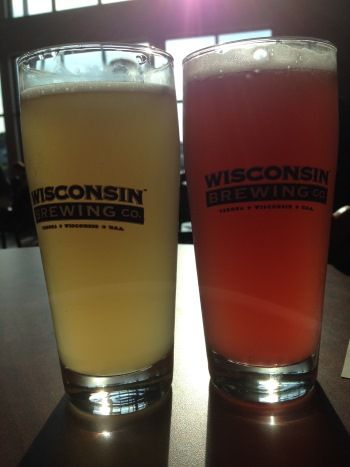
Berliner Weisse poured a light yellow hue and was quite cloudy. There was about an inch of loose, white foam atop the glass that lasted just shy of a minute. There was a fair number of bubbles in the bier but not exactly what one would expect from the "Champagne of the North".

The aroma was puzzling because there wasn't much of one beyond a very faint citrus smell from the lactic sour. I encountered this same phenomenon last month with WBC's Czech pils that was devoid of scent just like Jean-Baptiste Grenouille. Perhaps there is some kind of olfactory quirk at play here. Breweries smell like, well, breweries – they smell like malt in hot water. Maybe one's nose becomes desensitized to certain beer smells if you are standing in a room with the aromas of the brewing process swirling and eddying around you. Still, I would think that hops and lactic acid smells would still be discernible even if more delicate malty ones were not. Do the Germans have a lengthy word for this kind of thing?

Upon tasting I noticed that there wasn't a whole lot of carbonation. Not too surprising given the relative paucity of bubbles. The tartness was middle of the road, although I don't mean that in a pejorative sense as when discussing rock music. There was some lemony citrus taste to the sour and I was surprised at how full the wheat flavor was.

At the finish the taste of the wheat lingered along with a mild lactic tartness. There was no Schaumhaftvermoegen.

While it may not rank with the greatest Berliner Weisses ever made, this bier was pretty tasty. It wasn't mega-knock-your-socks-off tart but neither was the sour so faint as to approach homeopathic strength. My preference is for a tad more tartness but I cannot complain as it had a nice, mildly acidic taste. However I will complain that the bier was short on citrus. I wish it had a little more of that lacto-lemon flavor. Oh, and more carbonation too. On the other hand, I enjoyed the wheat flavor quite a bit.

Whatever the flaws, it still made for a tasty and refreshing on a hot summer day. It comes in at 3.8% A.B.V., by the way, and the brewery has raspberry and woodruff syrups available for those wanting a shot of sweetness.

Junk food pairing: I thoroughly enjoyed the jalapeño white cheddar popcorn we had while quaffing our Berliner Weisses. The salt enhanced the sour which was complemented by the mild chili flavor.

28 August, 2016

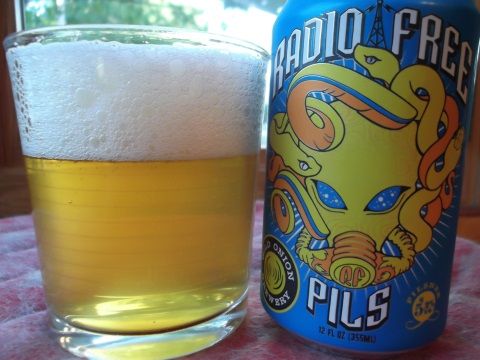
A Pils Fit For Perseus: Radio Free Pils by Wild Onion Brewery


Wild Onion's Radio Free Pils is so new that the brewery's website doesn't even have a page dedicated to it. Wild Onion Brewery, on the other hand, is celebrating its 20th anniversary this year. Although its name refers to the city of Chicago, "Chicago" being a corruption of the Potawatomi phrase for wild onions, the brewery is located firmly out in the far northwest suburb/exurb of Lake Barrington.

I don't know that I've ever had a Wild Onion brew before but I have a feeling that I have. Somewhere, somehow. But I feel confident in saying that I've never bought any of their bottles or cans before. This is likely due to me seeing their eyepahs and stouts on the shelf. No offense to Wild Onion but why go to Chicagoland to get those beers when I can get 5 Rabbit's Latin American-inspired cervezas, Off Color's off kilter brews, Metropolitan's wonderful lagers, and the only rye Märzen I've ever encountered.

Last month I just happened to be at a Chicagoland liquor store (ahem) and stumbled upon Wild Onion's Radio Free Pils. I wasn't sure what the medusa with scuba mask artwork meant, but it looked pretty cool and certainly caught my eye. And it was a pils instead of an eyepah. I will admit, though, that I was a bit hesitant and only bought a single can. The reasons were twofold. First that the Wild Onion is primarily an ale brewery, from what I can tell, and brewing a pils seemed like a bit of bandwagon jumping to me, truth be told. And secondly there is a trend, however small, of American brewers releasing a pils when its actually an American Pils Nouveau. I am expecting Noble hop flavor and instead get an orchard's worth of trendy tropical fruit.

Radio Free poured a dark straw color and was, oddly enough, slightly hazy. (Was this a newfangled New England style pils?) I got a big, white, creamy head that, sadly, disappeared at a good clip. There were bubbles aplenty inside which made me wish I had a pilsner glass at the ready. Except for the haze, Radio Free seemed to be quite pilsnery – in appearance, anyway.

Upon smelling the beer a wave of relief washed over me. I could not detect any fruit. Well, no fruity hops, that is. Instead I was treated to a rush of fresh grass. It was wonderful. There was also a touch of black pepper as well as some biscuit. Oh, and some sweetish orange which didn't come across as hoppy to me but rather like an olfactory illusion manufactured by some malt sweetness and the Noble hops. If that makes any sense.

The taste had a solid biscuity backbone that came with a bit of dough. That great grassy hop aroma came through here too and was just fresh and summery and oh so good. A mild citrus hoppiness was present too but this was the dry Noble kind, not the juicy American variety. Surprisingly, the beer wasn't as fizzy as I thought it would be, treating my tongue to a fairly moderate amount of carbonation.

Malt fades quickly on the finish leaving the hops to their own devices. In this case they brought a fairly substantial spicy-black pepper flavor along with a not insignificant amount of bitterness making for a dry denouement. A few large patches of foam lined my glass along with a cornucopia of spots.

Despite being on the singles shelf where beer, in the words of Off Color's John Laffler, go to die, my can of Radio Free Pils tasted fresh. It seems that the brew was introduced in June/July so it didn't have enough time to go south. And that's a good thing because the big – almost zesty – smell and taste of fresh grass from the hops here was superb. We're talking Platonic ideal of pils goodness. Even better, this taste of flora went to the cotillion with spicier tasting hops and some dry, citrus flavor and did a little dance and made a little love in a lupulin ménage à trois.

I also appreciated that the malt, although not big, made its presence known with a fine biscuit flavor tinged with sweetness. The beer's body was light but fuller than other pilsners that have a smaller malt component. Radio Free Pils is 5.2% A.B.V. and can be a fine thirst quencher on a hot day but, really, this is a sippin' pils. Don't chug it to beat the heat; savor every sip instead.

Junk food pairing: Radio Free is not a delicate little flower but nor is it a big, burly brew. Try some thick potato chips with generous dollops of dip. Onion is fine but don't shy away from bacon & horseradish.

24 August, 2016

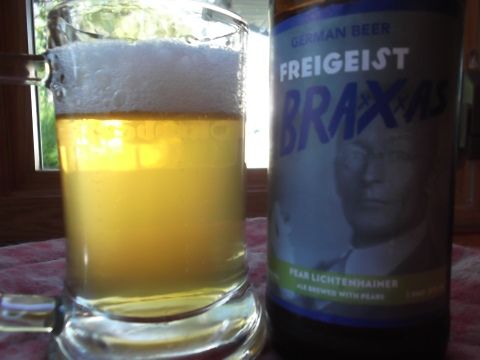
This Bier Belongs to the Realm of Light and Righteousness: Pear Abraxxxas by Freigeist Bierkultur


American microbrewers have yet to embrace the Lichtenhainer the way it has its cousins, the Gose and Berliner Weisse and I don't see this changing in the near future. Sour is acceptable – indeed, it is trendy. Smoke, however, is not.

As I noted when I reviewed the non-fruited version of this bier, its name comes from the central German town of Lichtenhain and was popular back in the day. The Lichtenhainer is a light, sour bier just like the Gose and Berliner Weisse but also smoky like the Grodziskie/Grätzer. The best of both worlds!

Freigeist Bierkultur seems the obvious choice to resurrect this near-extinct German bier style. Proprietor Sebastian Sauer obviously has a keen interest in his country's brewing history as he does his best to nurse historical styles that are on life support back to health. And he often does so thumbing his nose at any brewing regulations that seek to restrict the ingredients he can put in his biers.

I'm not sure exactly what regulations he flaunts because the more I read about German brewing laws, the more confused I get. It seems that the infamous Reinheitsgebot underwent some changes when Germany was reunited in 1990 and also that brewing laws vary by state. Unsurprisingly, I get the distinct impression that Bavaria's laws are the most restrictive. Witness Camba Bavaria beset by the Bavarian government who didn't take kindly to the use of lactose in their milk stout.

My bottle says that the bier therein was brewed at Eittinger Fischerbrau in Eitting, Germany. I looked up Eitting and discovered that it is located in Bavaria. I guess Sauer was trying to hide in plain sight. He must have had to barricade himself inside the brewery against the Brauereigendarmerie when he unleashed his Mango Gose Eisbock.

What we have here is Abraxxxas with pear. Coming in at 6% A.B.V. Abraxxxas is the big brother to Abraxas which is a shade lighter at 3.8%. Swiss-German author Hermann Heese adorns the label as he apparently referenced the gnostic deity Abraxas in at least one of his novels. (I don't recall any mention of god in Demian.)

The bier pours a light straw color and has a slight haze. Historically some brewers used wheat in their Lichtenhainers while others did not. Freigeist apparently has. The big, white, frothy head did not last long but there was plenty of effervescence as the plentiful bubbles in the bier attested.

That luscious temptress that is smoke made her presence known in the aroma. Not a deluge, but more than a simple tchotchke. The sour seemed to be lactic as there was a bit of citrus sour here too. The pear was on the faint side and was joined by vinous/tea-like smell.

All of those bubbles added up to a healthy carbonation. Lady Smoke was big and bold on my first sip but she mellowed as I continued to taste her. She has that rich, savory smoke taste which leads me to believe that we have beech wood smoked malt in Abraxxxas. The sour which was fairly prominent to my nose was on the mild side to my tongue, although it had a nice citrus taste. At first the pear was faint but there if you looked for it and it gave a nice bit of sweetness. However, as the bier warmed, the fruitiness gave up wallflower status came out to dance. Mind you, we're not talking Ballast Point levels of fruit but I didn't have to look for it.

At the finish the smoke faded but the tartness remained to greet a goodly dose of spicy hops which added some bitterness and made things rather dry. I also detected some salinity which I didn't expect as there was none in the non-fruited Abraxxxas. Schaumhaftvermoegen was notable by its absence.

The pear and the smoke reminded me of that tasty dish Bohnen, Birnen und Speck, auf Hamburger Art (Beans, Pears and Bacon, Hamburg Style) while the pear and spicy hops hinted at a saison. It is best to let pear Abraxxxas warm before quaffing as it brings out the pear flavor and sweetness and gives you this wonderful gestalt of smoke, sour, and sweet. The moderately sharp and acidic feel really helped give this bier a slightly dry, wine-like taste which was thoroughly unexpected and quite tasty.

Junk food pairing: Go with a bag of Steakhouse Funyuns with your pear Abraxxxas. The steakhouse part will add some complementary smoke flavor while the mild onion-esque taste enters into a synergistic relationship with the pear that results in gustatory delight.

23 August, 2016

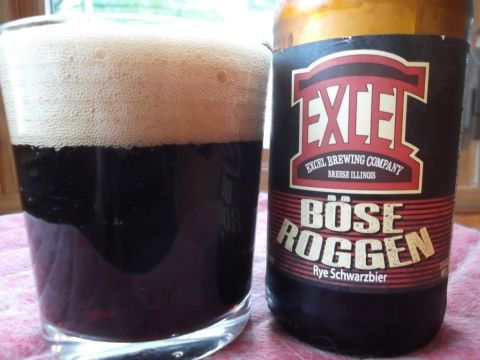
The Evil Rye: Böse Roggen by Excel Brewing Company


It is a testament to my tenure in IT that whenever I see this bier bottle, I don't think of doing well at some endeavor but rather of spreadsheets and green Xs. Excel the brewery is an adjunct (pun intended) of the Excel Bottling Company in Breese, Illinois. Breese is downstate, east of St. Louis, in the land that gave us Uncle Tupelo.

The brewing operation began in 2012 and Excel completely revamped its line-up in 2014. The bier at hand, Böse Roggen (German for "evil rye"), was a result of the changes. The special insight that rye and dark lagers are match made im Himmel is apparently unique to Illinois as the only other instance I know of this spectacular combination is Arc Welder by Chicago's Metropolitan Brewing.

Excel began distributing to the Chicago area about a year ago, it seems, and I picked up my six pack three weeks ago out in the burbs.

Böse Roggen appears to be totally black until you hold it at an angle to the light where you can see that it's really a very deep reddish brown. My best guess is that it was clear but I can neither confirm nor deny that one. While I have a thing for bright, pale beers with big, fluffy white heads in the summertime, this one had a big, loose tan head that lasted a fair while and radiated its own dark aestival beauty.

The Excel webpage notes that Böse Roggen is made up of 50% rye which is a combination of rye malt and chocolate rye malt. The more I think about chocolate rye malt, the more I think it should be designated a UNESCO World Heritage Food or perhaps be mentioned on those gold discs we affix to interstellar probes to demonstrate to the aliens out there that we come in peace and that at least some of us are epicureans.

Getting back to the bier, my nose beheld all that rye. You could smell its spiciness. But there was also the chocolate part of the equation with roasted grain, bitter chocolate, and coffee in equal parts to the rye making for a complex yet balanced aroma.

And that wonderful, earthy spiciness came through quite well to my tongue. Joining it were the requisite Schwarzbier tastes of coffee and chocolate, the latter being less bitter here than on the nose. The carbonation was pretty mild as was a grassy hop flavor. Overall a nice, clean lager taste with an emphasis on rye and dark malts.

All of those dreamy malt flavors dissolved into a hoppy finish that was a bit on the peppery side. This made things rather dry - not Bohemian pilsener territory but rather dry nonetheless. There was some Schaumhaftvermoegen with a couple decently-sized patches as the odd speck of foam.

Ausgezeichnet! The big dose of rye pays off here, to my taste, with the grain's prominent spiciness being a real treat to both my nose and tongue. As a fan of dark biers, I loved the schwarzbier base with its rich coffee and dark chocolate flavors that the chocolate rye malt added. And being a schwarzbier also means that Böse Roggen has a fairly light body and a clean, crisp lager taste. (It comes in a 4.8% A.B.V.) Rye and dark malts are two of my favorite ingredients and so this bier was like winning the lottery for me. The only problem with Böse Roggen is that I've got to cross state lines to get my hands on it.

Junk food pairing: For a sweet indulgence, pair Böse Roggen with some Dark Chocolate Crunch Pretzel Crisps and let the chocolate melt into the dark roasted flavors of the bier. On the savory side grab a bag of smoked gouda potato chips. The creamy cheesiness complements the bier's smooth taste while the smoke does the same with the rye and roasted grain.

22 August, 2016

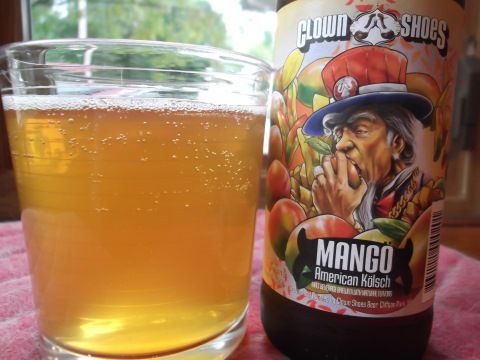
I meet Raquel Welch. I buy a nice mango American Kölsch.: Mangö by Clown Shoes Beer


This being my first encounter with a brew by Clown Shoes I sought out some info about them on the Internet. I discovered that all of their beers are contract brewed – as is Heady Topper. Clown Shoes began back in 2009 when Gregg Berman, then a wine distributor, decided to start a career in the glamorous brewing industry. He contracted with Mercury Brewing in Ipswich, Massachusetts and seems to be with them today.

The article I found noted "In fact, some of the most sought after brands like Heady Topper and Clown Shoes are widely known to be contract brewed." Not only did I not know that Clown Shoes was contract brewed but I was also blissfully unaware that their beer was amongst the most sought after. (I guess in Rumsfeldian language this was an unknown known. Or would that be a known unknown?) I suppose I read an element of rarity into "sought after" although I suppose that is not necessarily so. One could understand that sense of being hard to get if Clown Shoes was only distributed in areas that have place names out of H.P. Lovecraft stories. But I can buy it here in Madison so it cannot be scarce in the same way I understand Heady Topper to be.

Truth be known, I tend to think of Clown Shoes as the brewery that made Tramp Stamp and features brown-skinned women in various states of undress on their labels. (On the other hand, I do not recall a blonde ale with a skinny, blond woman in a bikini on the label.) This is perhaps unfair but they created labels to catch my attention and succeeded. Yet another pale ale, however, failed to catch my interest. It was, I believe, back in the spring that I heard about Mangö, Clown Shoes' mango American Kölsch and this did, however, catch my interest.

Clown Shoes has some distribution here in Madison but I have never seen Mangö in these parts. Instead I found it in suburban Chicago. It is billed as an "American Kölsch" but I am not sure what this means. Perhaps they just didn't want to slap "Kölsch-style" on the label.

Regardless, Mangö pours an inviting light gold color. It was hazy which makes me wonder if American Kölsches have wheat in them. My guess is that the very small white head that my pour begat would have been larger had I been using a stange. Alas, mine remain unpacked. The foam proved fleeting although the beer was quite effervescent with all kinds of bubbles inside.

The aroma featured the dual attack of the titular fruit as well as some cracker. The mango was up front, though not super pungent, while the grain came around the back in a pincer movement.

My guess was that the light berry-like taste of a traditional Kölsch (from the yeast) would be overpowered by the assault of the tropical fruit. While the customary fruity taste was indeed M.I.A., the mango's assault was really more like an extrovert at a meeting of Marcel Marceau Appreciation Society. It was never a cloying onrush but rather stood out because of the company. Still, the beer's clean, crisp taste come through. There was a light grain taste as the base and some grassy tasting hops that added contrast to the mango.

The M ingredients faded at the finish allowing those hops to take over. Everything about Mangö is an exercise in restraint so we're not talking a big hoppy blast but certainly enough for satisfyingly dry finish.

From what I can tell Mangö was introduced last year and I'm sorry I never stumbled upon it sooner because this is one tasty brew. A fellow from ancient Greece once opined "everything in moderation" and Clown Shoes have taken this to heart. This is simply a nice, light brew with a slight emphasis on the mango that doesn't drown out the tasty, light grain and hop flavors.

I know crafty brewers want me quaffing their Oktoberfests but I am still in the mood for beers like this.

Junk food pairing: Mangö's core philosophy is one of moderation/restraint and this should carry into your food pairing. Get some El Rey lemon flavored Tostaditas Chips. They are thin, light, and crispy. On the other hand, you can throw convention out the windows and double down on the fruit with mango snack cakes. Check your local Asian grocery store for these.

19 August, 2016

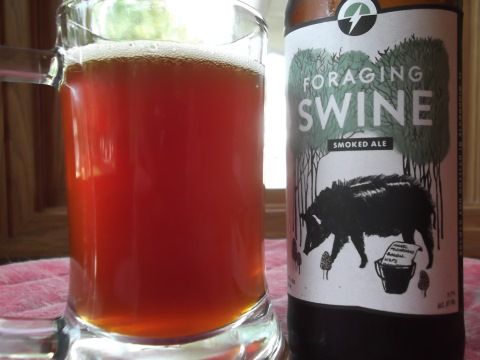
I want all my rauchmonbozia (smoky goodness): Foraging Swine by Scorched Earth Brewing


We return to northern Illinois after having gotten a taste of summer there earlier this week courtesy of Scorched Earth, which harbors at least one Twin Peaks fan I have discovered. Today we move onto autumn(?!) with their fall seasonal, Foraging Swine smoked ale.

If you look at the list of beers at Scorched Earth's website, you'll see that they categorize them. Hoppy beers are in "Hop Head Central" while Belgian styles fall under "Belgian Goodness". Most of the German bier styles are put into the "Cavemen" category. So far, so good. But soon the taxonomic wizard who came up with the clever names goes off the rails. Foraging Swine is the lone denizen of "Crazy Town". There's nothing deranged about being cuckoo for barley malted by smoky puffs. Indeed, you'd have to have a screw loose not to enjoy it.

Scorched Earth's website neglects to specify ingredients and they have yet to answer my inquiry** as to the type of wood used to smoke the malt here. But with the swine on the label and all the talk about pork in the description, I'll hazard a guess that it was beech wood. While the image of the boar rooting around for morel mushrooms as a foraging list sits in a nearby bucket is all pastoral and amusing, it does reinforce the stereotype of smoke beer all tasting like bacon which they do not.

Foraging Swine pours a lovely autumnal deep amber. It was a bit hazy which was odd. Perhaps there's some wheat in there. A quarter inch tan head dissipated rather quickly although the beer was laced with a goodly number of bubbles. The beer sure looked pretty and was a picture of fall with that deep amber color. (He writes on a summer day projected to be in the high 80s.)

Ooh la la! Foraging Swine has a big, firm smoky aroma and, after smelling it, my conviction that the beer has beech wood smoked malt was strengthened. Not being a chemist nor particularly well-versed in the smells imparted by burning wood, the best way I can describe it is as being smoky and spicy whereas cherry wood produces a sweeter, fruitier smoke flavor. There was sweetness there, though, from the unsmoked malts with honey and stone fruit aplenty. Tucked into the background was a little tea as well, though it was herbal smelling and not astringent.

My tongue did a little dance upon tasting the beer. The brewmaster did not shortchange it in the smoke department as it had a sizable beech woody taste. We're talking Schlenkerla territory here. Ausgezeichnet! Overall Foraging Swine had a pretty clean taste. There was some malty stone fruit sweetness which really came forward as the beer warmed but I couldn't taste anything from the yeast. Some moderate grassy hops helped take a little of the malty edge off.

The smoke lingered in my mouth just as I hoped it would. Those hops, however, had their own designs on my tongue and so they built up a nice black pepper taste and a fair amount of bitterness on the finish which ended up being pretty dry. There was no lacing to be found.

Good stuff, Maynard! Considering the smoke beer's poor reputation, I was quite pleased that Scorched Earth not only brewed one but brewed one with a fairly intense smoke flavor. It's the main attraction here and not a side show. But don't be fooled by the label and the beer's description. This beer does not taste like bacon. While the malts dominate here and make for a medium body, I thoroughly enjoyed how the hops went from grass to pepper and made for a dry, spicy finish. A wonderful contrast to all of the grainy goodness.

A great beer but I'm going to let the rest of my four pack age a spell. Foraging Swine is Scorched Earth's fall seasonal but it comes in at 7.7% A.B.V. and we're still in a sweltering summer.

Junk food pairing: Pair Foraging Swine with Lay's Brazilian Picanha potato chips. They have a hearty grilled beef flavor to them that just goes well with the beer's smoke.

** - my inquiry was eventually given an answer: yes, it is beech wood smoked malt here.

18 August, 2016

Diane, if you ever go to Algonquin, that Gose is worth a stop: Sweetie Pie by Scorched Earth Brewing Company


On a recent trip to Chicagoland The Dulcinea and I stopped in at a liquor store on our way out into the exurbs. My intention was to grab a six pack or two of brews unavailable here in Madison, especially Hoss which, sadly, has been demoted from year-round to seasonal. While I saw no Hoss, I did end up bringing home quite a bit more beer than I had planned.

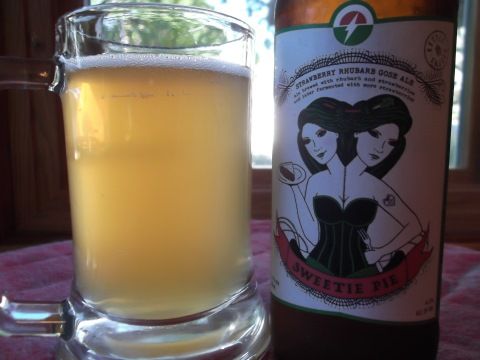
One of those brews was Sweetie Pie, a strawberry rhubarb gose from Scorched Earth Brewing. While I'd heard of and a bit about Scorched Earth, this was the first time I can recall encountering their beers. I think that at least part of the reason is that they don't distribute widely in the city. Chicagoland is very large, after all. They are out in Algonquin, which is a northwest suburb/exurb.

This was my second strawberry rhubarb beer with the first being New Glarus' Strawberry Rhubarb. While the brew from Little Switzerland is a wild ale, Scorched Earth's is a kettle soured gose. The same fruits being taken in similar yet different directions. Sweetie Pie, being a gose, has had salt added. In this case it is pink Himalayan sea salt. Beyond the normal NaCl qualities, I do not know what the blushing mineral has going for it.

Sweetie Pie is bright yellow. It was also quite hazy which surely is the because of the wheat in the bier. Goses are traditionally made of 50%+ wheat although I don't know the percentage here. The ¾" head on my glass was soda-like with bubbles jostling for attention when they weren't popping rather loudly. There was also a fair number of bubbles below the surface. Overall quite pretty, though I'd have like the head to have stuck around a bit longer.

The aroma was pleasantly fruity. First there was the sharp, lemony smell of the lactic acid which was followed by sweet, aromatic strawberry. The citrus was fairly strong while the strawberry was just a RCH less pungent.

On my first sip my tongue felt like German Sixth Army in 1942 as it was routed by a blast of lactic tartness. Contrary to the aroma, it didn't taste particularly lemony. The sour lessened on subsequent sips and my tongue recovered to taste that the rhubarb adds its own tartness which was not as sharp as the lactic variety. The strawberry was fairly sweet but not overwhelming and made for a tasty contrast. The wheat stood out and was joined by some more of a barleyed grain flavor. Just as the label boasts, the grains bear more than a passing resemblance to the crust of a pie. The lactic acid and carbonation combined to give the bier a nice bite and and overall acidulous taste. I couldn't really taste the salt as a distinct flavor but it added a fullness to the flavor and likely helped the wheat stand out.

The tartness lingered on the finish along with some of that wheat flavor. The latter I think was helped out again by the salt which became more apparent. Ixnay on the Schaumhaftvermoegenscray.

This is a very fine bier. After the initial salvo of sour, it mellowed a bit and found the perfect middle ground. (I only wish there was more of a citrus flavor to the sour.) While the strawberry was only able to temper the tartness a small amount, it's a testament to the brewers at Scorched Earth that it still stood out in its own right instead of bowing completely to the sourness. The whole sweet and sour dichotomy, the Jungian thing, if you will, was darn near perfect here. And they put just the right amount of salt in. It enhanced the flavor overall and left just a hint of salinity at the end for a unique finish.

It's like having the month of June in a glass.

Junk food pairing: I like to really savor the fruit and veg in this bier and so avoid big, bold flavors in accompanying food. Try some plain old potato chips. If you must have added flavoring, keep it mellow with something like sour cream and cheddar.

17 August, 2016

The duality of beer. The Jungian thing.: Rauch Pils by Mikkeller

>

Wowzers! It appears that this is my first Mikkeller beer. That's odd.

Mikkeller, it says here, was formed in 2006 by friends Mikkel Borg Bjergsø and Kristian Klarup Keller in Copenhagen. They built upon their homebrewing obsession and took inspiration from American microbrews. Keller would bow out after a short time leaving Bjergsø alone as the brewery's mastermind.

Mikkeller is a "gypsy brewery" meaning the company does not own a brewing facility, although that is apparently changing. Ergo Bjergsø trots the globe and makes his beers at other folks' breweries. Whatever you may think of the practice, it seems to have served him and Mikkeller well.

Although I've apparently never had a Mikkeller beer before, they do stick out in my mind because of the sheer numbers of beers I see by them. In 2013 they made 124 brews. Novelty is Mikkeller's stock and trade, I guess.

I don't have an explanation as to why it's taken me so long to try one of their beers. Part of it is surely just not having any inclination towards a style or a particular ingredient. Part of it may also be the curating here in Madison. Perhaps Madison bottle shops simply carry styles that are unlikely to catch my attention. After all, I did buy this bottle in Chicagoland.

Still, I am happy to continue the Summer of Rauch 2016 with brewery new to me. In addition to being my first Mikkeller beer, I do believe it is also my first rauch pils. This batch was brewed at D'Proef in Belgium.

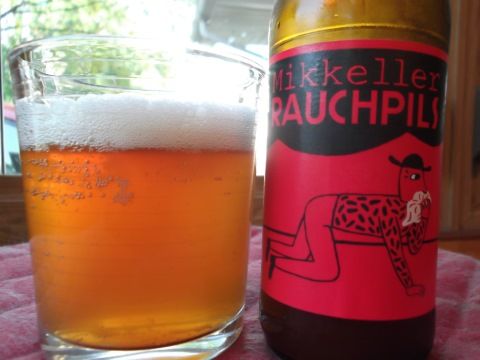
Rauch Pils is a lovely light amber color and hazy, which I thought odd and not pilsner-like. But multiple derivations from the norm can be a good thing. My pour made a big, loose, white crown that lasted an average amount of time. In a more pilsnery vein, it was quite effervescent with plenty of bubbly action that made me with I had unpacked my pilsner glasses.

Taking a whiff I caught that joyous, guaiacol goodness. I won't attempt to positively ID the type of wood used to smoke the malt but it smelled like Beech wood smoke to me. There was also a little cracker and even a dash of malt sweetness. And, being a pils, you had to have hops. In this case they smelled spicy. I don't recall any indication on the bottle as to whether this was supposed to be a Czech or German or Danish or whatever pils but the hop aroma was Bohemian to my nose.

When my tongue finally got in on the action, it was quite pleased. The smoke was at DEFCON 3 – not a DEFCON 1 Schlenkerla state of smoke but certainly much more than a background or accent flavor. And no, it did not taste like bacon. The non-smoked malts added a touch of sweetness while the hops took a grassy turn here on the taste. The greens were not very bitter and played second fiddle to the malt and I was reminded overall of a German pils.

Things took a turn back towards the Bohemian on the finish as the hops, whatever varieties they may have been, became rather peppery and chased away most of the malt flavor smoky or not. This made the taste pretty dry but not to the levels I associate with Czech pilseners. The lacing on my glass was really nice as there was one ginormous patch of foam surrounded by thin streaks.

After drinking Rauch Pils I decided that more people should make smoky pilsners. I really enjoyed the contrast between the pils elements – the hops, the light body, the fizzyness – and the smoke which brought a flavor less sharp to the table and one that added a fuller feel to the beer.

Junk food pairing: Rauch Pils pairs perfectly with Jays Barbeque potato chips. I like these chips because they taste more like a dry rub than a sticky sweet BBQ sauce. The big paprika taste has a nice earthy taste to it to complement the smoke but the chips are thin and light making for a nice contrast.

16 August, 2016

Farm to Glass: Honey Kolsch by Rogue Ales


I have not exactly plumbed the depths of Rogue Ale's (and Spirits) catalogue of brews. It seems that I've reviewed only two of their beers and one wasn't even really a beer. Sadly, when I hear Rogue's name mentioned or see their logo, I still think of "novelty" beers first. You know, that Voodoo Doughnut beer – whatever it's really called, the one they brewed using yeast from the brewmaster's beard, et al.

This is quite unfair and Rogue offers more than quirky novelty beers and they should be judged on their own merits instead of standing in the shadows of a Sriracha beer (which is pretty tasty, if I do say so myself). I would think that I'd be more into Rogue as a brewery, more interested in delving into their portfolio because I've come to think of it as the consummation of much of the promise of microbrewing. Allow me to explain although I will probably over-romanticize by filtering my hazy memories through rose tinted glasses

In the first half of the 1990s when I was developing my new-found taste for quality beers, the microbrewing movement was, in my opinion, much more aligned with the Slow Food movement than it is today. Back then small breweries – they were micro, after all – that were local was an ideal valued much more 20+ years ago, to my memory. It was understood that there could be variation amongst batches of the same beer because microbreweries weren't like Bud or Miller or Coors. Their production facilities weren't based on Taylorism. Microbrewers were like cobblers with their pegs and awls, not Nike factories.

As time went on microbrews became craft beer and that sense of drinking beer deliberately, drinking beer as an act akin to buying organic carrot from a local farm has faded. I am thinking of a quote from a brewer I heard on a recent episode of The Beer Temple Insiders Roundtable. Sadly I cannot quote it verbatim but it stated that refraining from brewing an IPA was like throwing money away. It was an irrational act.

I feel that locality, understanding where ingredients come from, and the like have taken a back seat to satisfying a hop fetish. People want their Citra and don't seem to really care where it comes from or what else may be in the beer. However, I have to concede the fact that people can name a hop variety and seek it out is to be counted as a victory for the Slow Food Movement. After all, how many friends of Spuds Mckenzie could name the hops used in Bud?

To bring this back to Rogue, the brewery/distillery/cidery/soft drink maker has farms. I don't know if Rogue owns them outright or who but they're called Rogue Farms and they supply the brewery with some of the ingredients used in their brews. And so I give Rogue credit for making good on the promise that the mingling of the microbrewing and Slow Food movements held back when the two were more aligned. Farm-to-brew was the logical endpoint when the two movements were combined.

Rogue Honey Kolsch is made with malt and hops grown on Rogue Farms and honey made by Rogue bees. I liked the idea of this combination from the moment I read about it and was keen on trying it. I found a six pack at Steve's on University Avenue and haven't seen it anywhere else in Madison.

It pours a medium yellow and was definitely on the hazy side. Rogue uses some wheat in the brew which I presume is producing the haze. A traditional German Kölsch, however, would be clear. I got roughly an inch of loose white foam atop my glass (I still need to unpack my stangen) while there were bubbles galore inside the bier.

That distinctive floral, sweet-yet-savory smell of honey shone through on the nose. I'm no honey expert nor do I know where Rogue's bees were getting their nectar but it was less floral to me and more earthy, for lack of a better description. There was also a little bit of lemony citrus and a touch of grain.

All those bubbles translated into some healthy carbonation. I was really happy add the honey flavor. It seems that most of the honey beers I've had don't use much. And so it becomes a minor accent in both the aroma and taste. Here the flavor is rather prominent and leans more to earthy and maybe woody than floral yet it also gave a sweetness like apple. The malt tasted dual-layered with both lighter biscuit as well as a sweeter, more doughy flavor.

If the bier's smell and taste were decidedly not traditional because of the honey, then at least the finish was more like the German import. It was moderately dry with grassy and spicy hop flavor pushing any lingering malt out of the picture. The bitterness was not big but was abetted by the carbonation. Rogue's in-house Alluvial hops are very Noble-like. My glass finished all gussied up with lots of Schaumhaftvermoegen. There were thin streaks almost everywhere and specks of foam in between.

A really tasty brew. The honey is perfectly toothsome and was used judiciously. Not too much nor too little but rather just the right amount. The bier tasted clean and fairly crisp as if it were lagered for a while. On the malt side, there was a bit more doughy flavor and less of that light, crackery taste that I prefer in a Kölsch. Still, the bier managed a fine light body. If I have a realcomplaint it is that it didn't taste very much like a Kölsch. But perhaps there's a tradeoff to be made: you can have your typical fruity yeast flavors or you can have a moderate big honey taste but not both at the same time. Or maybe that apple sweetness I tasted wasn't all honey but was rather the yeast as well.

Regardless of how well or how poorly Honey Kölsch adheres to German or stylistic tradition, it is a tasty brew that goes especially well in the heat.

Junk food pairing: Having a light sweetness and a splendid honey flavor means Honey Kölsch will go well with other honeyed foods. Try Lay's Honey Barbeque potato chips or some Snyder's Honey Mustard & Onion Pretzel Pieces.