13 December, 2015

A Taste of Mexico

When I moved to Madison, Mexican food cuisine was mostly Pedro's, Chi-Chi's, and Taco Bell. The only sign of remotely authentic Mexican food was a small grocery store at Fair Oaks and Milwaukee. Thankfully that situation has changed. Dramatically. You can't swing a dead cat in this town without hitting a Mexican restaurant that is at least decent. And there are several Mexican grocery stores here now too. One of the great things about this is that I can get a fine bowl of pozole in Madison now.

Today, despite it being the warmest December day since the end of the Little Ice Age and me not having a drop of Mexican blood, I made a pot of the luscious hominy and pork stew. It turned out rather well, if I do say so myself.

Here it is simmering away:


My plate of toppings. Nothing like some fresh jalapeño in chilly weather.


And here it is being served:


This was the first time I'd ever made pozole and I'm happy with how it turned out. I think the next time I make it I'd like to use either homemade chili powder assembled with some quality spices from Penzeys or a similar place. Or basically any chili powder that costs more than $0.99 for a few ounces. In my defense, I did use some good quality cumin.

11 December, 2015

The Still Waters of Colgone Run Deep: Ottekolong by Freigeist Bierkultur


Sadly, my basement will soon be bereft of biers from the free-spirited brewers of Freigeist Bierkultur in whose mission is to liberate the German palate from the chains of industrial brewing conglomerates. They do this by mining Germany's rich brewing history and devising brews that at times respect lost traditions and embrace the microbrewing revolution at others. Sometimes their biers do both at once.

Today we have Ottekolong ("Eau de Cologne"), an unfiltered Kölsch. Since Freigeist is located in Köln (Cologne), it was their destiny to brew one, the city's official bier style. I wonder how this bier is marketed in its hometown, if indeed it is. "Kölsch" is an appellation reserved for biers from a select group of breweries in and around Köln. Since Ottekolong does not conform to the specifications of the style and is not brewed by a signatory to The Kölsch Convention , they must label it in such a way to escape the scrutiny of the bier polizei. Wie sagt man "Kölsch-style" auf Deutsch?


Ottekolong pours a lovely gold hue. In a violation of The Kölsch Convention it is unfiltered and therefore a bit hazy. My stange had a small ivory head that dissipated quickly while there was a fair amount of bubbly action inside the glass.

As one would expect, the aroma had abundant cracker and toasted grains smells along with the style's characteristic fruitiness from its unique yeast strain. But there was a Noble hop presence as well that was grassy and slightly peppery too. Although Ottekolong has a light body, the clean, grainy taste was a bit richer here than in the Reissdorf, Früh, and Gaffel that I've had. This was balanced by some carbonation and those hops which were also grassy and peppery to my taste. The fruitiness was quite subdued here with the hops looming over it, especially the peppery notes.

Those hops became a little spicier on the finish which, along with the carbonation, made for a nice, moderately dry ending. Most of the Schaumhaftvermoegen slid into the bier leaving behind just a few dots of foam.

Ottekolong was basically everything you could want in a Kölsch. It was very refreshing with its light body (4.8% A.B.V.) and some nice bubbliness. Still, it was not short on flavor. The malt was substantial enough for a good, solid cracker flavor yet it didn't weigh on my tongue. I'd have loved it if there was a bit more fruitiness but, as it was, I thoroughly enjoyed the peppery hop flavor. It wasn't overpowering but rather it turned Ottekolong into a more spicy/savory take on the Kölsch than I am used to. The real shame is that I drank this bier in December instead of June.

Junk food pairing: Ottekolong is light yet hearty enough to take on a variety of junk foods. For example, it will pair well with the sweet heat of Pringles Xtra Fiery Sweet BBQ or the savory goodness of their Cheeseburger chips.

10 December, 2015

I Drank Beer From Chaska, Nebraska, Alaska, Itasca - What a Bonanza!: Continental Lager by Church Street Brewing Company


The Church Street Brewing Company is likely not the first brewery mentioned when you ask about Chicago area purveyors of fine suds. Revolution, Half Acre, Pipeworks – these breweries and their hoppy brews enjoy good reputations and are often in the Chicagoland beer limelight. But Church Street, in suburban Itasca, has been grabbing my attention the past couple of years on treks to Chicago area liquor stores. This is mainly because A) the brewery opened in 2012 and B) I noticed that their take on my beloved helles is available year-round. As their website says, brewmaster Joe Gregor's "true love lies in German lagers".

Church Street does not join Metropolitan in the ranks of pure lager breweries or brew only German styles but their roster is weighted towards those styles. And I am unsure if I even have any of their helles left so today, which is apparently something called National Lager Day, I am reviewing their pils. Considering the brewmaster's predilections and all of the German ingredients in it, I opened my bottles thinking that Continental Lager would be a German pils and not a Czech one.


Continental Lager pours a lovely straw color that is much brighter than my photo allows. (I hope my pictures will start to improve sometime soon after the solstice.) It is clear and quite effervescent. I got a HUGE foamy white head that lasted seeming forever. Obviously I poured the bier poorly as the crown was so large, I had to wait for it to settle. Once it did and I was able to fill the glass further, I was left with a lovely brew that had many a bubble going up to the generous head. Why I didn't use a pilsner glass is lost on me but I'm sure this would have been an absolutely lovely bier. Even without the "proper" glass, it still looked like a beauty.

The aroma featured fresh bread astride some corn. There was a mild herbal hoppiness which I wouldn't have minded if it were a bit stronger. But, being a German pilsner, everything is a bit more restrained than in its Bohemian cousin. Lastly there was just a hint of malt sweetness and also a very mild fruitiness that was reminiscent of a Kölsch.

That malty primacy in the aroma could be tasted. Continental Lager has a light body but a big malty taste of biscuit. Herbal hop flavor was joined by a touch of spiciness that really worked well with the grain. And that light fruitiness that I caught on the nose was also present here but took on a deeper character that was like raisin. It was an odd flavor for a pilsner but it was very mild and not at all unpleasant. Just atypical. The carbonation was easily tasted and I liked the restrained bubbly dryness it added to the mix.

I liked the crisp, dry finish quite a bit. The hops really stepped up their intensity and joined with the carbonation. My glass was left with a bounty of Schaumhaftvermoegen with webs of the stuff everywhere.

Continental Lager hit the spot. It had the requisite Teutonic restraint and even-handedness that I expect from a German pils. It was malty but not overly so; it had a nice hop flavor but it never went unchecked and instead provided balance to the overall flavor. To my taste it was akin to the Great Dane's Verruckte Stadt, a local German pils, with a slightly bigger malt backbone and the hops just a bit more vigorous while not having the brisk, spicy dryness of a Czech pilsner.

Continental Lager is 5.3% A.B.V. so, while not a session beer, it is a beer you'll want to have more than one of. Just as Led Zeppelin were "tight but loose", this beer is light but heavy. It goes down easy yet it has substantial flavor.

Junk food pairing: Steady on with the junk food. I recommend pretzels – hard or soft - with a mild cheese such as American Easy Cheese.

09 December, 2015

Teutonic Tyrrany: The Kaiser Imperial Oktoberfest by Avery Brewing Company


I thought that I was done with Oktoberfests back in October but I've been dragged back into the fray...

Avery Brewing Company began back in 1993 in Boulder, Colorado. It's a brewery that's never been on my radar. I don't mean this as a slight but simply that no one ever told me that I ought to try their brews nor did any of their beers ever jump out at me as something that I ought to be drinking. Things changed last year when I took notice of some bottles that had some unsavory characters on them. Avery may be the only brewery to have a line of beers featuring autocrats on its labels. The first entry in their ("supremely limited") Dictator Series, an imperial stout, featured Czar Nicholas II of Russia. It would not be until the third installment, however, that his cousin, Kaiser Wilhelm II of Germany, was given a brew of his own: an imperial Oktoberfest.

I recently grabbed a bottle of the latter and played some appropriately themed songs by Iron Maiden, Fish, and IQ as I sat down to contemplate the legacy of World War I. And savor what will surely be my final Oktoberfest of the season.


The Kaiser pours a deep amber color – almost copper – and is clear. I got about an inch of nice tan foam atop the bier while inside there was a fair amount of bubbles going upwards. This bier is sehr schön and one can imagine the Kaiser himself lovingly gaze at it as he did his dreadnoughts. The nose was also quite lovely with bready malt commingling with its sweeter side that was reminiscent of peach. Alongside the grainy festivities was a healthy dose of spicy hop aroma.

The promise of an Oktoberfest is a vein of rich malts flush with flavors redolent of the staff of life itself. An imperial Oktoberfest doubly so. And The Kaiser delivers in spades. First I caught a nice bready flavor that was somewhere between fresh bread and toast – lovely Maillard reaction goodness. The clean taste also yielded some malt sweetness that was like apricot and honey. But this was not a sweet bier as these more toothsome flavors were quite subdued in contrast to the more savory ones. These massive German malt flavors overpowered the hops just to the point where I could barely discern any Nobility. Carbonation added a little dryness while a 9.3% A.B.V. meant there was a generous burn from the alcohol.

On the finish the malt sweetness moved to the fore and lingered while some spicy hop bitterness finally came through. And the alcohol became even more noticeable. My mini-krug was left with some nice Schaumhaftvermoegen all around.

For being such a big bier, The Kaiser retained the medium body of its non-imperial cousins. It had a great bready malt flavor that kept the sweetness at bay. The alcohol burn is wholly appropriate for even these warmer than normal December nights although one may not appreciate it in August when the beer is released. A great bier to share on an autumn evening.

Junk food pairing: Cheese curds! Seriously, cheese kurds and Oktoberfests are a match made in Himmel.

08 December, 2015

Watery Domestic: Altbier by Prost Brewing Company


I've found it difficult to find a good altbier here in Madison. Finding a tasty Kölsch, the alt's lighter cousin, is much easier. It's by no means impossible to find some delectable alt goodness but my enjoyment is limited by the seasonal availability of altbiers that I enjoy drinking. I recommend Schmaltz's Alt by Schell, Iron Works by Metropolitan, and Rhine Heights by Vintage Brewing. They are less sweet than other iterations of the style found on store shelves. They taste more like Obergäriges Lagerbiers and less like brown ales. To my tongue, anyway.

This being the case, I was happy to hear that Steve's Liquor had begun to carry or had finally brought the fact to my attention that they have been carrying the beers of Prost Brewing Company. Prost is a Denver brewery that makes traditional German bier styles. I see no evidence of barrel aging, brettanomyces, nor a single Cascade hop in use over there. I decided to check out their altbier on a recent trek to Steve's.

As you can see from my photograph, Prost doesn't use puns as names for their beers nor do labels feature anything fancy. Just simple German austerity. How they get away with this is beyond me. I guess not trying to be clever and ostentatious makes you stick out in a craft beer crowd.


Altbier pours a rich copper color. The bier was clear with a fair number of bubbles going up. My glass featured a small ecru head that, sadly, didn't last very long. The aroma was rife with malty goodness. A rather sweet scent came first that was stonefruity but more savory, roasted grains came hot on its heels. Altbier is laden with Hallertau hops and I caught them on the nose as a restrained bit of grassiness.

Upon tasting I found that the fruity sweetness of the malt was rather like plum and that it wasn't as prominent as it was on the nose. Here the roasted grain flavor had pride of place. Behind that was just a little toffee flavor. The clean grain flavors were abetted by grassy/herbal hop flavors and bitterness. I think I was expecting more hop presence after my dreadful encounter with some senescent Uerige altbier this past summer. As Ron Pattinson noted, fresh Uerige is fairly bitter so now I expect all altbiers to be so when there is surely variation even in the brews made in Düsseldorf, the style's hometown. There was also a little carbonation to be had.

If all of this sounds pretty tasty, well, it could have been. The flavors themselves were good but I found the bier to be very thin. It had a pretty light body and the overall malt flavor tasted like the amateurish first steps of a homeopathic brewer.

The finish had that light malt sweetness fade to modicum of herbal hop dryness. No Schaumhaftvermoegen was to be had.

I really hope this was just a bad batch because I'd love to have a gut altbier year-round. Prost Altibier has all of the requisite flavors but it's just thin. The malts lack richness and depth – they have only hazy memories of Maillard reactions. I'll try this bier again but I am going to give Prost's other biers a chance first.

Junk food pairing: On the savory side try some Kettle Cheddar Beer potato chips with your Prost Altbier or, if you have a sweet tooth, you can't go wrong with a handful of dark chocolate covered pretzels.

Cerveza for Gringos: Super Pils by 5 Rabbit Cervecería


5 Rabbit Cervecería opened in 2011 and has developed a reputation for creative Latin American-inspired cervezas as well as for telling Donald Trump to go f*ck himself. I jumped onto the 5 Rabbit bandwagon early with trips to Chicago being like Christmas no matter what time of year they were as long as I could bring home some of their beer. Christmas came early and unexpectedly this year when their cervecería began being distributed in Madison. From what I can tell not every one of their cervezas is available here yet. Indeed, my bottle of Super Pils was purchased on a recent venture to Chicagoland.
The beer is part of the cervecería's Gringolandia series. ("Gringolandia" is term of endearment used by some Latinos to refer to the United States.) These beers eschew the Latin American influences and instead are slightly more conventional "interpretations of some popular craft beer styles". In this case we have what is essentially an imperial pilsner although an English yeast was used as were some decidedly non-Noble hops.


Super Pils pours a lovely light gold/straw color. The beer was hazy but this is by design – it is unfiltered. And so it was unsurprising that I got a good, pillowy off-white head that was in no hurry to dissipate. There was a country ton of bubbles going up the glass. The aroma had a pronounced grain/breadiness to it which was wonderful. It also had some honey sweetness as well but this was rather mild. As for hops, there was a distinct peppery smell.

This beer is 7.2% A.B.V. so a lot of malt was used and it shows. That great bready bouquet came through in the flavor as well. The honey sweetness was there too but content in a supporting role. All those bubbles I saw added a nice sparkling dryness to counter the malt. The beer is brewed with a combination of Celeia and Saphir hops, the lupuline intricacies of which are unfamiliar to me but it seems that both of them contributed to the peppery/spicy hop flavor here. Oddly enough, I found the hops to be mild side.

A pils is best when fresh and my bottle wasn't fresh. But I don't have reason to believe it was particularly stale either. The beer did not taste oxidized. Perhaps it's just my expectations set by "imperial" and "drinks like an IPA". Probably a combination of things.

The finish saw some bready sweetness fade to a mild dryness undergirded by the carbonation and topped by peppery/herbal hop bitterness. Schaumhaftvermoegen was medium with a fair amount of webbing connecting patches littered around the glass.

While I have not had occasion to taste much of Celeia and Saphir hops, I really liked the peppery and herbal flavors they brought to the table. I suspect that a fresher bottle would have had brighter and bolder versions of these flavors but, as it is, I really enjoyed them here. Super Pils also had a strong malt flavor that was short on sweetness, which was great. With all the booze and all of the malt flavor, the beer surprised me with its medium-light body and a dangerously easy drinkability.

Junk food pairing: Pair your Super Pils with some lime-chili tortilla chips or, alternatively, some garlic plantain chips. All of these chips have flavors that can withstand the extra maltiness of the cerveza and complement the hops.

06 December, 2015

Eudaimonia in a Bottle: Boathouse Pilsner by Titletown Brewing Company


Green Bay is Wisconsin's third largest city yet it doesn't enjoy much of a microbrew reputation in these parts. There is no shortage of beer from that city on Madison store shelves but no Green Bay brewery seems to have found a winning formula for gaining notoriety, for getting their beers to stick out in a crowded microbrew landscape. Perhaps this is just me. Or perhaps it is just Madison. Regardless, that is changing if for no other reason than the sheer volume. Once available only in the Fox Valley region, beer from Green Bay's breweries is now widely available on Madison's store shelves and on taps too.
If the quantity riddle has been solved, then what about quality?

Until now my experience with Green Bay suds consisted solely of Hinterland which I've found to be hit and miss. But now I expand my purview to include Titletown.

Titletown Brewing Company opened in 1996 in a disused railroad depot which used to be owned by Chicago & Northwestern. The brewpub grew and finally opened a production brewery which not only expanded capacity but also included a bottling line. Six packs became available in and around Green Bay early this year while Madison saw them arrive in July. Madison was, oddly enough, the first area outside of the Fox Valley to see Titletown bottles.

Green 19 IPA and Johnny Blood Red Irish Style Red Ale came first but were soon joined by Boathouse Pilsner. The bottle's label proudly boasts that it is a "Gold Medal Winning Beer". This refers to its first place finish at the 2010 Great American Beer Festival in the Bohemian Pilsner category.

What's a Bohemian pilsner? For starters, it's probably the only recognition Americans give to Czech brewing culture and tradition. We tend to think of the Bohemian pils as an addendum to a larger German brewing tradition instead of something that stands on its own. For more on Czech pivo I highly recommend reading some Evan Rail. Rail is a writer who lives in Prague (or lived there for a while) and has traveled the Czech Republic to taste its pivo. He has written a beer guide to his adopted hometown as well as a blog post that's no longer available with corrections and addenda to the Oxford Companion to Beer's entries on Czech beer and brewing.

Both he and Ron Pattinson make a strong case that we've really sold the Czechs short.
And so back to the question: what is a Bohemian pilsner? The Bohemian pilsner is, in simplified terms, a malty pale lager with a goodly amount of Saaz hop spici- and bitterness. If you scour the Interwebs you may find Rail's three-part history of the style and its progenitor, Pilsner Urquell.


Let me begin by apologizing to Titletown for my dreadful photo. It does not do their pivo justice. Boathouse pours a lovely dark straw/light gold color. The beer is crystal clear and I think you can see this despite my poor photography skills. My pour produced a small off-white head that, sadly, dissipated very quickly. On the other hand there was an abundance of bubbles going up my pilsner glass. I'd expect a much larger and longer-lasting head and hope that my glass wasn't dirty. But aside from that, this is one pretty beer.

The aroma was very malty with notes that were bready, almost doughy. I was surprised at how subdued the hops were here with a relatively mild herbal hoppy smell that had a hint of the floral to it. Boathouse had a really nice clean malt flavor that was bready and biscuity and less sweet than the aroma let on. It was a solid malt base but not as big as something like an Oktoberfest. The hops were more grassy than herbal to my tongue. Carbonation was also evident and added more dryness.

I finally tasted some spicy hop flavor at the finish which was moderately dry as the breadiess petered out. Schaumhaftvermoegen was lacking. Indeed there was none to be had.

In contrast to a Pilsner Urquell, Boathouse is rather mild. When I think of a Bohemian pilsner I think of Saaz hops with their intense pepper/spicy flavor and a hefty dose of bitterness that adds a lot of dryness. Boathouse does not have this. What it does have is a great clean bready flavor with just enough hops to achieve a delectable balance. The hops here are mostly grassy and herbal tasting instead of peppery and spicy but they still complemented the grainy goodness perfectly.

I really enjoyed this beer. Its polished gold clarity gave it a visually arresting look especially after my recent brown ale and turbid weissbier reviews. The bready flavor here was fantastic. There was a hint of sweetness that added another malty layer to meld with the hops. And while those hops may not be stereotypically Bohemian, they were flavorful and stood on their own yet didn't drown out the malt flavors. Aristotle would be proud of brewmaster Dave Oldenburg for having created a beer that places all of its flavors in perfect proportion.

Junk food pairing: Boathouse has a medium-light body. This paired with its relatively restrained hops means that you'll want some lighter fare to go with it. Try some Pepper Jack Cheez-Its or Jays Hot Stuff potato chips with their earthy zing of paprika.

04 December, 2015

Liquid Folk Art: Truck Stop Honey Brown Ale by Back Forty Beer Company


As I wrote yesterday, I recently spent some time down in Montgomery, Alabama. While there my wife and I jumped a broom and spent time with her family. And, of course, we sampled some Alabama brews.

My most extensive sampling was of beers from Back Forty Beer Company in Gadsden which describes its beers as "liquid folk art". Alabama is not exactly flush with breweries and, from what I can tell, most microbreweries there do not bottle or can. Back Forty does and a trek to a supermarket down there yielded a six pack of their Truck Stop Honey Brown Ale which was brought back to Madison.

Truck Stop was Back Forty's second offering when it was first released in 2010. It is brewed with wildflower honey from Alabama and was one of many brown ales I saw in Montgomery. They were nearly as common as IPAs, a decidedly different situation than here at home.


For the occasion I busted out my mini-British pint glass which was from the Great Taste at some point in the past several years. The beer poured a dark amber hue that reminded me of maple syrup. It was clear. Back Forty is not particularly effervescent as I got a small off-white crown which did not stick around for long and only a few stray bubbles were to be seen floating upwards.

My nose caught a mildly sweet earthy aroma from the honey followed by some caramel. On successive sniffs I also discerned a very mild floral scent which I would think flowed from the honey. Malt was the order of the day in the taste which was surprisingly clean. Moderately sweet toffee was followed by roasted grain and coffee notes from the chocolate malt. Carbonation added a little dryness while what are surely the Willamette hops came through as a bit of spicy bitterness which became bolder as the beer warmed.

I was surprised by the finish which was rather dry. The malt sweetness petered out rather quickly which allowed the carbonation and grassy/herbal hop flavors to come through. There was not much lacing to report and the vast majority of the foam slid down into the beer.

Truck Stop has a rather light body which belies its 6% A.B.V. But this is likely a plus in the Deep South where it's hotter and the heat stays longer than here in the Upper Midwest. I was pleasantly surprised by the use of chocolate malt and the resulting roasted grain flavors which are coveted by my palate. It added a little extra depth to the flavor and kept the sweetness in line.

I enjoyed Truck Stop quite a bit. There's nothing intense or in-your-face about it but rather you get a nice easy-going set of flavors. The brown ale was ascendant back in the 1990s when I started drinking microbrews and I drank my share of Pete's Wicked Ale. But the style fell out of favor. I'm as guilty as anyone for this as I haven't allowed myself to be charmed by the mellow maltiness of the brown ale very often this millennium. What's old is new again.

Junk food pairing: Grab a handful of trail mix to go with your Truck Stop. The dried fruit will complement the toffee notes perfectly while the salt accents the roasted grain while bringing out more hop flavor and bitterness.

03 December, 2015

Suds of the South: Montgomery Edition


(Railyard Brewing Co.)

Earlier this month I spent some time in Montgomery, Alabama. I was last there about four years ago and much had changed. While there is still much work to be done, Montgomery is a city on the make. A downtown parking lot where we parked our car in 2011 is now shiny, new apartments and my in-laws informed me that there many more such developments. And it's a sure sign of gentrification that city now boasts a brewpub, Railyard Brewing Company, which seems to have opened not long after our last visit.

It was a bit odd for this Cheesehead to look at a restaurant's beer menu and not see Spotted Cow or Wisconsin Amber or Hopalicious. Instead there were offerings from local breweries such as Black Warrior Brewing Co. in Tuscaloosa; Huntville's Straight to Ale (which seems to really like monkeys and other non-human simians); Avondale Brewing and Good People Brewing Company from the state's largest city, Birmingham; Madison's own (Madison, Alabama, that is) Rocket Republic Brewing Co.; and Back Forty Beer Co. in Gadsden.

There were also suds to be had from breweries that I'd sampled previously but are not distributed in Wisconsin. For instance, there was Lazy Magnolia's (Kiln, MS) tasty Southern Pecan Brown Ale. The more well-known Yuengling and Sweetwater were also on the menu. (Sweetwater 420 was everywhere.)


(Spring Street Saison and Freckle Belly IPA)

Avondale's Spring Street Saison was a fine beer with its lighter body and luscious fruity/peppery yeasty flavors. Railyard's Irish Style Red and Roundhouse Rye were both very good. They had nice malt-hop balances and were quite refreshing in the balmy(?!) 50 degree temperatures.


(Roundhouse Rye and Irish Red)

For reasons unknown, I took to Back Forty. I shocked my wife by ordering a Freckle Belly IPA with my dinner. It was fairly malty for the style and had a preponderance of piney/resiny hop flavors atop more floral ones. (Is there a distinctly southern take on the IPA?) Not being much of an IPX drinker, I found it to be simply OK but I did empty the glass. My post-prandial pint was their Cuban Coffee Stout which I thoroughly enjoyed. The coffee didn't drown out the dark malt goodness, which I appreciated. It was flavorful yet not filling.


(Back Forty's Cuban Coffee Stout)

I'll continue my love for Back Forty in a coming post. But now I want to close with a few sudsy observations from my trek in the South:

--It seems that we here in the Madison area are lucky enough to have more breweries and brewpubs than the entire state of Alabama. If not, then I'd bet it is close. Having said this, Alabama brewing culture is coming to life.

--Alabama brewing culture seems to be concentrated in the northern part of the state. I presume that the larger cities are there. Plus, proximity to Atlanta may have something to do with it.

--Speaking of Atlanta, Sweetwater was not considered a "Premium Draft" beer at a restaurant we went to. Neither was New Belgium.

--From what I could tell, most Alabama breweries don't bottle.

--Brown ales were prevalent which made it seems like it was the 90s all over again. Lazy Magnolia's Southern Pecan Brown Ale might be the Spotted Cow of the South.


02 December, 2015

That's a Peach, Hon: Peach Hefeweizen by Stevens Point Brewery


This is the final entry in my late-year weissbier triptych. In my previous post I pondered the customary slice of lemon that is duly affixed by bartenders across America to weissbier glasses. For better or for worse, I skip the zitrone. It's just not my thing although I can see the appeal of it. Having said this, I am not ideologically opposed to blending a weissbier with some fruit or using your bier to steep tea or adding a floral dimension to brew.

This past summer Point introduced Peach Hefeweizen via their Whole Hog series which features various brews made in limited quantities aimed at the craft beer drinker. The pumpkin ale enjoys a glowing reputation from what I can tell. I miss the imperial pilsner which seems to have been brewed once in 2009 and then disappeared.


Peach Hefeweizen pours a light gold hue and was hazy as expected. The beer was crowned with 1"+ of nice ecru head. This was a nice effervescent brew with lots of bubbles going upwards. And I mean lots. It was bubbly like a fine pilsner. Very pretty.

On appearance, Peach Hefeweizen gets high marks. The problem started when I smelled the bier. At first I caught peach. But as my brain tried to discern some evidence of this being a weissbier such as a bit of banana or clove, it realized that it had also gotten a big dose of butter. Diacetyl! D'oh! To the best of my knowledge, and anyone reading this from G. Schneider & Sohn please correct me if I'm wrong, but there should be no diacetyl in a weissbier. I could probably live with a little but this smelled like a lethal dose.

The beer's taste matched its aroma with the peach coming first followed by the dreaded butter. I could also taste the carbonation. What I failed to taste, however, was any indication that I was drinking a weissbier. I am loathe to make any proclamations about a beer so severely compromised by diacetyl but the prominence of the peach left me with the impression that, had the diacetyl not been present, I wouldn’t have tasted much in the way of phenols anyway. The peach flavor was strong instead of being at a lower dosage where it would complement any banana or clove flavors.

My drinking experience, such as it was, finished with the buttery flavor dying out leaving the peach to linger for a short time until a nice dryness from carbonation and some grassy hops entered the scene. Schaumhaftvermoegen was oddly light. So light, in fact, that there was but a smattering of small spots.

Did anyone else out there run into diacetyl in this bier? I'd hate to think it was just me and my poor beer storing habits. Aside from the off flavor, the peach wasn't bad. The label says both "Beer with Natural Flavor Added" as well as that peaches were used. Does this mean that only peaches were used? The peach flavor of the beer didn't exactly taste like fresh fruit but nor did it taste fake.

Junk food pairing: If this bier had no diacetyl, I'd pair it with either some Kartoffelchips or pretzels with mustard and/or horseradish. You'll need something to cut through all that peach.

Out of the Cellar: Kellerweiss by Sierra Nevada Brewing Company


As I noted yesterday, I've been sampling some weissbiers lately in memory of my brother who passed away earlier this year and was a fan of the style. Unlike me, he enjoyed the lemon that commonly garnishes glasses of weissbier here in the States. For many years I've been under the impression that slapping some citrus onto the glass was a misbegotten practice that originated here in America where the mantra "more is better" is an almost ineluctable part of life.

I haven't found anything to indicate when or where the practice started but Michael Jackson encountered glasses adorned with lemon slices in Germany during the mid-60s so it seems unlikely that we Americans can take credit for the innovation. (After all, lemon slices also garnish schnitzel in Germany so it's not like there's a great anti-lemon sentiment over there.) However, it seems that the practice has fallen out of favor in the beer's homeland while it remains strong on this side of the Atlantic. Indeed, it is so ingrained that I was given a slice of lemon when I ordered a Schlenkerla Rauchbier Weizen a couple years ago at the Essen Haus. My brother, on the opposite end of the table, was enjoying his unsmoked weissbier mit lemon.

My foray into the world of weissbiers continues with Sierra Nevada's Kellerweiss.


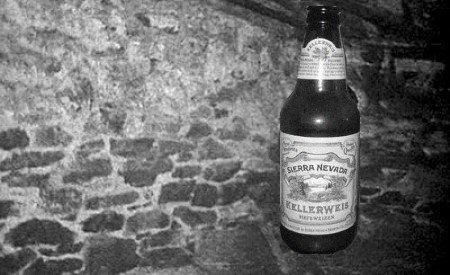
Kellerweiss pours a light gold. (My photograph makes the beer appear a bit darker than it really is.) As to be expected, the brew is turbid with all the yeast having been left in. Also expected was the large white head. Wheat is laden with proteins which are dragged kicking and screaming out of suspension by the carbonation. I love the foam on weissbiers. It's rather thick – almost like meringue – and it sticks around until the last of it slides into your gaping maw. Weissbiers should be effervescent and my Kellerweiss had lots of bubbles going up the glass.

The beer's aroma was instantly appealing with a delicate lemon-citrus scent stealing through pungent banana phenolics. Underneath the fruity bouquet was also some grain that was cracker-like. Kellerweiss has a medium-light body and I was happy to find that the banana-like scent came through in the flavor. This is strictly a personal preference of fruitiness over clove-yness or bubbleguminess. There was a hint of clove, however, which is well and good and probably a necessary accent to keep the flavor from becoming overly fruity.

Also handy in keeping the taste on the straight and narrow is carbonation. One can definitely taste it in Kellerweiss. Rounding out the flavors was more cracker-like graininess. Not very strong but definitely there beneath all that the yeast had wrought.

Dryness from the carbonation overtook the lingering banana in the finish. It was abetted by a small dose of spicy/peppery hops. Schaumhaftvermoegen was plentiful with strands of it lining my glass.

I praised Saint Francis' Lust weissbier yesterday for being fairly substantial. Kellerweiss has a lighter body (4.8% A.B.V.) and slightly less intense flavors overall. This in addition to the drier finish from more piquant hops yields a beer that I can imagine would be quite easy drinking in warmer weather. Mind you, I don’t mean to imply that Kellerweiss is lacking because it isn't. It is flavorful and delicious and I'm sure my brother would have enjoyed it.

For a brewery whose reputation, as I discern it, rests on hoppy pale ales, Sierra Nevada superintends an array of fine German-style biers. They brew a wonderful pilsner, an Oktoberfest conceived with a German brewery, a great Kölsch, and a very tasty weissbier. To top things off, they are introducing a gose next month. I regularly drank Sierra Nevada Pale Ale back in the first half of the 1990s but eventually my tastebuds wandered as microbreweries sprang up. Rediscovering the brewery over the past few months has been a real treat.

Junk food pairing: On the savory side, pair Kellerweiss with some Wasabi & Soy Sauce Pringles. For dessert, pair it with dark chocolate covered pretzels.

01 December, 2015

The Principles of Lust Are Easy to Understand: Lust by Saint Francis Brewing Company


My brother died earlier this year and I miss him more than words can say. I spend at least a little time each day struggling to get used to his absence and looking back at his life. He did not drink much alcohol but he did enjoy a good weissbier. When I see bottles of the stuff on a tap list or a store shelf I think of him. And so I've decided to try a few examples of his favorite bier style in his memory.

The German "weissbier" means "white beer". The term developed at some point in the dim and distant past and referred to any pale brew which, several hundred years ago, meant that it used air dried malt. At some point – which looks more and more like the 19th century – the term began to be reserved for Bavarian wheat ales which had been brewed for a long time. These beers are also referred to as weizens as "weizen" means "wheat". (And "hefeweizen" means "yeast wheat", those cloudy yellow iterations of the style.)

Weissbier is known for the phenolic compounds produced by the particular strain of yeast used to brew it. These phenols give the beer flavors that are like clove, banana, bubble gum, et al. The style also has a signature glass which is hourglass shaped but narrower at the bottom than at the top.

The Saint Francis Brewing Company is located in St. Francis, Wisconsin which is just south of Milwaukee. The beer served at the brewery's restaurant is brewed on premise while bottles are filled with beer made up in Black River Falls at Sand Creek. Saint Francis is a brewery that seems to fly under the radar. Or just doesn't seem to get much press. I don't know what the brewery's reputation is in the Milwaukee area but it doesn't even seem to have one here in Madison. The only time I can recall a tavern promoting their beer was this past summer during a pre-Great Taste event at Buck and Badger. But considering the brewery's expansion plans, people are drinking their beer. They just don't write about it much, I guess.


Lust pours a light gold color. Being unfiltered the yeast makes the beer cloudy. Wheat is high in protein so you are guaranteed a nice head no matter how slowly you pour your weissbier. I got a big frothy white head that was like the Energizer Bunny – it lasted and lasted. There were a goodly number of bubbles heading up my glass.

Truth be known I am not a huge fan of clove. I don't hate it, by any means, but I much prefer my phenols to be of the banana smelling/tasting variety than clove. Lust endeared itself to me from the get-go as my nose caught banana when I opened the bottle. In addition to that fruity scent there were some vanilla notes as well as grain/cracker. It was difficult not to think of Nilla Wafers as I inhaled Lust's mellifluous aroma.

That wonderful banana scent translated into the taste as well. Lust has a medium body and is apparently 6.5% A.B.V. so this is no small bier. Correspondingly, the banana taste was moderately intense. A mild dose of clove was underneath it which was perfectly fine to my taste. A biscuit/grainy flavor made its presence known as did the carbonation.

Recently I've become much more cognizant of carbonation and what it does to a beer's flavor. In some brews it will add a small acidic bite while in others you end up with a little dryness. (And I suppose a cicerone out there can also tell me a dozen other things that carbonation does to a beer's taste that are beera incognita to me.) Here the carbonation adds a touch of dryness which takes the edge off the phenolic rush. Lust has some heft and the bubbles help keep the flavor from drifting off into cloying mess.

At the finish, the banana/clove flavors fade into a coda of mild grassy and peppery hops. The carbonation adds a bit more dryness as well. When I had finished the beer my glass was left with a couple large blotches of Schaumhaftvermoegen along with a fair amount of webbing.

In a word, ausgezeichnet! While it's true that I've not done an in-depth survey of Wisconsin weissbiers, Lust is at the head of the pack to my taste. In contrast to the last couple I've had, Lust has a bigger, more rich body, which I liked. In addition to not having a thin, watery taste, Lust also abounds in banana flavor instead of clove or bubble gun. This beer just hits all the right weissbier notes for me. I'm sure my brother would approve.

Junk food pairing: Although you cannot go wrong with pretzels, Lust is flavorful enough to stand its ground against more intense junk foods. For something different, try lime-chili tortilla chips or plain ones with a spicy pico de gallo or salsa.

No More Oak Oppression: Heart of Oak by the Jacob Leinenkugel Brewing Company


The Jacob Leinenkugel Brewing Company began in 1867. Over the years it developed into a prosperous regional brewery. In 1988 it went from craft to crafty before such a distinction was ever thought of when the Miller Brewing Company bought it. In the mid-90s the brewery began to establish its reputation of the maker of beers that taste like Froot Loops/Fruity Pebbles, a bit of renown that remains today. Berry Weiss was introduced in 1996. Ten years later came Sunset Wheat with its big Tang-y orange flavor. The following year saw Summer Shandy hit shelves and the brewery has since made its fortune with shandies. In 2012 the brew went national and by 2014 accounted for 50% of the brewery's business.

Having achieved such great success with Zima: The Next Generation with a new flavor of shandy seemingly introduced annually (watermelon is next), it's easy to forget or not even know in the first place that Leinenkugel brews more than fruit-flavored concoctions. Microbrew fans are attracted to the Big Eddy series of high octane and intensely flavored beers. But Leinies has been (relatively) quietly rolling out beers that are neither fruity nor imperial. For instance, they introduced a new winter seasonal a few years ago called Snowdrift Vanilla Porter which I found to be horrible but gave us a new annual IPL which is pretty good.

This past summer Leinies introduced a new beer as part of its Autumn Explorer Pack called Heart of Oak, an "oaked Vienna lager". Aging beer on oak to imbue it with the wood's distinctive flavor is a fairly new trend in microbrewing and not particularly widespread although it is gaining in popularity. How did Leinenkugel's foray into the world of arboreal aging turn out?


Heart of Oak pours a beautiful amber hue. The beer was clear and adorned with a big frothy head that was…ecru. There were a lot of bubbles going up the glass. I found the aroma to be quite inviting with the mellow earthiness of the oak coming up front with a bit of bread behind it as well as some malty sweetness that was plum-like to my nose.

I realized that, while I've noted the oak, I've not said anything about the Vienna lager. We here in Wisconsin are blessed with three amber lagers that are either Vienna lagers or are based on the style: Sprecher Special Amber, Capital Wisconsin Amber, and Wisconsin Brewing Company's Golden Amber Lager. The first two have been around, to the best of my knowledge, since the 1980s and are cornerstones of Wisconsin microbrewing. Wisconsin Amber seems to trail only Spotted Cow as the top Wisconsin microbrew to be found in non-microbrew establishments around the state.

The style dates back to around 1840 and one Anton Dreher, a denizen of – quelle surprise – Vienna. I'm not sure that anyone knows what his beers were like exactly but I tend to think of the style as being a lighter take on the Oktoberfest/Märzen. The emphasis is on the malt but the Vienna lager isn't quite as malty as its Bavarian cousins.

My aside aside, it was the oak which really stood out in the taste. While it didn't have the forest-in-a-bottle taste of Atom Smasher you couldn't miss it. But the oak's relatively moderate flavor didn't hide the malt which had a nice Maillard reactiony breadiness. There was also a little bit of malt sweetness that tasted like stone fruit to my palate. A hint of vanilla was subtle but its sweet-yet-savory flavor worked well with the oak and malt while carbonation added a little bite and some dryness. Lastly there was a bit of peppery "heat". I have no idea where it comes from but it's that same kind of "heat" that Capital's Autumnal Fire has but milder in this case. It tastes less like pepper than it does alcohol but Heart of Oak is not a big beer. Perhaps this is just my tongue tasting hops in an odd fashion or some such thing.

The beer finishes dry but moderately so. The oak flavor lingers a bit as does some carbonation. As they slowly dissipate, they're replaced by a mild astringency and an equally mild dose of grassy hop bitterness. Schaumhaftvermoegen consisted of two large splotches.

Heart of Oak benefits greatly from having just the right amount of oak. It complements the malt rather than overpowering it. The brew had a smooth mouthfeel and a medium-light body that belied its 6% A.B.V. which I think of as being rather high for the style. I also liked the dry bite given by the carbonation. All those bubbles helped balance the flavors here.

I thoroughly enjoyed this beer. It has a clean lager taste yet it has a complex set of flavors led by the oak. It managed to walk a fine line between being light & refreshing and hearty & warming. My only complaint is that it is generally sold as part of a variety pack that includes one of Leinenkugel's ubiquitous "shandies".

Junk food pairing: Heart of Oak pairs best with crackers and cheese. Try some Cheddar 'n Bacon Easy Cheese on Vegetable Thins or Cheddar Easy Cheese on Chicken in a Biskit crackers.

25 November, 2015

The Third Time Is the...: Raspberry Sour Porter by Freigeist Bierkultur


Earlier this month I thoroughly enjoyed Freigeist Bierkultur's Salzspeicher Cherry Sour Porter and Lichtenhainer. In addition to Kirschen, they also brew the porter bier with Himbeeren, a.k.a. – raspberries. I guess this is a Himbeerbier. (Doesn't that just roll off the tongue?) Will the third beer be the charm?

As I noted with the Kirschenbier, the base is a porter that, according to the brewery, draws upon two historical porter styles. First is a sour German version and the second is a brackish British take on the style. Neither of these ur-styles is familiar to me but this is hardly surprisingly. From there Freigeist adds fruit juice and/or "real fruits during fermentation".

Salzspeicher Raspberry Sour Porter pours black and opaque. When you hold your glass up to the light at just the right angle you can see that it's a deep mahogany and appears clear. While I was unable to see what, if anything, bubbles were doing inside the glass, the beer was crowned with a nice ¼" tan head. This is a very pretty bier. My wife shared my aesthetic judgement and said as much after seeing my glass from an adjoining room. Either I unknowingly married Jaime Sommers or her spectacles are just that good.

The aroma was similar to its cherry counterpart in that the fruit was most prominent. I'd be lying if I wrote that it smelled just like fresh raspberries, but it did smell pleasantly fruity. On the porter side of things, I caught bitter chocolate in the aroma as well. This beer smells like pure Deutsch dessert decadence.

Unsurprisingly, the taste is similar with the raspberry up front while the malt contributes subdued dark chocolate and even more subtle coffee flavors. I found the raspberry to be rather sweet. Not cloyingly, but it tasted as if the fruit contributed only a hint of tartness with the sour porter doing most of the work in that department. I'm not sure what bacteria sour the beer. It doesn't take particularly funky as whatever strain of brettanomyces it is that gives you that wet blanket flavor nor is it citrusy like lactobacillus. Think New Glarus' Belgian Red. Or Raspberry Tart, for that matter. The porter is imbued with that kind of tartness.

I'd be lying if I wrote that the beer tasted of fresh raspberries. Instead I was reminded of the Frango Raspberry Chocolate candies you find at Marshall Fields. Or a raspberry liqueur. It just lacked that sprightliness, that zestiness that tastes fresh and real. The beer tasted raspberry-flavored as opposed to raspberry-infused.

Some salinity came through at the finish which accentuated the lingering raspberry and bitter chocolate flavors. There was also a tannin-like bitterness that added some dryness. Schaumhaftvermoegen consisted only of a few thin streaks.

For a brew that is dessert in a bottle on paper, it has a medium body that makes for a very drinkable beer. A 6% A.B.V. works well for a digestiv or to be drunk on its own outside of a meal. Sadly, after the fantastic cherry sour porter, this one was a real let-down. The porter part remained great but the raspberry just didn't take like real juice in the way that the cherry did.

Junk food pairing: As with the Cherry Sour Porter, I will recommend either some pork rinds or dark chocolate covered peanuts depending on your mood.

This Beer's Name is Abraxxxas and It Is Smoky and Sour: Abraxxxas by Freigeist Bierkultur


Oooh! Another bier from the free spirits at Braustelle in Cologne. The last (and first) bier of theirs I reviewed was a cherry sour porter and now I have a Lichtenhainer.

What is a Lichtenhainer? The name derives from the town of Lichtenhain in central Germany. Lichtenhain is a suburb of the city of Jena which is about the size of Green Bay. According to Ron Pattinson, students at the university in Jena did a lot of drinking in Lichtenhain. (For my fellow Wisconsinites, imagine if UW-Green Bay students headed over to De Pere to consume mass quantities.) The style was popular in Thuringia, the region of central Germany wherein lies Lichtenhain, and brewed in various cities in the area.

If you read Ron's post, you'll find that the style is described differently at different times by different people. For example, some say it should be brewed with 100% barley while others include wheat in their descriptions. Regardless, Lichtenhainer is a light, sour, and smoky bier with a de-emphasis on hops. Presumably it belongs to the same family as the Berliner Weisse, gose, and Grodziskie/Grätzer. Also like its cousins, I assume that Lichtenhainer fell out of fashion starting in the second half of the 19th century as lagers became popular and the Reinheitsgebot began to be applied outside of Bavaria.

Abraxxxas can perhaps be described as an imperial Lichtenhainer as it is the bigger (6% A.B.V.) version of Abraxas (3.8% A.B.V.) I have never had the latter so I'm unsure if the beer at hand is more sour, more smoky, etc. than its little brother.

If memory serves, the last few beers I've reviewed have had a golden hue and Abraxxxas is no different. The beer was hazy as well which led me to believe that there's wheat in it. My pour produced a nice off-white cap – about an inch of frothiness atop the turbid golden elixir. There was a modicum of bubbles going up inside the glass.

The aroma surprised me by being very fruity. First peach and then cherry were bound together by gentle wisps of smoke. The smell was an olfactory joy like no other I'd experienced before. The taste had a measured smokiness to it and not a more intense one like a Schlenkerla rauchbier. Just as the smoke flavor was restrained so too was the sourness. It was a lemony lactic tartness but far removed from the near-lethal sours from Destihl that I've had lately. While they may both be sibilant words, smoke and sour aren't flavors that I generally think of as going great together. Chocolate and peanut butter they ain't, right?. Yet the contrast between a modicum of smoke and a little citrus sour is quite tasty. A bit of carbonation added a hint of dryness and there was a distinct grain/cracker flavor which became a bit sweeter and breadier as the beer warmed. This provided a more 'neutral" taste to the proceedings and some contrast to the smoke'n'sour.

For the finish the gentle, luscious smokiness lingered while the carbonation added a bit of bite. This dryness commingled with a hint of bready sweetness for a rather complex ending. The Schaumhaftvermoegen was pleasing as there were some large patches of foam lining my glass.

Truth be told, I adored this bier from my first sip. To start, I love smoke beers. From the smokier Schlenkerlas to this brew with its much milder smokiness, it is simply a flavor I love. Seemingly against all odds, the smoke and sour just blend perfectly. Abraxxxas' body is medium-light with the carbonation giveing the beer a nice bubbly mouthfeel. The A.B.V. aside, "imperial" is perhaps not an appropriate descriptor as there isn't anything heavy, über-intense, or otherwise dictatorial about Abraxxxas' flavor. Instead it is quite easy-drinking with a 500ml bottle being nowhere near enough.

Junk food pairing: Pair your Abraxxxas with a handful of Sriracha almonds. They add a little more complementary smoke as well as a bit of chili which melds well with the beer's smoke'n'sour fantasia.

Taurus to the Left of Me, Cancer to the Right: The Twins by Lake Louie Brewing


Last year Lake Louie Brewing overhauled its line-up. Beers were shuffled around into various series and new brews were introduced as well. The transformation continued into 2015 and included the introduction of a maibock back in the spring called The Twins. The name is a reference to Gemini, a sign in the zodiac, but both the beer and Lake Louie gained a measure of infamy back in April when a Madison Craft Beer Week event featuring the brew was held at the Silk Exotic strip club and promoted with the catchphrase, "Grab hold of a pair."

Puerile humor aside, the maibock is a potent pale lager. Brewed and lagered over the winter, it's tapped in the spring and serves as a liquid transition between the dead of winter and the rebirth of life in the spring. Although associated with Munich these days, the bock was invented in the north-central German city of Einbeck. The brewers of Einbeck were renowned for their quality beers and legend has it that Duke Maximillian of Bavaria recruited an Einbeckian brewer by the name of Elias Pilcher in and brought him to Munich in 1614 to demonstrate his mad skills for the poor, backwards southerners who took the northern style like a junkie to the needle. They are the ones who bestowed the name "bock" onto the beer as a corruption of Einbeck.

The modern maibock came about in the mid-19th century when Hofbräuhaus took advantage of then-new malting techniques which allowed for paler malts. The result was the pale (helles) bock we enjoy today each spring. I've never traipsed around Munich in the springtime so I am unsure of what an authentic maibock tastes like. These lighter bocks are generally hoppier than other iterations of the style but there is disagreement as to the malt character. Should it be sweet or more bready? At the end of the day I suppose it's irrelevant and that there is likely a fair amount of variation.

Although released back in the spring, it is once again Starkbierzeit (strong beer time) and it seemed appropriate to pull a bottle of The Twins out from my cellar last week.

The Twins pours a lovely golden hue. I got a small off-white head that went away all-too quickly. Being clear, I could see that there were many a bubble going up inside the beer. The aroma was distinctively sweet with honey and apricot scents standing out. As befitting a style that is hoppier than your average bock, there was also some grassy hop aroma to be had which became more pronounced as the beer warmed.

Whatever may or may not be the "authentic" taste of a maibock, sweetness prevails here. It's a clean sweetness, though, with it coming from malt. I tasted a stonefruity flavor primarily, although there was also a bit of toffee in there. Those grassy hops made a welcome return from the nose into the taste. While not a particularly hoppy beer, the hops were definitely more pronounced that in other types of bocks. All those bubbles I saw translated into some bite. Not enough to really challenge the malt sweetness but, in tandem with the hops, the carbonation made for a nice little distraction.

The one thing which did throw down the gauntlet before the sweetness was the alcohol burn. The Twins is around 8% A.B.V. but it tasted even headier. While Galen would have lauded the sanguine properties of The Twins, Matt Kenseth would recognize this beer's ability to fuel his car. I suspect that one's interest in feeling the burn on the tongue is going to go a long way in determining whether you enjoy this beer or not.

At the finish the malt sweetness gives way to some hop spiciness and its attendant dryness. And there's the omnipresent vital heat from the alcohol as well. Schaumhaftvermoegen was sparse with only a few dots around my glass.

As I noted above, this is a boozy-tasting beer and I was surprised by the heat. Once my tongue became acclimated, I enjoyed it quite a bit. I am not a hophead. My preference for malt-forward beers was certainly satisfied here but I appreciated the extra hops too. Bocks are usually quite lean on them but I thoroughly enjoyed the additional bitterness and the grassy/spicy flavors in The Twins.

One of, if not the, first microbrews I ever had was Capital's Maibock. Not only did it serve as an introduction to quality beer but also to the concept of seasonal suds. And so I have to admit that the style has a special place in my heart. It's nice to have another local maibock to indulge in come spring.

Junk food pairing: The Twins is a big beer with very intense flavors. With such brews I prefer not to try and counter the beer but to complement it with other intense flavors. Bleu cheese and chilies are favorites. Dip some Buffalo Blue Cheese Pretzel Combos in a blue cheese dips. Or find a nice spicy potato chip like the Spicy Thai ones from Kettle Brand. This mélange of flavors is guaranteed to keep away the chill.

23 November, 2015

Every Sweet Has Its Sour: Here GOSE Nothin' by Destihl Brewery


The last time I drank a sour beer from Destihl, I felt like I was putting my mouth's life at risk. Counter Clockweisse had enough tartness to fell a horse. Since then I've been consuming comparatively tame beers and my tongue has been rather happy. But now the belle epoque is over and it's once more unto the breach, dear papillae.

Here GOSE Nothin' is another entry in the Wild Sour series from the downstate Illinois brewery. It's billed as a "Leipzig-style gose" with no frills, i.e. – no fruit, no exotic spices shat out by monkeys to be collected and processed by virgins, etc. This is a straight-up sour wheat beer with salt and coriander.

The beer pours a pretty golden hue. It was also, oddly enough, clear. Perhaps it was filtered. Or, more likely, I am simply ignorant on the matter of proteins in wheat beers. My glass was graced with a massive, firm white head and I was under the impression that a beer's head was related to proteins. Oh dear. I fear that I am out of my league on this matter. This beer was bubbly. I mean this stuff was effervescent in a champagne kind of way. In addition to the generous head, there were rather a lot of bubbles in the beer floating upwards and onwards.

Considering Destihl's reputation (in my mind) for deadly sour brews, I was surprised (and pleasantly so) that the first thing my nose caught was a green apple scent as opposed to a citrus one indicative of lactic bacteria. That came next in the form of a very lemony scent. All of these fruity smells made for a great nose that was fresh and piquant.

The taste was the reverse of the aroma. That lemon/citrus lacto tartness was immediate and prominent. Its astringency dominated the flavor although some green apple was in the background. As its appearance alluded to, Here Gose Nothin' is a very we'll-carbonated brew with all of those bubbles giving a nice bite. The style's signature ingredients, the coriander and salt, were both present but relegated to supporting roles. I could taste the coriander but it was a bit of spiciness tucked away in the back somewhere. Likewise, there was enough salt to hint at salinity but I had a hard time tasting its effect otherwise. As the beer warmed it took on a slightly funky sourness. Instead of being solely a lemon/citrus thing, a bit of that wet blanket seeped in.

As you'd expect from a gose, Here GOSE Nothin' has a light body. The lemon tartness lingered into the finish with the bite from the carbonation and the salinity moving up. Sadly, there was no Schaumhaftvermoegen left on my glass.

Here GOSE Nothin' is a very tart beer. Not lethally so but it certainly takes its sourness to heart. I really liked the bright, fresh citrus flavor provided by the lactic bacteria along with the slightly more muted green apple notes. Letting it warm slightly produces another layer of funky complexity with a moderate dose of barnyard. If hefty doses of brettanomyces aren't your thing but you're not above smaller ones, give this beer a go(se). I found the salt to be just about the right amount but wished there was more coriander. I like coriander and think it provides a nice counterpoint to all of the tartness.

Despite the spicy shortcoming, Here GOSE Nothin' is a bracing and refreshing detour from the heavier beers I've been drinking lately in anticipation of winter's arrival.

Junk food pairing: Pair your Here GOSE Nothin' with some chevda. I like the additional coriander it brings as well as the other wonderfully pungent spices.

20 November, 2015

A Gose to Drive Scurvy and the Winter Blues Away: Blood Orange Gose by Anderson Valley Brewing Company


Here we are waiting on half a foot of snow to fall and I'm going to write about a gose. Stranger things have happened at sea, I guess.

The gose is an old German style. It is a top-fermented sour wheat bier that is flavored with salt and coriander in addition to hops. Gose originated in the town of Goslar and soon spread to Leipzig where it gained immense popularity. It's one of many northern German beers that fared poorly in the face of the 19th century lager trend and the application of the (in)famous Reinheitsgebot laws to breweries outside of Bavaria in the early 20th century. The style died a slow death in its homeland and was finally pushed into extinction in the aftermath of World War II. Since then it has been resurrected by a few breweries in Germany. However, gose is making a much greater comeback here in the United States where sour beers are en vogue and American microbrewers are happy to oblige.

Some American brewers stay true to tradition while others tweak it by adding flavors beyond salt, coriander, and hops. One example of the latter that comes to mind is the Marionberry Hibiscus Gose by Widmer Brothers that Dexter's had on tap a couple years ago. Another is the bier at hand: Anderson Valley's Blood Orange Gose.

My photo isn't too bad this time. Putting white paper behind the glass really helps with getting the true color of the beer across which, in this case, is a light gold. It was slightly hazy which is understandable given the wheat in the grain bill. My stange was graced with a nice frothy white head which was in no hurry to dissipate. There were a few bubbles going up the glass.

The aroma was rather simple to my nose but it was a citrusy extravaganza of the titular blood orange and that lemony scent of the lactobacillus bacteria which gives the bier its sour taste as well. And it was the lactobacillus which I tasted first upon taking a sip. My tongue got a decent dose of that piquant lemon tartness. The blood orange, which was so prominent on the nose came through in a more moderate way on the back end of my sip. I could also taste the wheat with some breadiness coming through but it was in the background as was a modicum of carbonation.

At the finish that lemony lacto tartness lingered and there was also a little bite from the carbonation. Sadly, no Schaumhaftvermoegen was left on my stange.

For reasons only known to Anderson Valley, they make Blood Orange Gose available in October through April. Why they would foist a wonderfully light-bodied and fairly low alcohol (4.2% A.B.V.) brew on us in the colder months is beyond me. I guess you'll want to buy some in the spring and hold onto it for the summer months because this is a great beer. And I say this despite not being able to taste any salinity nor coriander. Perhaps these flavors would have been more apparent if the bier had been warmer. As it was, I thoroughly enjoyed the blood orange-lemon combo. While tart, it was moderately so. This is not like a Destihl wild sour which should come with a warning label saying consumption could damage your tongue.

I was not impressed with Anderson Valley's regular gose, The Kimmie, The Yink, and the Holy Gose Ale but the addition of citrus really helps. This is simply a great, refreshing bier.

Junk food pairing: This is a light-bodied brew with flavors that are not overly intense so pairing something counter risks overwhelming it. Instead find something complementary like lime chili tortilla chips.

Once You Go Schwarz, You Never Go Back: Fishin' in the Dark from Capital Brewery


Back in 2012 Kirby Nelson left Capital Brewery for the pastures of Verona. When Brian Destree took over Nelson's role, Capital was widely viewed as something of an Augean stable, littered with unfashionable lagers. Destree was charged with the Herculean task of turning things around and he did so by diverting rivers of IPAs into the brewery's portfolio.

Last year when Ashley Kinart was Capital Brewery's Assistant Brewmaster, she was given liberty to concoct a brew of her own devising. Rather than continue the march into IPA oblivion, she instead proved herself to be a recidivist by brewing Fishin' In The Dark, an imperial schwarzbier. The idea came to her in a daydream:

"'In the middle of this terribly long Winter I had this day dream that I was canoeing down the Wisconsin River with my boyfriend and we stopped on a sand bar to do some fishing. It was late in the day and we made our last cast while the sun was setting. We started humming the tune to 'Fishin’ in the Dark' and the idea just popped in my head,' said Kinart. 'That night I thought about what a beer with the same name would taste like, and the next day I pitched it to Brew Master, Brian Destree."

Dark lagers are amongst my favorite bier style so I was quite pleased to hear about this development although I was bit flummoxed at the notion of an imperial schwarzbier released just in time to greet summer and its attendant hot temperatures.

Trying to distinguish between a dunkles and a schwarzbier seems to be more art than science. There is the obvious difference of color. Science helps out here. "Schwarzbier" means "black beer" and thusly these beers are darker than their dunkles cousins. Beyond that, I'm not quite sure of just how different they are supposed to taste. It seems that your Munich dunkles is supposed to emphasize Munich malt and its attendant toasted flavors from Maillard reactions while a schwarbier aims for a lighter flavor involving dark malts that don't venture into the bitter/burnt territory like a porter.

Sprecher's Black Bavarian is generally classified as a schwarzbier. While it has an SRM of 40+ giving it the requisite color, it has a much richer malt flavor than, say, Köstritzer's schwarzbier. Black Bavarian has more alcohol and a heavier body too. Methinks this conundrum deserves more research. Preferably done in Deutschland. (I hear that schwarzbier is undergoing something of a resurgence in the former DDR, especially Saxony.)

Let's look at Ms. Kinart's creation.

As you'd expect, Fishin' in the Dark pours a deep, deep brown that looks very schwarz sitting in a glass looking licentiously drinkable. It’s quite opaque so I couldn't observe its clarity and was too lazy to pour a small amount in a separate glass to try and determine such. My pour gave me a nice tan head of about a centimeter. Because of that aforementioned opacity, I couldn't see inside the beer so there may have been effervescence of an Alka-Seltzer-like intensity and I wouldn't have known.

The aroma began with a sweetness like raisins before notes of coffee and dark chocolate enveloped my nose. Truly lovely even if the sweetness was a bit surprising. Those coffee and chocolate scents came through in the flavor with some slight bitterness as did a smidgeon of smokiness which was most welcome. There was also some sweetness here but the plum-like flavor was more subdued than the dulcet aroma. The overall flavor was clean with the emphasis on the malts. I also caught a little bite from the carbonation.

This being an imperial beer and weighing in at 7.5% A.B.V., the body was medium-heavy. It also means that I could taste a little alcohol burn in the finish as the coffee/roasted grain flavors lingered. Towards the very end a mild peppery hop bitterness kicked in to complete a dry finish. My glass was left with some nice Schaumhaftvermoegen as there were some nice tan webs left on the sides.

While having a heavier body than your typical schwarzbier, Fishin' in the Dark was not syrupy and retained a surprising amount of the nimbleness on the tongue of its non-imperial cousins. There is an intense maltiness to this beer which I loved. Slightly bitter coffee and dark chocolate flavors cozied up to a more mellow roasted grain taste in harmony. I buy Fishin' in the Dark in June and stash it away in my basement for chilly autumn days like today. Capital's Munich Dark is much better suited for summer.

Junk food pairing: While drinking Fishin' in the Dark eat some Baby Swiss Cheez-Its dipped in asiago-artichoke dip. The salt will intensify the malt flavors while the cheese and mayonnaise will provide a soft, mellow counterpart to them.

18 November, 2015

Catching the Microbrew Zeitgeist: Salzspeicher Cherry Sour Porter from Freigeist Bierkultur


German brewers are not especially well-known for brewing porters. It is perhaps more correct to say that they are well-known for avoiding them like the plague. But The American microbrewing revolution is being felt across The Pond. And rather than genuflect before the pilsner clerisy, the insurgents at Freigeist Bierkultur are fomenting a little rebellion in their fermenters.

Freigeist means "free spirit" (or "free-spirited" or something akin to that) and Freigeist Bierkultur "is the experimental offshoot of Cologne's revolutionary small brewery, Braustelle. Here we strive to break the chains of industrial brewing by reviving and updating, Germany's unique, historical beer styles." Looking over the brewery's portfolio, it seems that they're doing a good job of it. For instance, I see a Doppelsticke Alt and, being in Cologne, this is must surely go beyond peccadillo into heretical territory.

Beyond being a brewing fifth column sent from Düsseldorf (however, they also brew Kölsches), Freigeist brews beers unlike any other German brewery. At least any other German brewery whose bottles reach the shores of Lake Mendota. Their brews occasionally pop up at Riley's which is where I picked up a bottle of Salzspeicher Cherry Sour Porter.

"Salzspeicher" means salt warehouses, specifically, the ones on the bottle's label which are located in Lübeck. They achieved notoriety for being used in the classic silent film Nosferatu and are featured because this porter was brewed with salt. Freigeist maintains that the beer is based on an East German sour dark beer crossed with an old English porter style which had salt in the recipe. I've not encountered mention of these types of porters previously. This isn't surprising as the style has a convoluted history that's beyond my ken. (And outside that of most drinkers, I suspect. Recall the hubbub surrounding New Glarus' Old English Porter.) Despite this, I was quite intrigued by a salty-sour porter brewed with cherries.

My Salzspeicher Cherry Sour Porter had a rather small tan head when I poured it. Holding my glass to the light, the beer had a deep mahogany hue and was opaque when looked at straight on. From what I could tell the beer was clear but I couldn't discern effervescence owing to the aforementioned opacity. Tart cherries dominated the aroma at first. It gave way to a hint of salinity in addition to the expected roasted malt scents that were akin to well-done and burnt toast.

As with the nose, cherry was prominent in the taste but there was no sweetness to be had. Instead the fruit lent a wonderful tartness to the beer. Underneath the fruit I could taste more sourness but I could not identify it. The overall sour profile reminded me of New Glarus' Belgian Red. Perhaps a bit of some strain of brettanomyces but it was mild. The cherry tartness was more prominent but there was a hint of funk behind it. Musty but not a whole barnyard's worth.

I cannot speak to the historical porters upon which this beer was based but it had the typical malt flavors one expects from a modern porter. That is to say that black malt flavors prevailed with coffee and dark chocolate undergirded by a tinge of that ashy, burnt bitterness. I could also taste the carbonation but only just.

The beer had a medium body and was rather smooth. It finished with the cherry tartness and chocolate flavors from the malt lingering. As the chocolate faded, cherry was joined by a touch of grassy hops. My glass was left with very little Schaumhaftvermoegen – just some small patches here and there.

Salzspeicher Cherry Sour Porter mixes an abundance of chocolate malt flavor with cherry to make a velvety smooth beer. This may read very dessert-like but the tartness of the cherries and the additional yeast/bacteria add just the right amount of funky sourness to dispel that notion. This isn't a lip puckeringly sour beer. Everything is kept on an even keel with just enough tartness to put it on equal footing with the malt flavors which are highlighted by the salt. Not being an extreme beer, it was quite easy to drink the entire half liter bottle myself. And I could do so as the beer is 6% A.B.V.

When I finished the bottle I found myself wondering if this beer is actually distributed in Germany. From what I've read it seems that the bottled "craft" beers of Germany are export-only or, at least, not widely available in Deutschland. I sincerely hope Freigeist Bierkultur's biers are available in its homeland because, if Salzspeicher Cherry Sour Porter is any indication, this new wave of German brewing is not to be missed. Freigeist also gets my respect for not simply aping American IPA culture and tacking its own uniquely German craft beer course.

Junk food pairing: If you're in the mood for something savory, then pair Salzspeicher Cherry Sour Porter with pork rinds. The fatty goodness with complete a flavorful trifecta. For dessert, pair it with dark chocolate covered peanuts. You can get these is large quantities rather cheaply at Farm & Fleet.